
We use cookies to provide you with a better experience. By continuing to browse the site you are agreeing to our use of cookies in accordance with our Cookie Policy.
Karen Schulte of Mueller Associates highlights the plumbing systems designed, specified and installed at Fuse at Mason Square, a new digital innovation hub at George Mason University.
This mission-critical infrastructure requires coordinated control of heat load, airflow, humidity, cleanliness, redundancy and energy efficiency to keep increasingly dense digital systems reliable and scalable.
As digital infrastructure becomes more powerful, more compact and more essential to everyday business operations, data center cooling has become one of the most important disciplines in facility engineering.
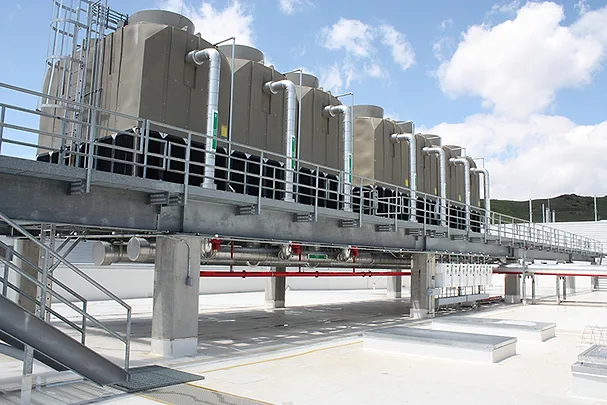
Cooling towers are highly efficient heat rejection systems; however, they can consume a lot of water. Pairing cooling towers with heat recovery, geothermal systems and integrated building planning can reduce energy, save water, and turn waste heat into a valuable resource.
Cooling towers play a critical role in heat rejection for power generation, industrial and lab process cooling, data centers and, more commonly, in HVAC cooling systems.
Sized above code and built with redundancy, Fuse at Mason Square shows how plumbing systems can prepare buildings for a wetter, less predictable climate future.
For most plumbing engineers, designing water systems means designing to code.
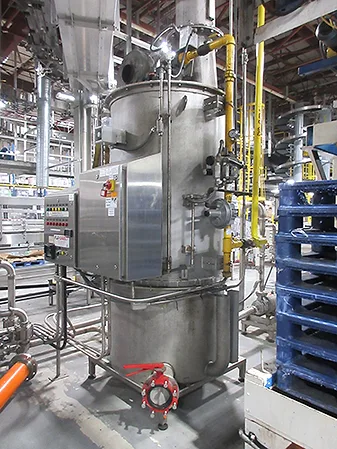
Industrial facilities can improve efficiency, sustainability, productivity and compliance by replacing steam-based hot water generation with direct, right-sized hot water systems while retaining steam where it remains necessary.
Steam built the industrial age, but it doesn’t have to run it any longer. In fact, in many cases, it shouldn’t.
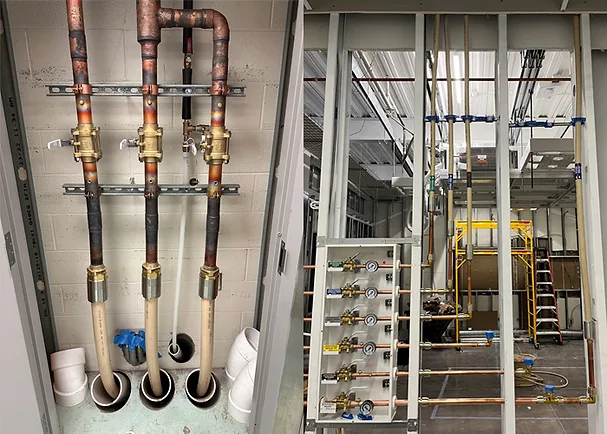
Approved for use in medical gas systems, the corrugated copper tubing performs just like rigid copper but installs in a fraction of the time while increasing site safety.
Although corrugated medical tubing (CMT) is often perceived as a relatively recent solution for medical gas systems, it has been proven in the field across industries for more than 20 years.
Federal courts are barred from applying state affidavit-of-merit requirements at filing, lowering the threshold for malpractice claims against design professionals while shifting early litigation strategy in diversity cases governed by the Federal Rules of Civil Procedure.
Earlier this year, the U.S. Supreme Court issued a decision in a Delaware medical malpractice action with particularly important ramifications for all professional malpractice actions brought in federal court.
Double check valve assemblies, detector check valves and reduced-pressure zone assemblies protect potable water systems from backflow, especially in fire protection and high-hazard applications.
Last month, in Part 2 of this series, we covered air gaps, air breaks, atmospheric vacuum breakers, hose thread applied vacuum breakers and pressure vacuum breakers.