When we consider all that’s changed in the transportation world over the last decade, the electric vehicle (EV) boom takes center stage. Alongside electrification, other major changes such as larger passenger vehicles, denser parking layouts and automated parking systems are reshaping how vehicles are used and stored. As mobility infrastructure evolves, so must our approach to designing systems that protect these vehicles and spaces.
Protecting the wide range of EVs and gas-powered vehicles on the road and in garages today can feel like a fast-moving target — one that goes 0 to 60 mph in under four seconds.
In the fire protection industry, conversations about EVs often focus on the dangers of the lithium-ion (Li-ion) batteries that power these cars. The National Fire Protection Association (NFPA) recognizes that EV fires pose unique challenges and can include rapid, large and explosive flames. These dangers warrant careful attention, as they reinforce the need for specialized fire protection strategies that allow electrification and mobility infrastructure to advance safely.
Some fire protection professionals even question whether the rise in EVs is contributing to an increased fire hazard on roadways and in parking structures. However, let’s look at the statistics:
• EVs make up approximately 1.96% of all vehicles on the road in the United States.
• In 2025, 9.02% of U.S. new vehicle registrations were for EVs, according to a report by Experian Automotive (https://bit.ly/4w2qvHS).
• NFPA data shows that internal combustion engine (ICE) vehicle fires occur every two to three minutes in the United States. There is currently no evidence that EVs are more likely to be involved in a fire than ICE vehicles (https://bit.ly/4bhvLzh).
While data doesn’t support the idea that EVs increase the frequency of fires, concerns persist about whether modern vehicles and changing parking configurations can contribute to larger, harder-to-control fires. It also raises the question: Is today’s parking infrastructure equipped to limit the consequences when a fire does occur? In addition to physical damage, parking capacity can be reduced, operations may be interrupted, revenue can be lost and facilities could remain out of order for months.
A 2025 parking garage fire at Jacksonville International Airport started with one vehicle and quickly spread to dozens of others. The fire was eventually contained by firefighters because there were no sprinklers in the garage. The rebuild was estimated to cost $38 million, with $3.7 million in lost revenue due to 500 parking spaces being out of service (https://bit.ly/4bLwgl0).
This example illustrates how quickly a vehicle fire can become a broader infrastructure and business continuity challenge. To understand how fire protection can help reduce these consequences and enable the safe use of emerging technologies such as EVs and automated parking systems, we must first understand modern vehicles and infrastructure, how they’ve changed over the years and the fire hazards they present.
More plastic, more danger
Passenger vehicles used to be constructed primarily of metal and other less-combustible materials. Today’s vehicles use more plastic, from 6.2% of the overall vehicle weight in 1995 to 10% in 2024, per the NFPA Research Foundation Phase 2 report, “Classification of Modern Vehicle Hazards in Parking Structures & Systems.” The bumpers, engine components, interior finishes and even the gas tank are all some form of plastic. This is true for all vehicles, ICE and EV alike (https://bit.ly/4f51F4d).
Further, NFPA calorimetry testing shows fairly similar peak heat release rates for ICE vehicles and EVs of similar size. This suggests that the size of an automobile fire isn’t primarily determined by the vehicle’s fuel source (gas vs. battery) but by the entire makeup of the car.
Despite the similarities in the size and intensity of ICE and EV fires, we can’t discount the differences in how ICE vehicles and EVs burn. Off-gassing, which is the release of highly toxic and flammable gases, occurs when a Li-ion battery enters thermal runaway. When thermal runaway is the source of the fire, it often rapidly develops into large, violent flames.
Firefighters and fire protection engineers around the world are still working to find the best way to approach and deal with Li-ion battery fires. While NFPA’s Research Foundation has shown that fire sprinklers are effective at containing and controlling vehicle fires and reducing the severity of damage, it has not been shown that providing higher water densities because EVs might be present is an effective or necessary strategy.
Modern parking structure challenges
To achieve resilient parking infrastructure, we must account for more than the vehicles themselves. We must consider how vehicles are arranged, how quickly fire can spread between them and whether water from sprinklers can reach the location of the fire. This is increasingly important as parking facilities adopt denser layouts and automated systems to maximize capacity.
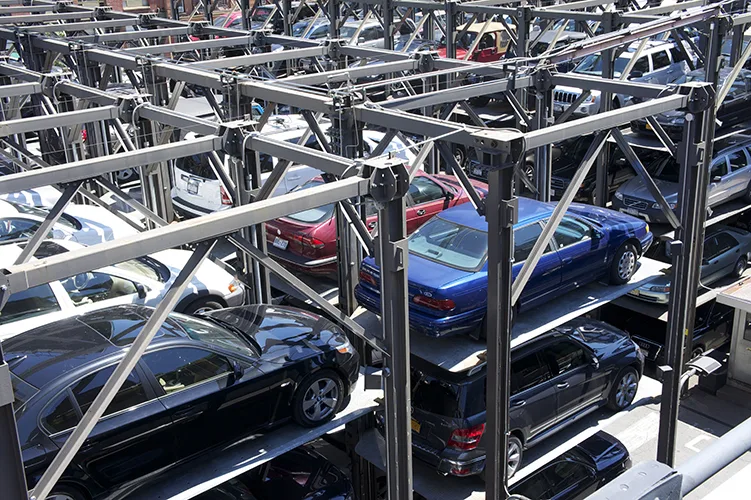
Automated parking stackers, used to fit more vehicles in a smaller footprint, pose challenges for fire sprinkler systems. This is especially true when vehicles create barriers that prevent water from overhead sprinklers from reaching fires in vehicles below.
These automated parking systems offer clear advantages for capacity, convenience and business. However, realizing those benefits safely requires fire protection to be considered as part of the system’s design, not after the technology and layout are already in place.
Increased vehicle size also means less space between cars in parking spots. In past large parking structure fires, it can be shown that once a vehicle fire reaches a certain size, it can and will ignite nearby vehicles, even those separated by empty parking spaces.
When a fire spreads to numerous adjacent vehicles, it becomes exceedingly difficult for responding firefighters to gain control of it. This means achieving early control with fire sprinklers is critical for reducing structural damage, protecting surrounding assets and limiting the length of operational disruptions.
Industry guidance
Historically, there hasn’t been much guidance on handling some of the more complex situations, such as fully automated parking systems. However, that is changing as research is conducted and the results are used to update and develop new guidelines with prescriptive requirements in upcoming standards. These changes give owners, designers and authorities having jurisdiction clearer guidance on protecting parking areas while supporting the safe adoption of technology and long-term resilience.
Here are some of the changes that have already happened in codes and standards:
• NFPA 13
In the 2022 edition of NFPA 13, Standard for the Installation of Sprinkler Systems, parking garages were moved from the annex list of examples for Ordinary Hazard Group 1 (OH1) classification to Ordinary Hazard Group 2 (OH2). The initial driver for this change was supported by the NFPA Research Foundation’s work analyzing the composition of modern vehicles and the increased use of plastics. This design density has been further supported by ongoing testing by the foundation.
Car stackers and car lift systems with two cars stacked vertically have been listed as Extra Hazard Group 2 (EH2) since the 2016 edition of NFPA 13, though questions have been raised about this being the appropriate classification. From a practical standpoint, EH2 is defined as being appropriate for shielded fires, which is the case for vertically stacked vehicles. It has also been demonstrated through testing that OH2 does not provide effective fire control for this application, further confirming that EH2 is appropriate.
Even though car stackers were addressed in previous editions, the 2022 edition of NFPA 13 added a provision in section 10.3.2 stating that if sidewall sprinklers are placed between cars stacked vertically, the ceiling protection can be designed based on the occupancy classification of parking garages, which is OH2. Similar language was added to section 11.3.2 of the 2025 edition for extended-coverage sidewall sprinklers.
• NFPA 101
In the 2024 edition of NFPA 101, Life Safety Code, section 42.8.3.5 was added to require automatic sprinkler systems in all new parking garages. NFPA 1, Fire Code, points to this section for the protection of all new and existing parking garages and points to NFPA 88A, Standard for Parking Structures, for the construction and protection of all new parking garages.
• NFPA 88A
The 2019 edition of this standard had an exemption allowing sprinklers to be omitted from parking garages that meet the definition of “open.” Other exemptions were also permitted based on construction type or height.
In the 2023 edition, this was changed to require sprinklers in all parking garages, regardless of whether they are open or enclosed.
• International Building Code
Beginning in the 2021 edition of the International Building Code (IBC), requirements were added to 903.2.10 requiring sprinklers in open parking garages where the fire area exceeded 48,000 square feet. Previously, open parking garages were exempt from sprinkler system requirements.
An exemption for open parking garage sprinkler protection was also removed from section 903.2.11.3 for buildings over 55 feet in height.
Sections were added to define and provide requirements for mechanically accessed enclosed parking garages, which NFPA 88A refers to as fully automated parking systems. The requirement for these structures is a specially engineered automatic sprinkler system, also known as a performance-based design, since there previously have been no clear prescriptive criteria for protecting these types of systems.
Additional changes are expected as research continues around parking technologies and facilities:
• The NFPA 88A 2027 edition will be released later in 2026 and is expected to include significant changes adding prescriptive criteria for the design of sprinkler systems in fully automated parking systems and clarifying other protection requirements for parking garages in general. A chapter providing guidance on performance-based design for automated parking is also expected to be added to aid fire protection engineers who wish to choose it as an option.
• The next edition of the IBC is expected to remove any square footage thresholds for providing sprinklers in new parking garages, matching the NFPA codes and standards in requiring sprinklers in all parking garages, regardless of size.
For organizations planning to build or renovate parking facilities, following these developments can help ensure future readiness by aligning their fire protection designs with the latest guidelines.
Building more resilient parking infrastructure
As EVs, automated parking systems and other technologies continue to advance, fire protection must advance with them. Research and real-world experience show that sprinklers can be effective for controlling vehicle fires before they spread throughout a structure.
Even with a quick fire department response, the domino effect of a fire spreading from vehicle to vehicle is difficult to stop without fire sprinklers. Early sprinkler control can limit fire growth and the resulting damage while supporting overall business continuity.
Parking structures support airports, hospitals, workplaces and other facilities that require ongoing operations. Resilient, future-ready infrastructure gives these organizations confidence to implement new technologies while keeping people, property and business protected. Fire protection systems designed for modern vehicles and parking structures play a key role in supporting safe future innovations in transportation. l
Melisa Rodriguez is senior manager of industry relations with Johnson Controls. She is a licensed Fire Protection Professional Engineer with 22 years of industry experience and has held various roles, including project manager, designer, lead fire protection engineer and senior business development manager. She is NICET-certified Level IV in Water-Based Systems Layout.