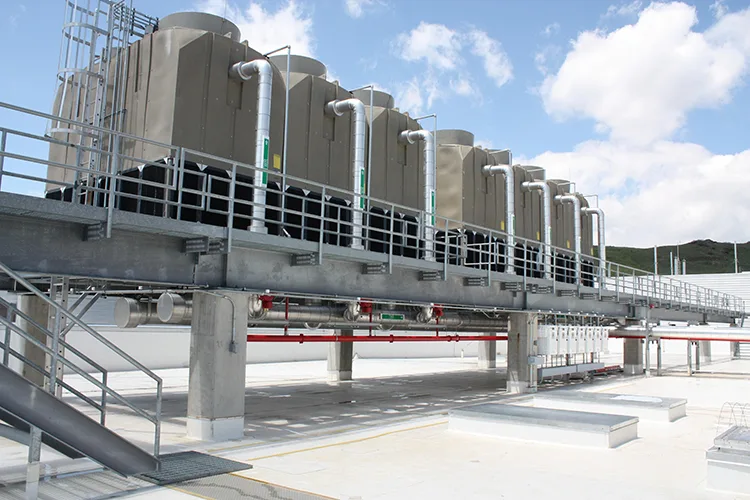
Cooling towers play a critical role in heat rejection for power generation, industrial and lab process cooling, data centers and, more commonly, in HVAC cooling systems. Instead of using sensible coils to reject heat to an already hot outdoor atmosphere, cooling towers rely on water evaporation to absorb heat and cool the remaining water.
While this method of heat rejection can be very efficient, it consumes a precious resource. However, layered strategies for heat rejection and heat recovery can aid in maximizing the effectiveness of cooling towers while at the same time limiting water consumption.
Traditional building systems use independent heating and cooling systems to condition program areas. One system cools the building by extracting heat while another generates heat from another source, commonly natural gas or electricity.
Smaller systems, such as those in residential buildings, may use a heat pump to either reject or absorb heat to the outside air. The larger the cooling system gets, the more likely it is to employ a cooling tower.
While these systems on their own can be energy efficient from an energy code perspective, they are inherently wasteful. Most cooling systems reject heat that could be recovered or boosted to provide reduced energy heating to other systems. This opportunity becomes more apparent with building programs consistently requiring both heating and cooling.
For example, a hospital with an imaging suite and other cooling-intensive programs requires cooling year-round that could be converted to beneficial heating in winter months.
While some buildings do not have significant simultaneous heating and cooling loads, they may be in a climate with more balanced heating and cooling demands over the year. In such cases, geothermal systems can leverage the mass of the ground to store and extract heat over the year without requiring a supplemental cooling tower for heat rejection.
Instead of using water to reject heat to the atmosphere, the system stores heat in the ground during summer, allowing it to be drawn back out in winter with low energy use.
Evaporation as a means of heat rejection
Cooling towers use a fan to draw air across wetted media and promote evaporation. As water evaporates — changing from liquid to vapor — it draws heat away from the remaining water, based on water’s high heat of vaporization. This process is extremely effective and used for large cooling applications.
However, as water in the cooling tower evaporates, it leaves behind minerals. After several cycles of evaporation, water hardness increases to the point that some of it must be drained to prevent scaling on tower media, coils and chiller tube bundles. Fresh water then replaces the drained water to lower hardness and repeat the cycle.
An alternate method uses softened water in combination with raw water to reduce incoming water hardness, increase the cycles of concentration, and reduce the amount of blowdown.
Standing water in a tower basin (or swimming pool) will also naturally evaporate over time. Depending on the project location and climate, the annual evaporation of surface water area can be upwards of 8 feet or more. Between the natural evaporation of standing water and the intentional evaporation of water in a cooling tower, these systems can consume upwards of 3 gallons per minute of water per ton of cooling load, or 12,000 BTU/hour.
Water-cooled chilled water systems with cooling towers are often significantly more efficient than standard air-based refrigerant compressor-based systems. And in climates and buildings with a significant amount of cooling and reduced heating loads, cooling towers go a long way toward improving energy efficiency.
Programs with high process loads, as well as water-cooled high density data centers, can leverage cooling towers alone or with a limited amount of supplemental mechanical cooling to provide the necessary heat rejection.
Aside from solar or other renewable sources, power utility plants also use water to generate steam and provide heat rejection for generators. These large power generation systems are historically inefficient relative to their water usage. When power transmission losses from the source to the end user are factored in, these systems require even more power and water.
Although they may use water for heat rejection with cooling towers, more energy-efficient buildings and systems can save even more water if managed correctly by limiting the power utility component.
Water conservation and cooling towers
A common feature of cooling towers are drift eliminators, which help eliminate water droplets in the tower plume to aid in keeping water losses as close as possible to the evaporation rate for cooling. Most cooling towers also enclose the area around the tower basin to avoid direct sunlight to limit Legionella growth while reducing evaporation loss.
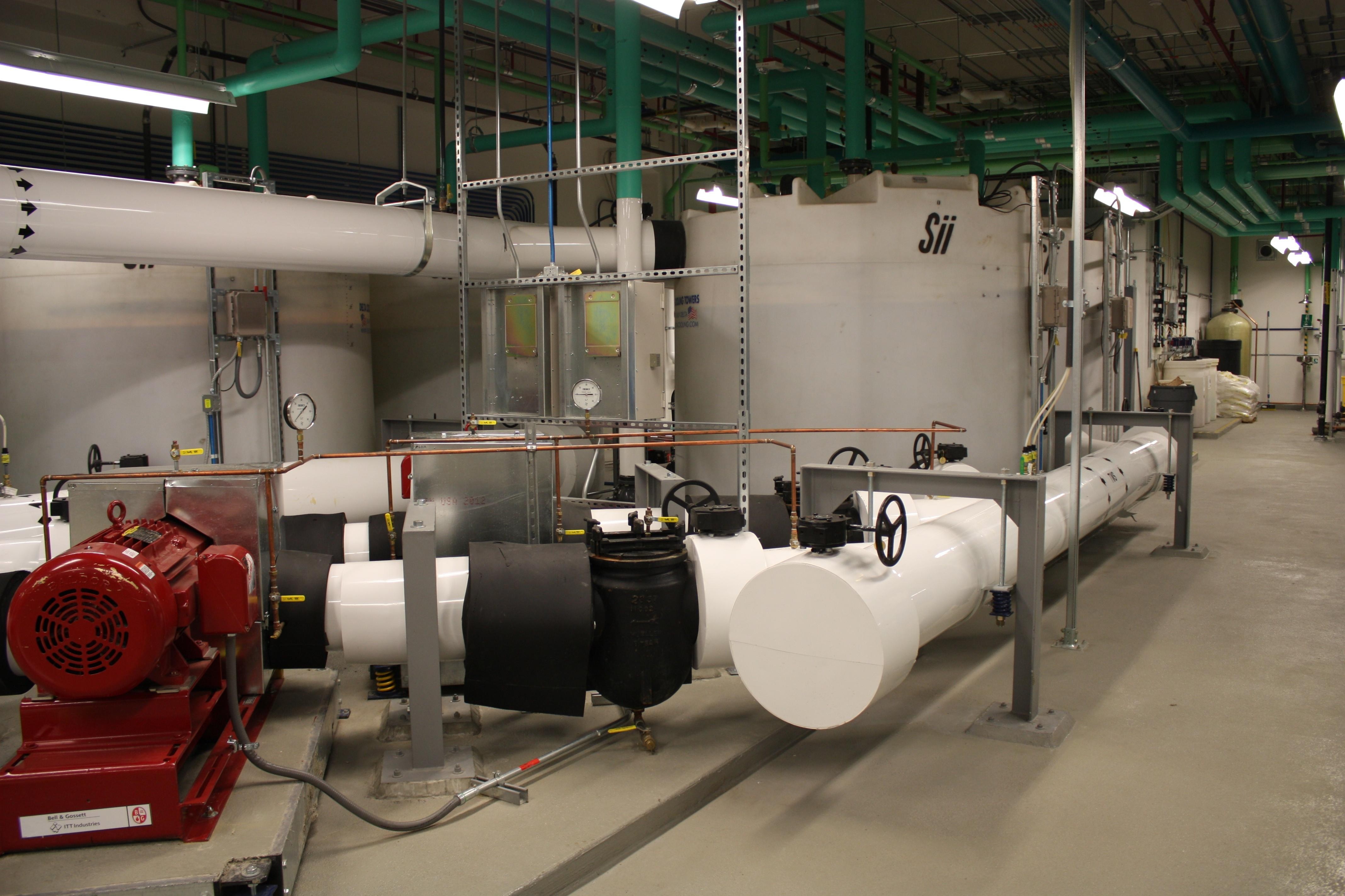
An idle cooling tower with a full basin will continue to evaporate water even when not in use. Some cooling tower installations in colder climates use remote tower basins that eliminate standing water in the tower basin by directly draining it into storage tanks within the building. This removes the need for tower basin heaters in freezing climates while reducing the surface area of water exposed to atmosphere and associated evaporation losses.
A grey water system in a building typically collects, filters and cleans water from showers and sinks, and then uses it to flush toilets and urinals. Rainwater collection systems, where permitted by code, similarly collect, filter and repurpose rainwater to provide make-up water for cooling towers and/or irrigation systems.
Regardless of the water source, cooling tower blowdown can be stored and used to support building irrigation. Several factors are involved in the application of such systems, including the extent of cooling tower operation annually, anticipated blowdown rates, expected water hardness, and the variability of irrigation demand over the course of the year.
Heat rejection vs. heat recovery
While heat rejection expels heat to atmosphere or other mediums, heat recovery reuses heat to condition other systems or areas of the building.
A prime example of this principle is found in a laboratory heat recovery system, which in its most basic form consists of a pump and two coils. The pump circulates a water-based fluid between an outside air coil and a laboratory exhaust coil. In winter months, the heat in the laboratory exhaust preheats outside air with potential for no cross-contamination.
While these basic systems can be 50% effective or more, they are limited by the operating temperatures of the respective systems. Process cooling water systems can be about 90 F, but even at that temperature, their ability to heat a building is limited. Increasing heat recovery effectiveness beyond this often requires the use of heat pumps.
Water-to-water heat pumps cool the source water (chilled or process cooling water) while boosting the associated waste heat (heat rejection) to an effective heating temperature. System losses generated by this process are further credited to the heating water system, creating an effective heat recovery system that reuses waste heat rather than rejecting it.
This same technology is in use today, allowing geothermal systems to export heat to the ground in summer and extract heat from the ground in winter. Such systems can also simultaneously provide cooling and heating when the associated building loads are balanced. Here, waste heat is either stored for later use or used immediately, depending on system type and time of year.
For example, data centers require year-round cooling. Some of the first things that come to mind when designing data centers are how much power they will require and how we can best cool them. Like traditional large-scale cooling systems, large megawatt scale data centers will likely consider cooling towers and water-cooled chillers for heat rejection.
In areas where water resources are limited, data center operators may be forced to install air-cooled chillers for heat rejection — albeit at reduced energy efficiency. There is, however, another aspect of this challenge to consider.
Future state of heat rejection, heat recovery and water conservation
One of the traps we face as architects, engineers and designers is our tendency to think of building programs and systems in silos. This system cools the building and requires heat rejection. That system provides heating to the building and desires an efficient fuel source.
Data centers are located near power sources and situated near warehouses or other remote locations away from other building types. Laboratories are commonly located near universities or research hubs, adjacent to offices and other related spaces. Residential buildings or complexes are often located away from both programs.
When we consider these building types holistically within the context of energy, local climate and water conservation, there are some clear opportunities and potential benefits to placing these program types in close proximity to one another. The Energy Systems Integration Facility (ESIF) at the Department of Energy’s National Laboratory of the Rockies (NLR) is a prime example of what is achievable when these programs and systems are brought together in a symbiotic relationship (https://www.nlr.gov/esif).
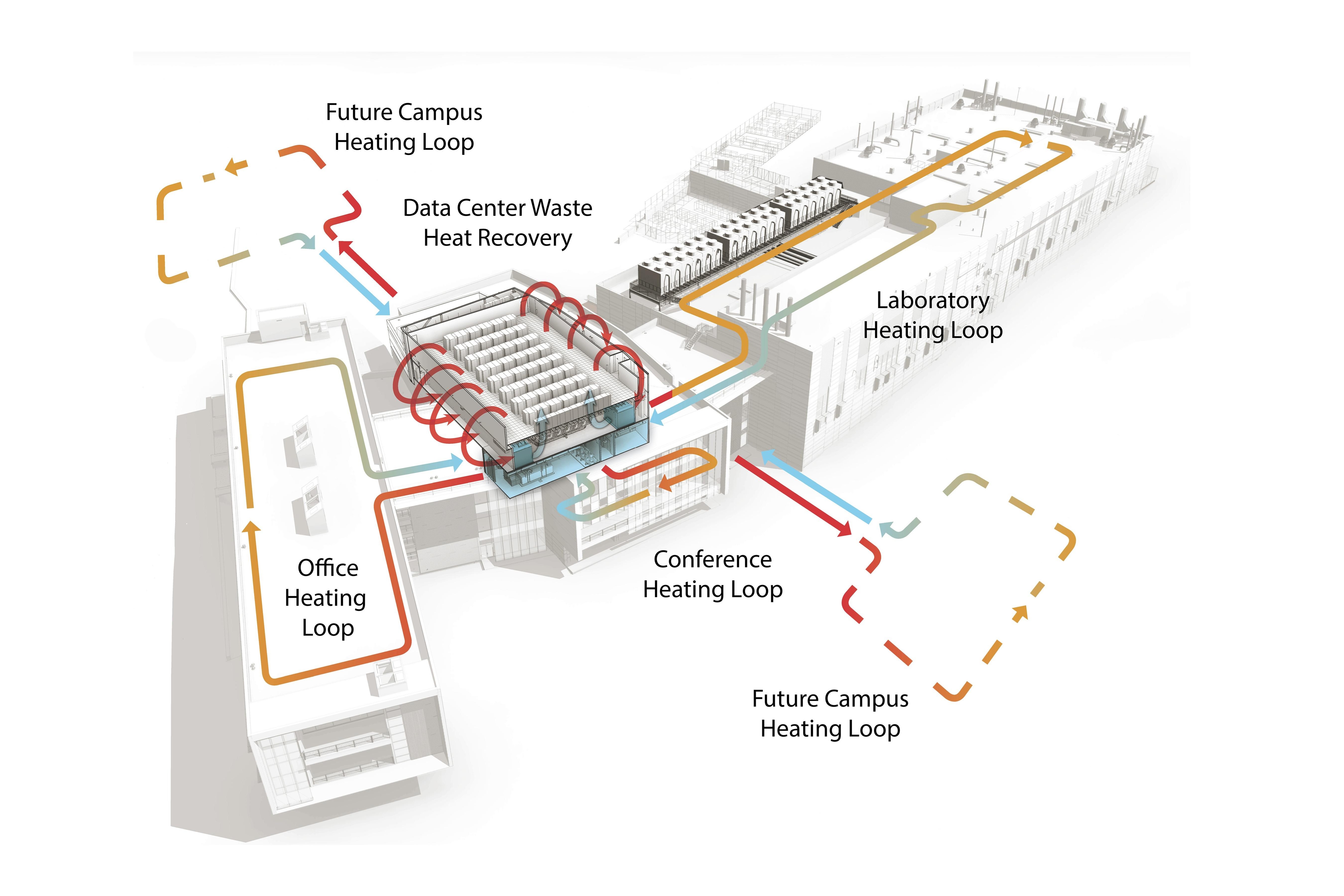
At ESIF in Golden, Colorado, a high-performance computing data center sits adjacent to high-bay research labs and supporting office programs (see diagram). The high desert climate near Denver, together with cooling towers, can provide all the cooling needed for the data center without the use of compressors or chillers. Building systems are designed to leverage low-grade data center waste heat (95 F or more) for primary and supplemental heating to the offices and laboratories respectively.
The building design also anticipates a future where low-grade waste heat could be exported, saving water for cooling. Future planning includes provisions for local water-to-water heat pumps, which would recover waste heat on-site and export heating water through the existing campus piping network.
If large-scale data centers in cold climates were similarly integrated into business parks or adjacent to residential communities with geothermal systems, data center waste heat could augment community heating, making systems more efficient, lowering energy use for the larger community, and reducing the annual data center water consumption. The result is lower overall energy consumption; however, it requires a framework for the interconnections and a commitment from all parties to continue operations for years to come.
Even in this future state, cooling towers will remain in use to reject excess summer heat and to ensure continuous data center operation even with disruptions or reduced demand for heat in the larger community.
Cooling towers remain an effective means of heat rejection in hospitals, industrial parks, campuses and data centers. Although they use water for evaporation, several features and strategies can limit water loss, while reuse opportunities can lower overall consumption. Energy savings from cooling tower systems further reduce the demand for power at utility plants, lowering their associated water use.
Heat recovery remains a tremendous opportunity not just to provide energy savings, but reductions in water consumption. By moving from independent cooling with heat rejection to a combined heat rejection and heat recovery mindset, we preserve resources while pressing forward with goals to lessen our impact on the environment, preserve resources and maximize energy efficiencies in buildings.
Robert Thompson, PE is a studio design leader, senior principal and mechanical engineer at SmithGroup. Robert’s mechanical systems design seeks to balance energy performance and systems efficiency while leveraging available resources.



