As digital infrastructure becomes more powerful, more compact and more essential to everyday business operations, data center cooling has become one of the most important disciplines in facility engineering. What was once treated as a supporting mechanical service is now a primary determinant of uptime, operating cost and scalability.
In high-density environments, thermal management is no longer a background issue but a core design problem that influences room layout, equipment selection, airflow control and long-term reliability.
Modern data centers operate in a thermal regime that is far more demanding than conventional building HVAC. Precision-cooled facilities commonly require about 35 to 70 watts per square foot (W/sq ft), while newer high-density installations can reach 200 to 300 W/sq ft or higher in some cases. Those numbers illustrate the scale of the challenge.
The task is no longer merely to produce cooling capacity. The real challenge is to deliver that capacity to the right location, in the right quantity, under stable environmental conditions without wasting energy or compromising resilience.
Heat load as a design driver
The foundation of any data center cooling strategy is heat load. Electrical energy used by IT equipment is ultimately released as heat, meaning every watt drawn by servers, storage, networking devices and support systems must be removed from the space. Therefore, a 100 kW IT load requires approximately 100 kW of cooling capacity before ancillary loads are included.
That simple relationship becomes more complex once the supporting infrastructure is added. Uninterruptible power supply losses, power distribution losses, lighting, ventilation and occasional occupant loads all contribute to the total thermal burden. For this reason, cooling cannot be sized from floor area alone.
A 5,000 square foot server hall operating at 50 W/sq ft requires roughly 250 kW of cooling for IT load alone. At 150 W/sq ft, the same room requires about 750 kW. In modern facilities, rack density is often a more important design driver than room size.
As equipment becomes more compact and power density rises, the problem becomes increasingly localized. The thermal challenge shifts from cooling a room to cooling specific rows, racks and inlets. That change has major implications for mechanical design.
Airflow management
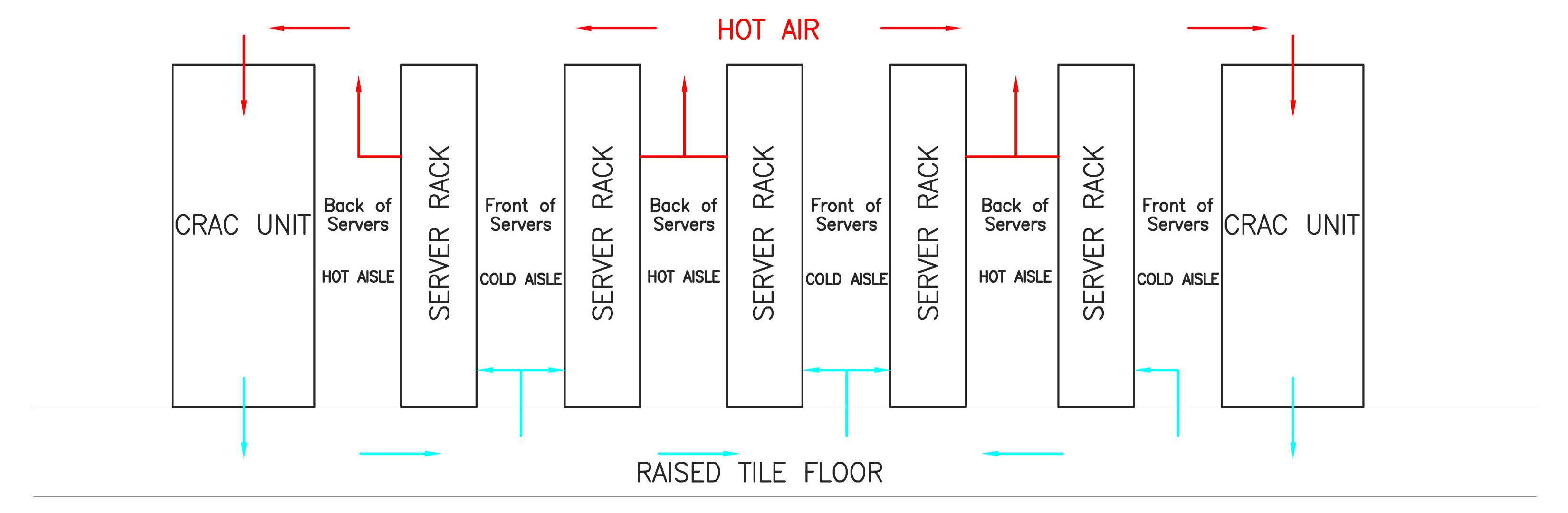
Cooling performance depends as much on airflow management as on refrigeration capacity. The most effective arrangement remains the hot aisle/cold aisle layout, in which rack fronts face cold aisles and rear exhausts face hot aisles (see Figure 1). This configuration reduces recirculation, improves temperature uniformity and helps ensure that conditioned air reaches server intakes before it is reheated by nearby equipment.
This principle becomes even more important as rack loads rise from the historical range of 4 to 5 kW toward average racks of 12 kW and beyond. Once density increases, poor airflow organization quickly undermines performance. Hot exhaust air that is allowed to mix with supply air forces the cooling plant to work harder, drives up fan energy and creates localized hot spots even when nominal cooling capacity appears adequate.
In that sense, the room layout is not merely an architectural detail. It is part of the thermal system itself. Good cooling is not just about producing cold air. It is about controlling where that air goes, how it moves through racks and how it returns to the system.
Temperature and humidity control
Temperature alone is not enough. Humidity control is equally critical because both excessive moisture and air that is too dry can damage electronic equipment. Too much humidity can lead to condensation on components, while too little humidity can increase the risk of electrostatic discharge. In a high-value digital environment, either condition can create costly downtime.
For that reason, modern data center environmental control often uses dew point and controlled humidity bands rather than relying only on a single room humidity reading. Dew point is a more useful indicator of moisture content because it better reflects the actual state of the air as it moves through the facility. It is especially valuable in environments where cool supply air and warm exhaust air coexist in close proximity.
The practical goal is stable inlet conditions at the equipment level. That requires sensors and controls placed where thermal conditions are actually meaningful, not just at a central point in the room.
Rack-level monitoring gives operators a more accurate picture of what the IT hardware is experiencing and allows faster correction when conditions drift.
Pressurization, filtration and cleanliness
Positive room pressure is another important part of the cooling strategy. By maintaining a slight overpressure relative to surrounding spaces, the data center reduces the infiltration of dust, unconditioned air and other contaminants. This is especially important in facilities with raised floors, cable cutouts and repeated access points, which can become leakage paths if not carefully managed.
Filtration and pressurization work together. Filtration improves the quality of supply air, while positive pressure reduces the entry of dirt and outside air from adjacent areas. Together, they help preserve both thermal performance and equipment reliability.
In a tight, well-sealed room, the cooling system has less unwanted air to condition and fewer opportunities for performance loss.
This is one of the most overlooked truths in data center engineering: Cleanliness and airflow control are inseparable. A clean, sealed room is not just easier to maintain. It is also easier to cool efficiently.
Choosing the cooling system
The choice of cooling system depends on scale, budget, redundancy requirements and maintainability:
• Direct expansion systems are often selected when first cost and installation simplicity are the main priorities.
• Chilled-water systems are typically favored in larger facilities, where long-term efficiency and part-load performance carry greater weight.
As rack densities move beyond 30 to 50 kW per rack, traditional air-based cooling begins to approach practical limits. At those densities, designers increasingly consider liquid-assisted cooling, direct-to-chip (D2C) systems, or hybrid approaches that supplement air movement with more localized heat removal.
There is no universal best system. The right choice is the one that matches the facility’s operating profile, growth expectations and reliability goals.
In a data center, cooling must be treated as mission-critical infrastructure. If a cooling component fails, the thermal consequences can be just as disruptive as a power outage because modern electronics have little tolerance for rapid temperature rise. That is why redundancy, maintainability and fault isolation are essential design requirements.
Resilience does not come from oversizing alone. It comes from a complete system strategy that includes equipment arrangement, airflow control and the ability to maintain operation during maintenance or partial failure. A robust design prevents one component failure from turning into a room-wide thermal event.
In a data center, thermal continuity is operational continuity.
Energy efficiency and cost
Energy efficiency is now a central concern in data center design because cooling is one of the largest operating costs. The strongest efficiency gains usually come from:
Reducing air mixing;
Sealing leaks;
Improving aisle separation;
Using more efficient fans and chillers;
Aligning the cooling strategy with the actual load profile.
Efficiency depends on delivering conditioned air precisely, not excessively. That distinction matters because excessive cooling, poor return-air management and uncontrolled leakage can all raise energy use without improving reliability.
In that sense, efficiency and reliability should not be seen as competing goals. When the system is properly engineered, they reinforce one another.
Data center cooling is best understood as a high-density thermal engineering problem. It requires coordinated control of temperature, humidity, pressure, airflow, filtration, redundancy and energy use.
As computing loads continue to rise and racks become more powerful, the margin for error becomes smaller and the consequences of poor design become greater. The modern data center is not simply a room full of servers. It is a tightly controlled thermal system whose success depends on disciplined engineering.
Cooling is not ancillary to digital infrastructure. It is the thermal backbone that makes digital infrastructure possible.
Sahil Mahajan, PE, P.Eng., CPD, LEED Green Associate, holds a Master of Science in Mechanical Engineering and is head of the Plumbing and Fire Protection Department at KEA Engineers in Iselin, New Jersey. He has 20 years of experience in HVAC, plumbing, fire protection design and construction management, and is a licensed Professional Engineer in both the United States and Canada.