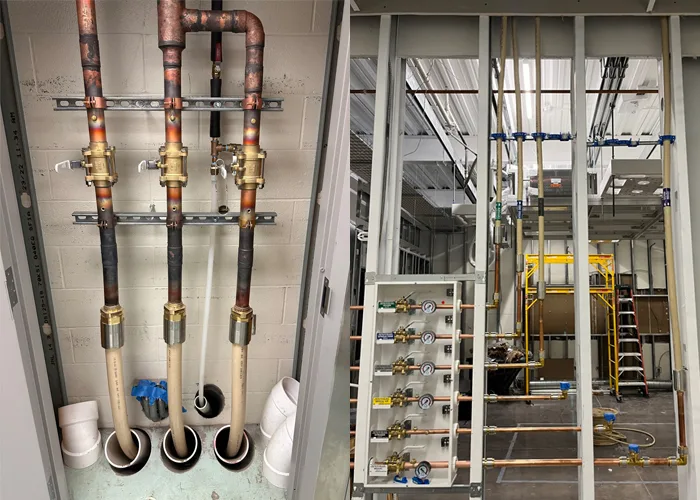
Although corrugated medical tubing (CMT) is often perceived as a relatively recent solution for medical gas systems, it has been proven in the field across industries for more than 20 years. However, even with repeated application success, some questions and confusion around CMT still exist.
Approved for use in medical gas systems, CMT is a corrugated copper alloy tubing that performs just like rigid copper but resolves key long-standing installation issues. Compared to cleaned and capped copper, CMT significantly reduces installation time while increasing site safety when piping medical gas distribution systems.
With a full understanding of CMT, contractors and the medical facilities they support can gain significant advantages by using this next-generation copper.
Here are four common questions about CMT, followed by education about what it is, how it differs from rigid copper piping and why it can give contractors a competitive edge.
Is CMT made of copper?
Yes. Think of this medical-grade corrugated copper alloy tubing as next-generation copper. CMT offers the same operational performance as rigid copper but addresses some of the traditional piping’s known limitations while also minimizing some of its hidden costs and safety risks. It comes in 1/2-inch up to 2-inch sizes, and its axial swaged, quick-assembly brass fittings can connect sections of CMT to one another or connect CMT to standard copper. If a project can be done in rigid copper, it can be done in CMT.
Is CMT more expensive than rigid copper piping?
When it comes to total job cost, CMT often is the same or even less than rigid copper piping — especially when considering both contractor costs and hospital burden costs.
CMT significantly reduces the preparatory burden for hospitals related to open flame as well as the overall installation time for medical gas systems. Installing rigid copper piping for medical gas systems typically requires hot work. Before it can be completed, hospitals must extensively prepare and devise interim life safety plans to secure a permit.
Compared to traditional cleaned and capped copper, CMT for medical gas systems requires significantly fewer joints and often no brazing during installation, reducing the risk of fire in facilities and lowering costs related to fire watch. For underground installs, CMT can be installed inside of a conduit or a directionally bored nonmetallic sleeve to potentially reduce or even eliminate costly excavation and site disruption, saving even more time.
Minimizing or even eliminating brazing during medical gas system installation also lets hospitals restore surgical areas, care spaces and patient rooms back to service faster and more efficiently, improving hospital uptime and patient safety.
For contractors, the rapid speed of CMT installation can free installers to complete more jobs. This efficiency helps address the industry’s ongoing skilled labor shortage while increasing overall profitability.
Is CMT compliant with code?
The 2018 edition of NFPA 99: Health Care Facilities Code included the option to use CMT for medical gas piping. CMT is fully compliant and its use is included as part of many state codes. It also meets ICC-ES ESR-4565 seismic resilience.
Note: It’s important to be aware of which edition of NFPA 99 a municipality recognizes. If a city or town requires designing to a version of NFPA 99 before the inclusion of CMT, the Centers for Medicare & Medicaid Services (CMS) has issued a categorical waiver, QSO-20-40-LSC, which permits the installation of CMT in new and existing applications. Per the waiver, facility owners must document the use of CMT and that the systems were installed according to NFPA 99 requirements but do not need to seek preapproval for usage from CMS.
It should also be noted that only installers who have successfully completed the manufacturers installation program and received the American Society of Sanitary Engineering 6010: Medical Gas Installers certification (or state equivalent) can perform installations. If contractors have questions about compliance or want to schedule a training, they can reach out to their CMT supplier.
When it’s installed, it doesn’t go in perfectly straight.
Is that OK?
Yes, and it’s part of the beauty of CMT. CMT performs just like copper, but it has a robust, yet flexible design. Where rigid copper tubing must be cleaned and cut every 20 feet or less, CMT comes in rolls that are sometimes longer than 500 feet and installs as one long piece of pre-cleaned tubing for less contamination risk. This balance of integrity and flexibility results in gas delivery systems that require fewer fittings to change direction than rigid copper piping and are less likely to buckle, snap or crack under stress.
The flexibility of CMT gives hospitals and other medical facilities in seismically active regions such as the Mid-Atlantic or Western United States a distinct advantage. Medical gas distribution systems are key areas of hospital infrastructure that can be vulnerable to the effects of an earthquake.
Mission-critical healthcare facilities must be resilient to earthquakes and remain structurally safe during and after their occurrence. The flexibility of CMT resists damage from seismic and building shifts for leak-free, reliable gas distribution, making it ideal for medical gas systems in these areas.
When installing medical gas pipelines, many contractors automatically use rigid copper. However, there’s another fully compliant option: CMT. How it differs from rigid copper piping is why it gives contractors a competitive edge. Using CMT, contractors can complete projects faster, address labor shortages, minimize installation burden and risk for hospital customers and improve overall profitability.
Flameless Addition of Nitrous Oxide Outlet in OR Using CMT
The challenge: Advocate Good Samaritan Hospital in Downers Grove, Illinois, needed to add an additional nitrous oxide outlet into an operating room surgical boom. However, the difficulty of working above operating room ceilings, the risk associated with hot work and the multiday OR closure for construction made the project extremely cost prohibitive. That changed when Medical Technology Associates and JPI MedGas presented a flameless installation using MediTrac CMT.
The solution: Using MediTrac ½-inch CMT made it possible to pre-install a straight fitting of it to the medical gas boom connection off-site, minimizing on-site installation time. Because of CMT’s flexibility and lack of brazing, the JPI team routed all tubing using pre-existing access covers rather than having to remove and replace large sections of the hard pan ceiling. The final connections and tie-in to existing piping was made using flameless axially swaged fittings at the access panel location.
The outcome: While the project was estimated at over 18 hours to complete installation using traditional cleaned and capped copper, JPI MedGas completed the installation of the MediTrac system, including off-site pre-fabrication, in only three hours. The team performed on-site work without open flame and after patient care had already ended, allowing patient care to resume the following morning.
Mathis Carlson is the special projects and education manager for Flex-Trac, Inc., the leading manufacturer of corrugated medical gas tubing, or CMT. At Flex-Trac, Inc., Mathis assists in medical gas system design and sizing, technical support, training and general medical gas information and education.



