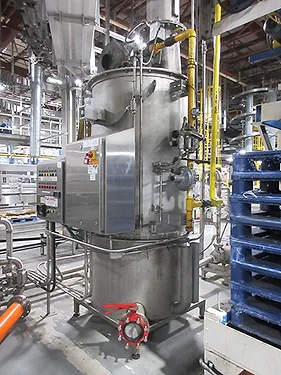
Steam built the industrial age, but it doesn’t have to run it any longer. In fact, in many cases, it shouldn’t. While steam remains essential to many applications, hot water is a more practical thermal solution for a significant portion of industrial processes. This idea forms the basis of desteaming, a term we use at Armstrong International for replacing steam-based hot water generation with a right-sized direct hot water solution where appropriate. The goal is not to eliminate steam from the plant, but to use it where it is truly needed and generate hot water more directly where it is not.
As a company founded largely on steam-based systems and products, we believe steam will always be a necessary solution for certain industrial processes. However, our experience as a thermal utilities provider has shown that facilities can significantly improve efficiency by moving certain hot water applications away from steam-based generation and toward direct hot water solutions.
In those applications, the transition can also help reduce operating costs, fuel use and associated emissions, while challenging the long-standing assumption that traditional steam-to-water heating systems, such as shell-and-tube or plate-and-frame exchangers, should remain the default approach for industrial hot water generation.
While traditional firetube boilers may hold efficiencies as high as 85%, losses begin to mount outside the boiler room. Based on Armstrong’s field experience, thermal system studies and decades of work with industrial steam systems, flash steam, radiation losses and incomplete condensate return can reduce overall steam-to-water efficiency by as much as 25% to 30% in some applications.
This can bring true system efficiency down to roughly 65% to 70%, creating a strong case for evaluating whether direct hot water generation would provide a more efficient approach.
Industrial hot water systems are, by design, far more efficient at delivering the temperatures required for process applications than steam systems because they generate and distribute hot water directly, eliminating the energy losses inherent in converting water to steam and back again. That said, like steam systems, they require a system level approach in their design, operation and maintenance, because of the range of critical processes and applications they support. How they perform directly dictates the operational viability of industrial facilities.
Industrial plants all rely on hot water to keep equipment clean and production moving. When the system under- or over-performs, the consequences surface quickly. In fact, that interconnectedness throughout operations cannot be overstated.
The system must accommodate many different hot water needs. Some process applications require temperatures up to 180 F. Emergency fixtures such as eyewash stations and safety showers require tepid water, generally defined as 60 F to 100 F under ANSI/ISEA Z358.1.
Personnel hygiene applications are governed by scald-prevention requirements, including Uniform Plumbing Code limits for public-use lavatories and standards such as ASSE 2017 Performance Requirements for Water Temperature Limiting Devices.
Elsewhere in the plant, sanitation and equipment washdown applications often require higher temperatures, with specific setpoints determined by the facility, process and applicable regulatory requirements. Each use brings its own temperature and volume requirements that must be managed with a relatively high degree of accuracy.
Compliance metrics — maximum and minimum acceptable hot water generation, distribution and point-of-use temperatures, flow requirements, sustainable water heating methodologies, and user safety requirements, among others — must be collectively understood, agreed upon and shared across engineering, operations and maintenance.
Some organizations formalize this discipline through a water management plan, a facility-specific strategy typically overseen by the facility manager or safety team, with input from consultants and engineers, and guided by national standards such ANSI/ASHRAE Standard 188-2021, Legionellosis: Risk Management for Building Water Systems, and ASHRAE Guideline 12-2020, Managing the Risk of Legionellosis Associated with Building Water Systems.
How facilities meet those requirements varies significantly based on their operational and infrastructure differences, which is why there’s no one-size-fits-all solution for achieving an efficient hot water system. However, operators can build in lasting safeguards and efficiencies by focusing on core design and operational principles, emphasizing four key pillars: efficiency, sustainability, productivity and compliance.
Efficiency
Washdown and sanitation, which often account for a significant portion of a site’s hot water demand, traditionally required a steam boiler for hot water production, raising the question: Why are we turning water into steam if the objective is to then turn the steam back into water?
For these applications, direct-fired gas water heaters using natural gas, propane or biogas deliver the required hot water volumes while achieving efficiency gains of up to 25% compared to steam-based systems.
In general, efficiency problems in hot water systems often start at the source, where the heat is generated. In industrial facilities, that means the source method has an outsized impact on overall system performance.
Options include steam-to-water conversion using heat exchangers, direct-fired systems using natural gas, propane or biogas, and, in some regions, oil-fired water heaters — each offering unique efficiency profiles, system complexity and operational implications.
Standard commercial gas-fired water heaters underperform when compared to newer high-efficiency technologies. They operate at lower combustion and deliver poorer overall system efficiencies, and they are not built for the harsher conditions found in industrial environments.
Despite this, many industrial facilities continue to rely on commercial-grade water heaters, often due to legacy system designs or incremental expansions that did not originally account for industrial duty cycles.
By contrast, newer direct-fired and condensing gas water heating technologies can achieve operating efficiencies as high as 99.7%, delivering higher usable hot water output per unit of fuel. This, in turn, lowers operating costs and associated carbon emissions.
Because direct-fired heaters operate on demand, firing only when hot water is called for from a storage tank, they avoid the idle operation and standby losses associated with continuously running steam systems. This further reduces fuel consumption while maintaining availability for sanitation and washdown requirements.
The range of temperatures required across different hot water applications only magnifies the inefficiency of using steam as the default source for hot water generation, particularly when the required hot water setpoints are well below steam-system temperatures. In addition, when varied hot water loads are served from a steam system, facilities often need additional equipment to transfer and regulate heat for each application.
This typically includes shell-and-tube or plate-and-frame heat exchangers for hot water conversion and a complete steam supply train consisting of steam separators, steam traps, pressure-reducing valves, steam control valves, air vents, vacuum breakers and condensate return pumps. Each component adds capital cost and introduces an additional maintenance obligation and potential failure point, many of which can go undetected. Over time, these issues increase the likelihood of production disruption and further reduce system efficiency and reliability.
While steam systems are well suited to handling peak thermal loads, they often do so at the expense of efficiency during normal operation. On-demand water heaters, however, when combined with storage, can satisfy peak loads while avoiding the efficiency penalties associated with continuous peak-ready operation.
By storing hot water during periods of lower demand, facilities can meet short-term peak requirements while operating water heaters more efficiently and predictably. However, proper storage design requires careful consideration.
Tank material, insulation quality, sizing and location all influence performance and heat loss. Storage temperatures must also be managed to inhibit bacterial growth while still supporting downstream temperature requirements. Storage systems should therefore be sized and specified by a qualified thermal engineer as part of the overall hot water system design.
With demand variability under control, facilities are positioned to act decisively on where steam is still required for hot water generation and where desteaming will improve overall thermal efficiency. If steam is retained, feedforward hot water generation systems reduce complexity by using constant, low-pressure steam and minimizing reliance on standard temperature control valves and, in some cases, condensate return pumps.
These systems provide on-demand hot water at the required temperature without relying on resistance temperature detectors, or RTDs, and feedback loops. Feedforward systems using digital mixing valves also support accurate temperature delivery for the intended process.
Sustainability
Improving the overall efficiency of a facility’s thermal system is a direct path to meeting sustainability goals. Within hot water systems, reducing reliance on fossil fuels through optimization rather than complete elimination is the practical approach, particularly where existing steam infrastructure supports multiple process loads beyond hot water generation.
In this context, optimization starts with identifying opportunities to recover and reuse waste heat already present within the facility. Chillers, production processes, wastewater lagoons, rivers and ponds all represent potential heat sources that high-temperature water-source heat pumps can recover and convert into usable hot water, reducing reliance on primary fuel.
Understanding how heat moves through the facility is equally important. Thermal mapping establishes where heat is generated and utilized within a facility. A pinch study then matches available waste heat sources to appropriate heat sinks, producing a theoretical heat exchanger roadmap. When reviewed by a qualified thermal engineer, this analysis often identifies feasible projects, including the desteaming of sanitation hot water generation.
In many facilities, heat generated for process operations, such as cooking, heating oil or drying product, is ultimately discharged through drains or wastewater systems or released to the atmosphere. Identifying and recovering this waste heat should be a priority within any net-zero roadmap.
For existing installations, eliminating steam is often a long-term objective rather than an immediate action. Steam infrastructure is typically complex and supports multiple process loads. As a result, a practical first step is desteaming hot water applications where feasible while simultaneously improving the efficiency and optimization of the remaining steam system.
On-demand direct-fired water heaters also play a role within broader sustainability strategies. By avoiding standby losses and operating only when demand exists, these systems reduce unnecessary fuel consumption while still supporting disinfection requirements through high-temperature generation and downstream temperature control.
Sustainability also depends on keeping systems clean and free of scale buildup, which reduces heat transfer, increases fuel consumption and compromises hygiene. Historically, controlling scale meant chemical treatment and ongoing maintenance. However, nanobubble technology offers a revolutionary, cost-effective solution.
Installed as a static side-stream, the system creates microscopic bubbles that remove scale and prevent future deposits, improving system performance, efficiency and hygiene without introducing additives.
Productivity
A plant’s productivity and bottom line are directly tied to the performance of its hot water system. Underperforming systems drive up maintenance costs, increase energy consumption and cause unplanned downtime.
Dependable, efficient water heaters, accurate mixing and temperature control, properly designed hot water hose stations, variable-frequency-drive pump assemblies, and supporting accessories all contribute to optimized hot water delivery. Together, these elements help reduce maintenance demands and energy waste while supporting consistent operation.
Washdown typically consumes a significant portion of steam boiler capacity, which directly affects other processes that depend on it. In effect, sanitation and process demands fight each other for steam.
Desteaming washdown operations, however, allows a facility to keep up with process demands even when large amounts of hot water are needed for sanitation at the same time. As a result, desteaming should be a standard consideration for existing facilities and a design requirement for grassroots or brownfield (renovation/expansion) projects.
When hot water systems perform predictably, sanitation, washdown and process activities can proceed without interruption, directly supporting smooth operations and overall plant productivity and profitability.
Safety and compliance
No discussion of process hot water systems is complete without addressing corporate safety initiatives and compliance with OSHA and Food and Drug Administration guidelines, which must directly influence how hot water is generated, controlled and distributed within industrial facilities.
Because hot water conditions vary with demand, process activity and operating state, meeting these safety and compliance requirements consistently cannot rely on isolated components or procedural controls alone. A system-level approach is required.
Building and equipment cleaning and sanitation, worker protection, sterilization, emergency preparedness and safety protocols depend on a holistic system approach that includes control valves with precise temperature regulation, hot water hose stations equipped with thermal shutdown, and steam/water hose stations designed to prevent the passage of live steam.
In industrial hot water systems where personnel are actively involved in operations, the ability to control temperature limits is a critical consideration. Production demands cannot outweigh the obligation to protect personnel from scald injury and other thermal hazards. Systems must therefore be designed to deliver hot water at appropriate temperatures for the intended application while maintaining defined safety limits.
Technologies used for hot water generation and temperature control play a central role in achieving this balance. Digital mixing valves, which allow outlet temperatures to be controlled within a few degrees of the set point, provide a proven means of supporting personnel safety while maintaining process requirements as part of a site’s hot water generation and distribution strategy.
For industrial facilities still relying on steam to make hot water, the case for desteaming is clear. But like with any thermal system, hot water applications require a comprehensive approach to deliver peak performance and efficiency. Generation method, temperature control, storage, distribution and maintenance decisions are all interconnected, and each directly affects overall system performance.
When guided by the four key pillars of efficiency, sustainability, productivity and compliance, operators build in lasting safeguards and efficiencies that ensure peak system performance under day-to-day operating conditions. The result outperforms steam on every measure that matters.
Steam powered the industrial age and remains essential to many processes, but for hot water generation, there is a better way forward.
Steve Ashby has served as the director of global food and pharmaceutical markets at Armstrong International since 2017. Steve has 27 years of experience in sales and operations in the thermal utilities industry.
Bhaskar Chowdhury has served as the director of industrial hot water at Armstrong International since 2014. Bhaskar has 15 years of experience designing energy-efficient industrial systems tailored to customer needs.




