
Water use in laboratories is fundamental, as professionals rely on it while searching for solutions or answers through experimentation and research. With proper design and construction, water and labs can work together to create a thriving environment where scientists and researchers can focus on discovery.
Without careful planning water-related issues can extend beyond the lab into other spaces throughout the facility, including offices and breakrooms.
When the term lab is used, questions often arise about what type of research is going on and whether testing is involved; however, outside of the design and scientific community questions about how and whether water is utilized are seldom raised.
Those questions often include:
- What water systems are in place?
- Is domestic water sufficient?
- Is there a need for other water systems?
The answers depend on the type of lab and its function.
For example, diagnostic labs primarily run tests on clinical specimens to gain patient health information on disease prevention, diagnosis and treatment. Hospital and clinical laboratories are similar to diagnostic labs but mainly act on findings in the moment to inform patient treatment or perform emergency work. National labs include those that focus on energy-related projects such as nuclear programs or the Human Genome Project. Lastly, there are research and university labs that focus on scientific research or research in humanities.
Though these labs differ from each other, they all use water to a varying degree. While domestic water may be adequate for some general applications, lab or industrial processes often require higher-quality water to ensure consistency and accuracy in results.
In these cases, more advanced treatment systems, such as laboratory-grade water or reverse osmosis deionized (RODI) water, may be better suited or even necessary to meet strict purity and performance requirements.
The benefits of separate water systems
Across all building types domestic water is provided to restrooms, breakrooms and if present, laboratory fixtures. However, using domestic water for laboratory programs without proper isolation can contaminate the entire system from a single sink or piece of equipment, compromising the health and safety of those within the facility.
This is where having separate lab or industrial water systems plays a role in protecting the domestic water within the building without hindering researchers’ efforts. Note that lab water is not treated or filtered but separated from the domestic line by branching off and feeding through a backflow preventer.
The sole purpose of backflow preventers is to ensure the flow in one direction to protect the feed line, which in this case is the domestic water, similar to what the backflow preventer provides at the building level to isolate the building from the primary water service. However, this preventative measure is not always the only one taken in laboratories.
While the backflow preventer protects the domestic water line, what protects the lab water line from internal contamination? Best practice within the lab is to provide a second barrier of protection — either another backflow preventer or a vacuum breaker.
A vacuum breaker operates in a similar manner by preventing backward siphoning. These may be integral to the laboratory faucet or added onto the supply line.
RODI is a more specialized water system often used to support laboratories that combines two separate water filtration types — reverse osmosis and deionization.
Both systems remove impurities from water, but they do so in different ways and produce varying levels of water purity.
Reverse osmosis filters out chemicals, bacteria and minerals from the make-up water line while deionization exchanges ions to further remove mineral impurities and dissolved gases from the water. This process is crucial in laboratories as researchers require pure water levels to not only ensure repeatable and predictable results, but to protect the equipment used as well.
Various levels of purity can be achieved through RODI. As classified per the National Committee for Clinical Laboratory Standards (NCCLS) and the American Society for Testing and Materials (ASTM), laboratory water is typically grouped into three types: Type l, Type ll and Type lll. The level of purity can be assessed at minimum based on the conductivity, resistivity, organic compound levels and biological contamination of the water.
Type lll water is solely reverse osmosis water that has the lowest level of purity and is utilized for basic lab applications.
Type ll water is produced by both reverse osmosis and deionization, allowing for reduced calcium levels to provide a good feed water to equipment.
Type l, or ultrapure water, utilizes Type ll water as the starting point with additional deionization, organic degradation typically through oxidation, and bacterial removal through ultraviolet radiation. Ultrapure water is reserved for the most critical applications and advanced analytical procedures.
Once the desired water purity level is achieved, proper piping materials must be used to maintain that purity.
Domestic and lab water (up to Type III water) often use copper piping with standard lead-free ball valves. Maintaining the achieved level of purity for RODI water systems (Type II and Type I water) requires specific pipe materials and valves with additional installation requirements above and beyond what is minimally required for domestic or lab water.
Due to the low pH of RODI water, copper piping is subject to corrosion and would leech into the water. Typical piping material for RODI systems utilize inert plastic piping such as polypropylene for Type ll or Type lll water whereas Type l is more likely to use polyvinylidene fluoride . In some instances, even 316 stainless steel may be used because of the materials’ ability to withstand high pressures and temperatures, continuous operational support and long service life.
Instead of ball valves, RODI systems commonly use diaphragm valves for system isolation. While ball valves have a long service life and are cost effective, diaphragm valves provide good chemical resistance without trapping water within the valve in the closed position.
Two configuration examples
RODI water must remain in a constant state of flow to prevent stagnation, which can cause bacterial growth and reduce water quality. Various paths may be taken when considering maintenance.
Most laboratories that use RODI serve more than one fixture. To minimize stagnant water, the RODI system is looped with piping dropping down to serve each fixture. This is a common approach for Type l ultra-pure water).
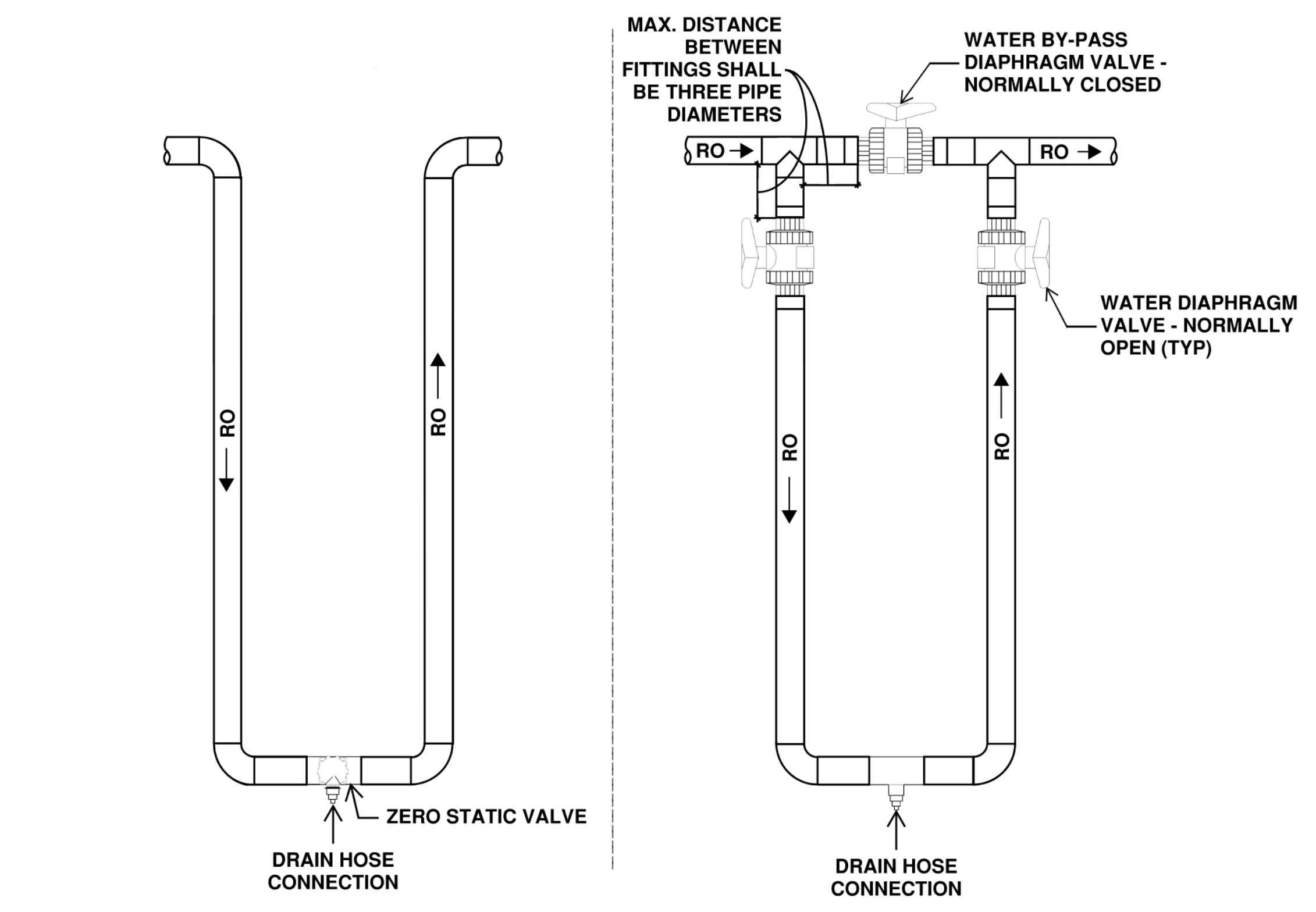
As shown in the diagram on the left, if this configuration is provided without bypass and isolation valves, maintenance of a single fixture will shut down the whole system and require an associated drain down and downtime to restore water quality.
However, another configuration alleviates this problem while allowing for continuous operation. As shown in the diagram on the right, this configuration provides branch routing that branches off from the main line, serves the fixture and loops back to tie into the main line again with a diaphragm valve on each branch and on the main line between branches.
This installation method is more common with Type ll and Type lll water as the design allows for isolated shutdown of individual fixtures though it increases the likelihood of stagnant water. To mitigate this, the diaphragm valves should be installed with a maximum of three pipe diameters between the tee fitting and the valve. This length provides enough space to connect the fitting to the valve via a pipe.
Integrating these water systems in laboratory environments requires careful design that balances functionality, performance and safety. Utilizing separate systems with proper design and the necessary safeguards helps prevent contamination and maintain water quality. Ultimately, a well-designed water system supports both the integrity of laboratory work and the safety of the overall facility.
Megan Hessil is a plumbing engineer at SmithGroup’s Phoenix office with experience designing plumbing systems for various building types and is a member of the American Society of Plumbing Engineers (ASPE). She can be reached at [email protected].



