When a commercial hydronic system starts showing signs of trouble — poor heat transfer, pump noise or reduced efficiency — technicians often look first to the obvious causes: air in the system, fouled strainers or faulty controls. Increasingly, however, the real problem runs much deeper.
The single greatest threat to long-term hydronic system performance often hides in plain sight: it’s the quality of the water itself.
Water is the working fluid, the heat carrier and, unfortunately, the silent saboteur. Left untreated or poorly maintained, it can corrode metals, form scale, produce sludge and foster biological growth. The result? Reduced efficiency, premature equipment failure and unplanned downtime — the consequences of which can be huge.
In a commercial building, the use of multiple boilers is common. If an issue is discovered and poor water quality is likely the culprit, the sad reality is that each boiler — and all the hydronic connected components along the water pathway — will experience the same challenges. If water quality issues are left to wreak havoc in a hydronic system for a period of time (depending on their severity), the equipment may not be salvageable.
It’s an all-too-common malady: Once a boiler or pumps fail due to poor water quality, a cascade of issues can result.
It’s no exaggeration to say that the overall health of a hydronic system depends on the health of the water circulating through it.
The chemistry of trouble
Even water that looks clear can be chemically aggressive. Minerals, oxygen and trace contaminants interact with system materials in complex ways that can erode performance and damage components. Understanding the main types of water-related problems helps underscore why treatment and monitoring are essential.
• Corrosion: This is the most common and costly form of hydronic damage. It occurs when metals react with oxygen or with water that is too acidic or alkaline.
Cast-iron components tend to form magnetite (black iron oxide), which appears as fine black sludge. Magnetite can clog boilers, circulators and radiators, causing uneven heating and accelerated wear.
Copper, when exposed to the right contaminants or to high TDS levels, or to pH, alkalinity or chloride levels outside the recommended ranges, is prone to pitting corrosion, often leading to pinhole leaks and eventual pipe failure. Other factors, such as high dissolved oxygen, certain bacteria and high water velocity, can also contribute to the problem, especially in combination with water chemistry.
Aluminum, used in some modern condensing boilers, is highly sensitive to water chemistry. If the pH drops below about 7 or rises above 8.5, aluminum surfaces can corrode rapidly.
Once corrosion begins, the byproducts themselves become part of the problem. Iron oxide and other particles accumulate in low-velocity areas, forming sludge that restricts flow and increases pressure drops throughout the system.
• Scale formation: Typically, hydronic systems aren’t prone to the formation of harmful, problematic scale; it is never an issue in sealed systems. However, if a leak develops and new, oxygenated water is added periodically, the risk of scale formation becomes an issue.
Hard water, which contains dissolved minerals such as calcium and magnesium, causes scale to form on the internal surfaces of heat exchangers and piping. Even a thin layer of scale acts as an insulator, reducing heat transfer efficiency.
Research from the U.S. Department of Energy shows that just 1/16 inch of scale on a heat transfer surface can increase energy consumption by more than 10%. As scale thickens, temperatures rise, efficiency falls and metal fatigue can lead to cracking or failure.
• Sludge and debris: Sludge isn’t limited to corrosion products. New or modified systems often contain construction-related residues, such as solder flux, metal filings, oil, joint compound and other debris. If these materials aren’t removed before startup, they’ll circulate through the system, where they combine with corrosion byproducts to create a thick, sticky sludge.
Sludge tends to settle in low-flow areas such as heat exchangers and valve bodies. It can also damage electronically commutated motor (ECM) circulators and pumps, whose tight clearances and magnetic rotors are easily fouled.
• Air and oxygen: Dissolved oxygen is one of the chief drivers of corrosion. Each time makeup water enters a system, it brings oxygen with it. Once inside, oxygen attacks metal surfaces until it’s consumed — producing rust and oxide particles in the process. Entrained air, meanwhile, reduces thermal efficiency and causes noise, cavitation and erratic flow. Modern systems, therefore, require high-performance air separators and degassers, along with proper pressurization, to minimize oxygen ingress.
• Biological growth: Microbial contamination is often overlooked, but it’s a growing concern, especially in systems experiencing intermittent operation or low flow. Bacteria and algae can form biofilms on internal surfaces. These slimy layers both restrict flow and create localized corrosion “hot spots” beneath them.
Over time, biofilms can foul heat exchangers, clog strainers and generate unpleasant odors. In open-loop domestic water or chilled-water systems — particularly if water circulated to and from chillers remains stagnant for long periods at temperatures from 76 F to 113 F — Legionella bacteria can grow if not properly controlled chemically, or through routine circulation of higher temperatures.
To eliminate Legionella bacteria, domestic hot water should be stored at temperatures above 140 F and cold water should be kept below 68 F. For hot water systems, it’s also recommended to ensure it is delivered to outlets at a minimum of 120 F to control growth.
Building a foundation for system health
Protecting hydronic systems from these problems requires a comprehensive approach that starts before commissioning and continues throughout the system’s life.
1. Initial system cleaning
Before filling a new or modified system, all piping and components should be flushed and cleaned. This removes construction debris, flux and oil that could interfere with inhibitors or foul equipment. Specialized cleaning agents are available for different materials (steel, copper, aluminum), followed by neutralization and thorough rinsing.
Skipping this step can undermine even the best water treatment program.
2. Water treatment and conditioning
Once the system is clean, the fill water should be conditioned with a suitable treatment package. Most chemical inhibitors serve three purposes:
pH control. Maintaining proper acidity/alkalinity to protect metals;
Corrosion inhibition. Coating internal surfaces with a protective film;
Scale prevention. Binding calcium and magnesium ions so they can’t form deposits.
Reputable manufacturers — such as Fernox, Sentinel and Rhomar — all offer formulations designed for specific system materials and temperatures. Some include biocides to suppress bacterial growth.
While brand selection can vary, what matters most is that the treatment chemistry matches the system’s materials and operating conditions, and that it’s regularly maintained.
3. Air and dirt separation
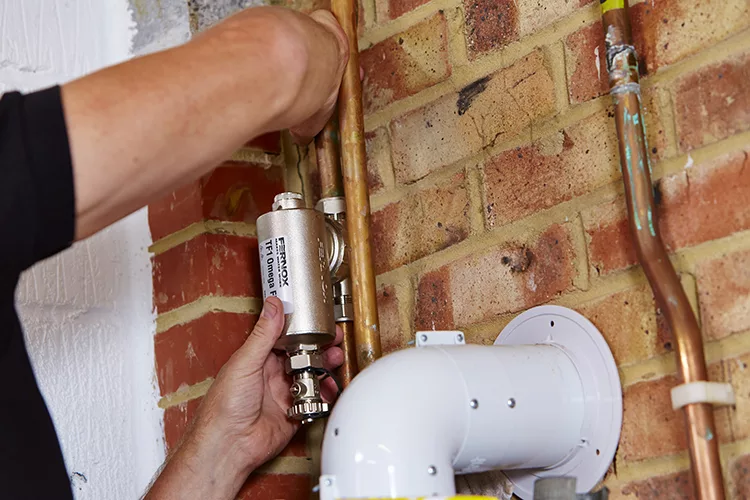
Advanced separators and magnetic filters have become standard in modern hydronic systems. Air separators continuously remove microbubbles and dissolved gases that can cause noise and corrosion. Magnetic dirt separators capture ferrous debris (such as magnetite) that can damage ECM pumps and small-passage heat exchangers.
Manufacturers now offer combination devices that handle both functions in a single body, improving reliability and simplifying maintenance.
4. Ongoing monitoring and maintenance
Water treatment is not a “set it and forget it” process. Inhibitors degrade over time, pH can drift and makeup water can alter chemical balance.
Regular testing — quarterly for critical systems, annually at minimum — verifies that treatment levels remain within target ranges. Simple field test kits can check pH, inhibitor concentration, hardness and conductivity. More detailed analysis can be performed by specialized labs.
Recording results over time builds a valuable system health history that helps diagnose problems before they become expensive failures.
5. Demineralized water
For the installation of smaller hydronic systems, demineralized water is ideally used for system fill. Produced through ion exchange, it removes calcium, magnesium and other ions that cause scale and galvanic corrosion.
Demineralized water is not the same as distilled water. Distillation removes virtually all impurities, including dissolved gases, but is energy-intensive and less practical in large volumes. Demineralized water, by contrast, strikes a balance between purity and cost.
At roughly $200 for a 55-gallon drum, it might seem expensive, though compared with the cost of replacing a fouled condensing boiler or ECM pump, it’s a bargain.
For medium- to large-scale closed-loop hydronic systems, companies such as Axiom offer demineralizers for installation in the water pathway. The quality of water, especially when mixed with anti-freeze (glycol), can affect system performance. Even marginal water quality can lead to scaling, sediment deposits and sludge accumulation.
When water quality goes wrong
What happens when a system is filled with untreated or poor-quality water, or when leaks allow constant introduction of oxygen-rich makeup water?
• Boilers. Scale and corrosion reduce efficiency, cause localized overheating and, in severe cases, lead to premature failure.
• Pumps and valves. Magnetite and sludge can jam moving parts, destroy bearings or cause electrical interference in ECM pumps.
• Heat emitters. Flow restrictions create uneven heating, noise and frequent air venting issues.
Once degradation begins, it often accelerates. Corrosion generates more debris, which creates more blockages, which lead to more corrosion. If it’s initiated, it’s a destructive cycle that can only be broken by cleaning and chemical stabilization.
New systems vs. retrofits
• The good. A new system offers the chance to start clean, fill with conditioned or demineralized water and establish a monitoring plan from day one.
• The bad. Retrofit projects often mix old and new materials — galvanized steel with copper, for example — which can accelerate galvanic corrosion if water chemistry isn’t properly controlled.
• The ugly. Chronic leaks introduce a steady stream of oxygen and minerals, rendering any treatment efforts ineffective. In such systems, addressing the source of water loss is the first step.
Components that rely on clean water
1. Boilers. Low-mass, high-efficiency condensing boilers are extremely sensitive to water quality. Even a small buildup of scale or magnetite can degrade heat transfer, triggering efficiency losses and nuisance lockouts. Older cast-iron and steel boilers are more forgiving, but they, too, suffer from sludge and corrosion over time.
2. ECM circs and pumps. ECM circulators are well-known for their energy savings. However, these pumps depend on precise magnetic and hydraulic tolerances. Ferrous sludge or particulate matter can damage bearings or interfere with the rotor’s magnetic field. Magnetic filters are, therefore, a must-have in any modern hydronic system.
3. Strainers and filters. Traditional Y or basket strainers are still useful for capturing large debris, especially at startup. For continuous protection, duplex strainers allow cleaning without system shutdown. Automatic self-cleaning strainers are also available for larger systems where downtime isn’t an option.
4. Magnetic strainers and filters. A decade ago, magnetic filtration was rare in hydronic systems. Today, it’s an essential safeguard, especially in systems using ECM technology or aluminum heat exchangers. These filters continuously remove magnetite and other fine ferrous particles that traditional strainers miss.
Water quality is the unseen foundation of hydronic system performance. It determines not only how efficiently a system runs today, but also how long it will last.
Every performance guarantee, every energy-efficiency claim, every warranty depends on maintaining proper water chemistry.
Whether commissioning a new system or servicing an existing one, technicians should treat water quality testing as a standard part of maintenance — on par with checking combustion efficiency or verifying delta-T (∆T).
In the end, good water means good performance. Poor water? That’s the hidden threat.
Dan Rettig’s career began as an HVAC commercial service technician focusing on chillers, cooling towers, heat pumps, boilers and oil burners. He also has experience with multiple control platforms for building integration. Over the last 13 years, Rettig has been employed by two different boiler manufacturers, including 12 years of product management experience. Rettig is currently the product manager for Thermal Solutions, a subsidiary of Heating Solutions Sales Co.