
The rise of hybrid and remote work arrangements has led to a decrease in the need for conventional office space and fewer Class A office buildings. As a result, property owners have adopted this trend by converting their underused or vacant office buildings into residential properties. Such conversions carry a unique set of plumbing design challenges, particularly with the design of the domestic hot water (DHW) system.
This article explores the overall plumbing design considerations and dives deeper into how we have approached DHW heating design in these office-to-residential conversions.
The rise of office-to-residential conversions
The COVID-19 pandemic brought significant changes to our way of life. While some of those changes were temporary, other changes are here to stay. Before the pandemic, most office workers were physically in their company’s office Monday through Friday every week. With the onset of the pandemic, office workers were working fully remotely for an extended period.
While the pandemic is behind us, many companies have permanently adopted hybrid work schedules. This may involve sharing office desks or remote work arrangements; therefore, these companies are opting to downsize their office space or forgo having offices altogether. As a result, many office spaces have been left vacant or underused.
In New York City, we have seen an increasing trend of property owners converting vacant office spaces to in-demand residential units. While these conversions begin to address the worsening housing crisis, they also offer an overlooked benefit of reducing carbon and benefiting the environment (https://bit.ly/4j1NMD8). Arup has been retained by various clients to study the feasibility of converting several office buildings into residential units.
Plumbing and fire protection challenges
Despite the challenges that face all disciplines, such as zoning regulations, existing floorplate layouts and increased residential loads, plumbing and fire protection engineers are also presented with unique challenges. Office buildings typically have centralized plumbing risers designed to serve restrooms and kitchenettes located in a core space that is standard across multiple floors. Residential buildings have multiple individual units across each floorplate. Each unit will include at least one bathroom, kitchen and potentially washing machines.
The first step in an office-to-residential conversion study is to examine the floorplate design and determine if the existing utilities are adequate. The total number of fixtures in the building needs to be tabulated and the total domestic (WSFU) and sanitary (DFU) fixture units need to be reviewed against the existing utilities.
In most cases, the existing utilities have been adequate, as in office buildings there are multiple fixtures within the restroom banks; in essence, those fixtures are being spread across the floorplate. As there will be many bathrooms on each floorplate, sanitary and vent risers will be added at each bathroom, and potentially domestic water risers as well.
It might be inferred that existing storm drainage risers should not need to change due to the conversion as the building footprint is not changing; however, the existing storm riser locations may need to be relocated. Even if the existing storm riser locations are not changing, the age and condition of the existing storm risers should be assessed, and the risers should be replaced if necessary.
Similarly, an office building’s existing fire protection equipment is typically located in the cellar and on the upper service floor. The fire protection risers can be replaced, depending on their age and condition, especially since the sprinkler layout across each floorplate will likely be removed and replaced up to the riser floor control assembly, at a minimum.
Consideration should be taken in the hydraulically remote area and sizing criteria as there are various methods in calculating this based upon the applicable construction or retrofit design (NFPA 13R, NFPA 13 area/density or room design method, etc.).

The domestic hot water question
While increasing the quantity of the sanitary and vent system risers to meet the new floorplate layout may seem straightforward, one of the most critical design considerations is how to approach domestic cold water and hot water heating. The building’s DHW loads will increase significantly, most notably to accommodate the need for showers, as well as for additional kitchen sinks, dishwashers and washing machines.
The building’s existing water heaters are likely to be undersized to meet the new DHW demands and changes in hot water usage patterns.
The biggest question that should be asked is whether a centralized or a decentralized water heating strategy should be pursued. A centralized water heating strategy is where one or more large-capacity water heaters and storage tanks serve multiple floors in a single zone. A decentralized water heating strategy is where each unit is provided with its own residential water heater. Both strategies have advantages and disadvantages.
When reviewing the appropriate strategy, it is essential to understand several key parameters specified by the property owner, including their desire for maintenance and individual unit metering. Likewise, trade-offs between the two strategies need to be considered.
In highly dense areas, such as New York City, every square foot of a building is valuable. Many property owners want to minimize the square footage allocated to mechanical equipment rooms, where large-capacity water heaters for a centralized water heating strategy would be located. We have come across some property owners who prefer to install water heaters in every unit and leave the maintenance of each unit’s water heater up to the individual tenants.
Local laws and codes should be studied early, as more jurisdictions require carbon emission reductions. Therefore, centralized water heating is not always a viable option, especially in areas where steam or natural gas are not readily available or are being phased out.
Some advantages of decentralized water heaters include reducing the number of domestic water risers to cold water piping only and reducing the amount of horizontal domestic water piping. Individual unit metering becomes less costly, as only half the number of water meters are required, i.e., one for each unit’s domestic cold water supply only.
However, care must be taken to provide adequate controls (such as electrical connections, automatic shutoff and drip pans) for each individual unit’s water heater. Additionally, a maintenance or replacement program should be put in place to monitor the large number of individual unit water heaters in the building.
It should be noted that, regardless of the strategy selected, electric water heaters impose a significant electrical demand, especially during peak usage periods. This demand needs to be coordinated with the electrical engineer, who may need to implement load management strategies.
A quick analysis tool
Ultimately, the upfront capital costs of installing the DHW system are a primary driver in selecting the appropriate strategy.
As part of our examination of capital costs, we created an in-house analysis tool that compares the two domestic water heating strategies and provides total cost estimates of pipe and water heaters for each strategy. This tool gives the plumbing engineer vital information that can be shared with the owner to make an informed decision regarding the appropriate domestic water heating strategy.
To properly use this tool, the engineer begins by listing and verifying assumptions for the building. The engineer populates the number of fixtures in each unit and selects the appropriate hot water pipe size and hot water return pipe size. The tool calculates the adjusted hot water demand and storage required for each unit, as well as the hot water supply fixture units. The engineer is given an opportunity to modify these values if using different assumptions.
The engineer is now presented with two options for proceeding with this calculation, depending on the amount of available information. Option 1 allows for quicker analysis when the exact number of units per floor and the location of service floors are not known. Option 2 allows for a more thorough analysis when the exact number of units per floor and the location of the service floors are known.
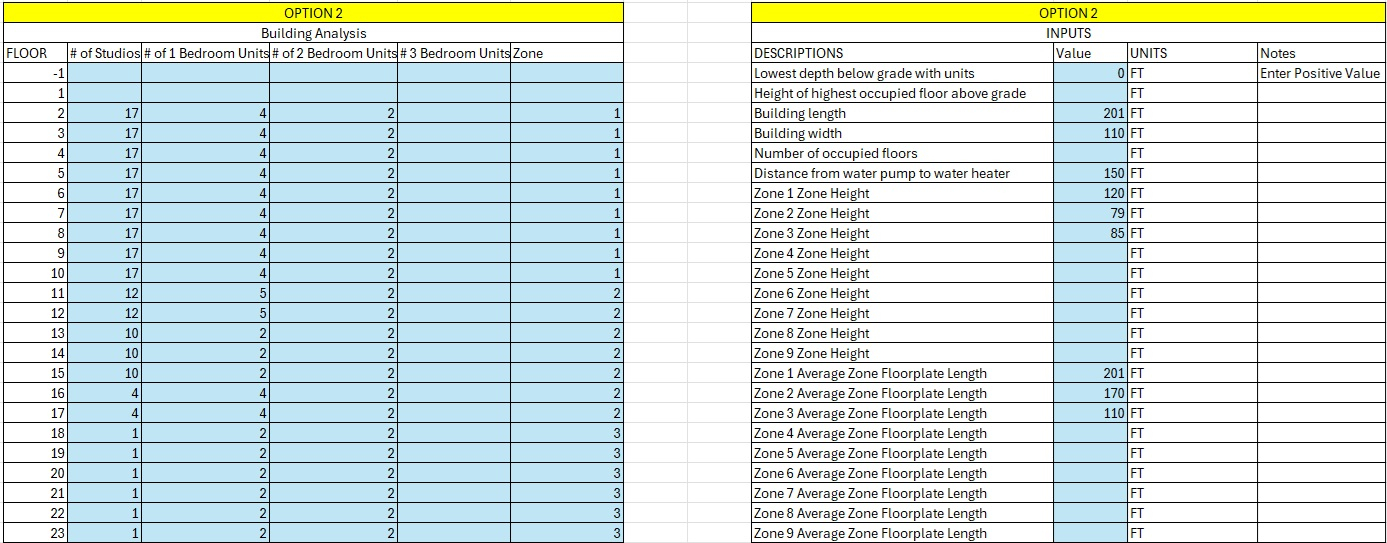
For both options, the engineer enters information about the building, such as the building’s height, length, width and number of floors. Additionally, when using Option 2, the engineer enters information with respect to the number of units on each floor as well as the height of each zone and the dimensions of each zone’s floor plate.
Upon entering all information, the engineer presses the run button for the chosen option, and the calculator estimates the sizes of the hot water distribution and hot water return piping for the entire building. It also selects the appropriate large-capacity water heater for the centralized hot water strategy. The engineer is given an opportunity to select different types of large-capacity water heaters from a drop-down menu if desired.
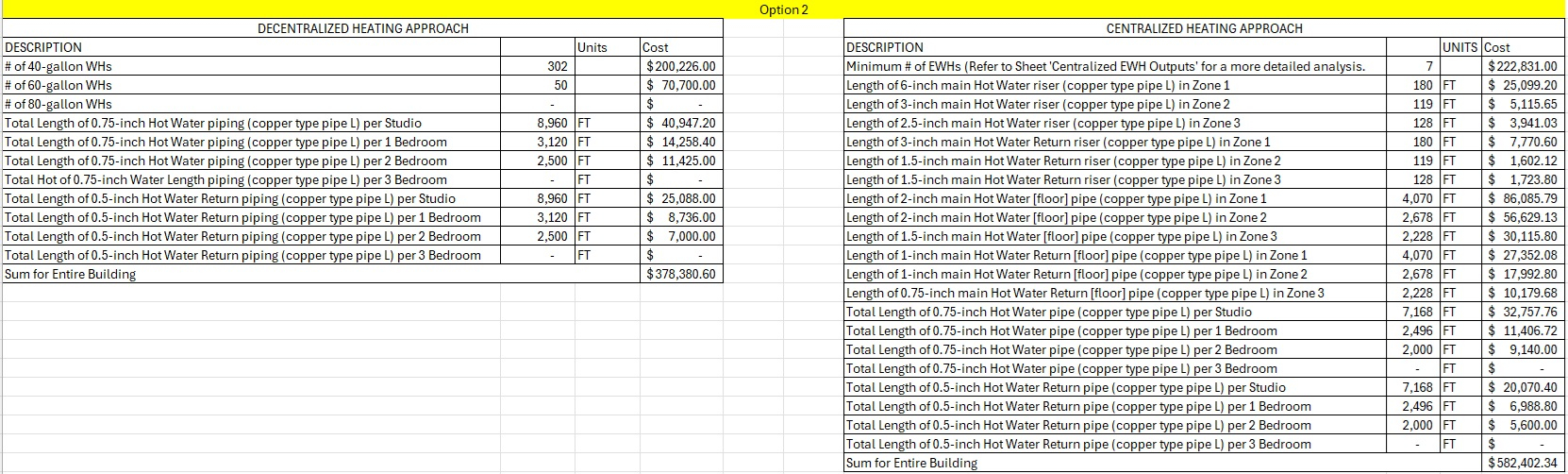
The last sheet of the tool provides a side-by-side comparison of the decentralized and centralized hot water heating strategies for the selected option. There, the engineer can easily see information, such as the estimated number of water heaters needed and the estimated pipe lengths and sizes for each strategy.
For a more thorough analysis, the engineer can enter the cost of each water heater and the cost of copper piping, and the tool automatically provides a side-by-side comparison of the costs of each strategy, with a line-by-line breakdown of the costs.
The engineer now has all the key data that the owner is looking for when selecting the DHW heating strategy. If any changes are made to the design, such as the number of units per floor, the engineer can quickly adjust the assumptions and obtain revised comparisons in mere seconds, thereby avoiding the need to repeat lengthy calculations.
Quick example for a quick estimate
We used this tool to collect key data on a sample project in New York City, where we had complete floorplate layouts, and proceeded to use the tool to compare the centralized and decentralized water heating strategies.
Step 1. We began by populating the number of fixtures per unit and providing estimates of pipe sizes and lengths per individual unit, editing the information in blue-colored cells as needed.
Step 2. Since we had detailed floorplans and knew the number of units per floorplate, as well as the location of service zones, we proceeded with Option 2 and populated the information in the blue-colored cells as needed.
Step 3. We pressed the button to auto-compute all key parameters for our systems.
Step 4. We entered cost information for water heaters and piping and were able to see a detailed line-by-line breakdown of the decentralized and centralized water heating strategy.
Step 5: We analyzed this information and returned it to the client with our recommendations based on material costs.
The move toward office-to-residential conversions is a solution to vacant office spaces due to the rise of hybrid work and remote work arrangements. While it is safe to say that the building’s entire plumbing and fire protection systems will be affected by such a conversion, the DHW system requires a significant amount of careful planning in the early design stages.
The choice of a centralized or decentralized water heating strategy will significantly impact material costs, the space needed for water heaters and future maintenance considerations.
We have developed a tool to aid our plumbing engineers in quickly analyzing material cost estimates for each strategy. As the early design is subject to rapid fluctuations, this tool helps the plumbing engineer stay on top of the DHW heating strategy by minimizing the need for lengthy calculations with every design change.
Robb A. Risani, PE, is an accomplished professional in the field of plumbing and fire protection engineering. As an associate principal at Arup’s New York office, he leads the East Plumbing Discipline and serves as the America’s Plumbing Skills leader within the organization. His leadership extends beyond his firm, as he is the president of the American Society of Plumbing Engineers’ (ASPE) New York City Chapter and ASPE’s Region 1 director.
Witold Dziekan is a talented plumbing and fire protection engineer in Arup’s New York office and is a member of the ASPE New York City Chapter. His interests focus on creating innovative tools that empower engineers to design more robust systems while maintaining flexibility during significant design changes.



