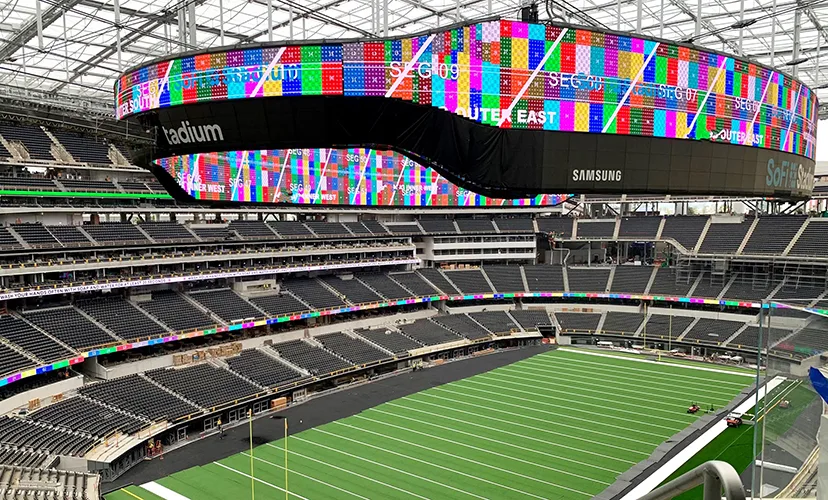
Summer 2026’s global soccer tournament is unlike any other, with matches spread across 16 stadiums in the United States, Mexico and Canada. Among the world-class facilities hosting international soccer stars and hundreds of thousands of domestic and international fans, SoFi Stadium in Inglewood, Calif., is perhaps the most impressive.
This $5.5 billion, 70,000-seat facility, which is home of the NFL’s Los Angeles Rams and Los Angeles Chargers, sports standout amenities including 260 luxury suites, a 2.5-acre outdoor plaza and a 70,000-square-foot circular 4K video board. Supporting this glamour are building systems engineered by Henderson Engineers, the engineer of record whose scope included plumbing as well as acoustics, architectural lighting, audio-video, electrical, fire and life safety, mechanical, security and telecom.
The stadium was designed per the 2013 California Building Standards Code (Title 24) as code minimum, which offers opportunities for energy efficiency and water savings. Plumbing fixture flow and flush rates are not to exceed the following values:
Showerheads: 1.75 gallons per minute (gpm) at 80 psi;
Lavatory Faucets (nonresidential): 0.2 gallons per cycle (gpc);
Kitchen Faucets: Maximum 1.8 gpm at 60 psi;
Water Closets (toilets): 1.28 gallons per flush (gpf);
Urinals: Maximum 0.125 - 0.5 gpf.
Henderson Engineers exceeded Cal Green Title 24-2013 requirements by specifying plumbing fixture flow and flush rates not to exceed the following values:
Showerheads: 1.5 gpm at 80 psi;
Lavatory Faucets (nonresidential): 0.125 gpc;
Kitchen Faucets: 1.5 gpm at 60 psi;
Water Closets (toilets): 1.28 gpf;
Urinals: 0.125 gpf.
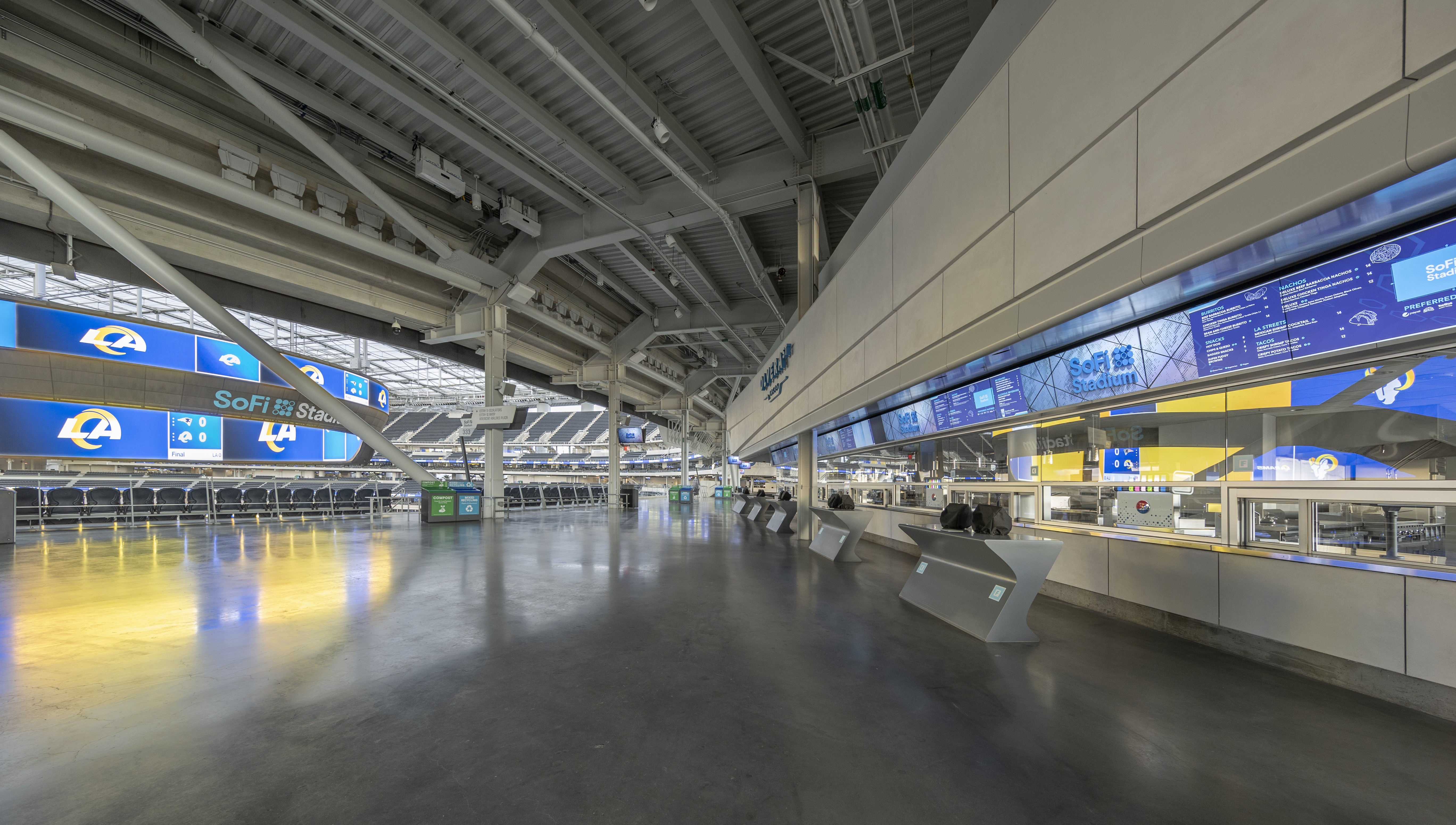
Metering faucets were utilized for all public lavatories to reduce potential waste of domestic water. Faucet controls were set to limit cycle length to 15 seconds for water usage of 0.125 gpc. Hot water to all lavatories and hand sinks was circulated through the wet wall to minimize hot water delivery time and minimize waste of hot water.
Hot water distribution pipe to fixtures other than lavatories and hand sinks were fed from circulated hot water distribution pipes with a maximum developed length of 25 feet to reduce potential waste of domestic hot water. Thermostatic mixing valves were specified for each lavatory, hand sink or sink with public access. The valves were set at 100 F for single temperature electronic faucets, 110 F for manual lavatory and hand sink faucets and 120 F for other sinks.
Pressure zones and pipe sizing
The stadium is located within the flight path of Los Angeles International Airport and height above grade cannot exceed 100 feet. To achieve the seating capacity of a modern NFL stadium, a hole was dug to build it with a field level at 100 feet below grade.
The venue was split into three pressure zones with the high zone serving upper level restrooms, concessions and the press box. Most of the concession stands, the team locker rooms, the commissary and large restrooms are located in the lower and middle level zones.
Many stadia have been designed with a loop all the way around at each pressure zone. The stadium was further split in half, with each side of the stadium provided a water service entrance near the 50 yard line.
This served to reduce the developed length of the water system, allowing smaller pipe sizes. Schedule 10 316 stainless steel pipe was used for all piping 6 inches and larger. Water mains in excess of 4 inches and larger were sized at minimum pressure loss with a velocity of 10 feet per second.
This allowed branch piping to be sized with a developed length of 150 feet at a much higher pressure loss, allowing the use of smaller branch piping versus a looped system. This design served to reduce overall piping material and cost.
Water pressure exceeded 90 psi during the day and can reach 130 psi at night. This is a common issue with water pressure in the Los Angelas metropolitan area, where the area is fed with long runs of water mains with a large pressure drop due to the system length.
Because the pressure exceeded 80 psi during the day, pressure reducing stations were used at SoFi Stadium to reduce pressure down to 80 psi at the bottom of the middle and low pressure zones. Thus, no pumping energy was needed to provide adequate pressure for the middle and lower zones.
The high zone was just high enough that it was not possible to provide 35 psi at the top of the high zone to feed flush valve water closets during an event. A booster pump was provided to boost pressure of each high pressure zone.
Henderson Engineers coordinated with the owner to provide (N+1) redundancy for the booster pump selection, specifying four pumps each at 35% to meet this requirement. It is common knowledge that, most of the time, domestic water loading is at best 20% of the absolute peak. A pump sized at 35%, running at 20% of the peak flow is generally running at its most efficient point of its pump curve. This serves to save the owner energy for most of the time the pump is running.
When a peak load occurs, such as at half time or at the end of a game, three pumps operate to meet the required flow rate. An automatic control valve, configured as a pressure reducing valve (PRV), was installed upstream of the booster pump and set at 80 psi, while the booster pump was configured to turn on at 78 psi.
When water pressure exceeded 80 psi, the automatic control valve (ACV) would allow 80 psi water through the booster pump to feed the high zone without the booster pump operating. When pressure dropped below 80 psi, the ACV would open fully and the booster pump would turn on to provide adequate pressure at the top of the high zone.
Water conditioning and water heating
Water in Southern California is hard, in excess of 10 grains per gallon and requires treatment for heating to 140 F. Ion exchange water softeners are not allowed in Los Angeles County. In lieu of ion exchange water softeners, alternative water conditioning options included electronic water conditioners, ion exchange tanks and template assisted crystallization. Template assisted crystallization was the technology chosen for water conditioning.
A central water heating system was specified for the lower pressure zones of the stadium because many fixtures were located throughout the middle and low zone stadium footprint. The water heating system was located at the top of the middle pressure zone and served the lower pressure zone with a PRV assembly to reduce the hot water pressure. The low zone hot water return was reheated back to 140 F with a brazed plate heat exchanger.
The system included water heating boilers and separate storage tanks. The water heating boilers utilized an all stainless steel heat exchanger to achieve a thermal efficiency of 96%. To fit in this limited height, horizontal storage tanks were specified.
The high zone includes many restrooms and concession stands throughout the footprint, making a central water heating system feasible. The system includes water heating boilers and separate storage tanks, and is a smaller version of the middle and low zone water heating systems.
Stormwater and sanitary systems
SoFi Stadium has a retraceable canopy allowing sunlight and wind into the stadium. It is not possible to drain the entire site by gravity to the storm sewer system as the rainfall intensity in the area is 2 inches per hour. Therefore, the stadium was broken into four quadrants to keep piping inverts as high as possible.
The four storm sump basins receive flows from various levels that drain down to the them due to their elevation versus the site storm sewer system. Design motor horse power was large and ranged from 42 to 70 horsepower per pump.
Not all storms in the area achieve an intensity of 2 inches per hour. Henderson Engineers dealt with this by specifying three storm sump pumps per sump basin, each sized at 50% of the absolute peak. This would allow one pump to run for off peak storms.
In addition to specifying pump motors with variable frequency drives (VFD) and a programmable logic controller (PLC) based control panel to modulate the pump speed, Henderson Engineers worked with the pump manufacturer to obtain a pump curve at the minimum recommended pump speed. This allowed the pump basin to be sized at the minimum volume for a 1-1/2 minute run time of a single pump running at minimum speed, thus making the pump basin much smaller than if it were sized at one pump running at 100% of the peak load, which saved the owner the first cost of a larger pit and the energy and materials to build it.
During off peak storms, a level sensor is used to sense the water level in the pit. The PLC modulates the pump speed to keep the level constant, allowing the pump to run at reduced speed and at reduced energy usage. If storm flow rate increases and the level increases, the second pump is staged “on.” If the storm water level reduces down to the level of first pump “on,” the first pump to start turns “off” and the second pump runs. This ensures equal wear on all three pumps.
SoFi Stadium’s high zone sanitary building drains can discharge by gravity to the sanitary sewer system located outside. Because the stadium is located inside a large hole, the middle and lower zones must be discharged to sump pits. The stadium was broken into four quadrants to keep piping inverts as high as possible.
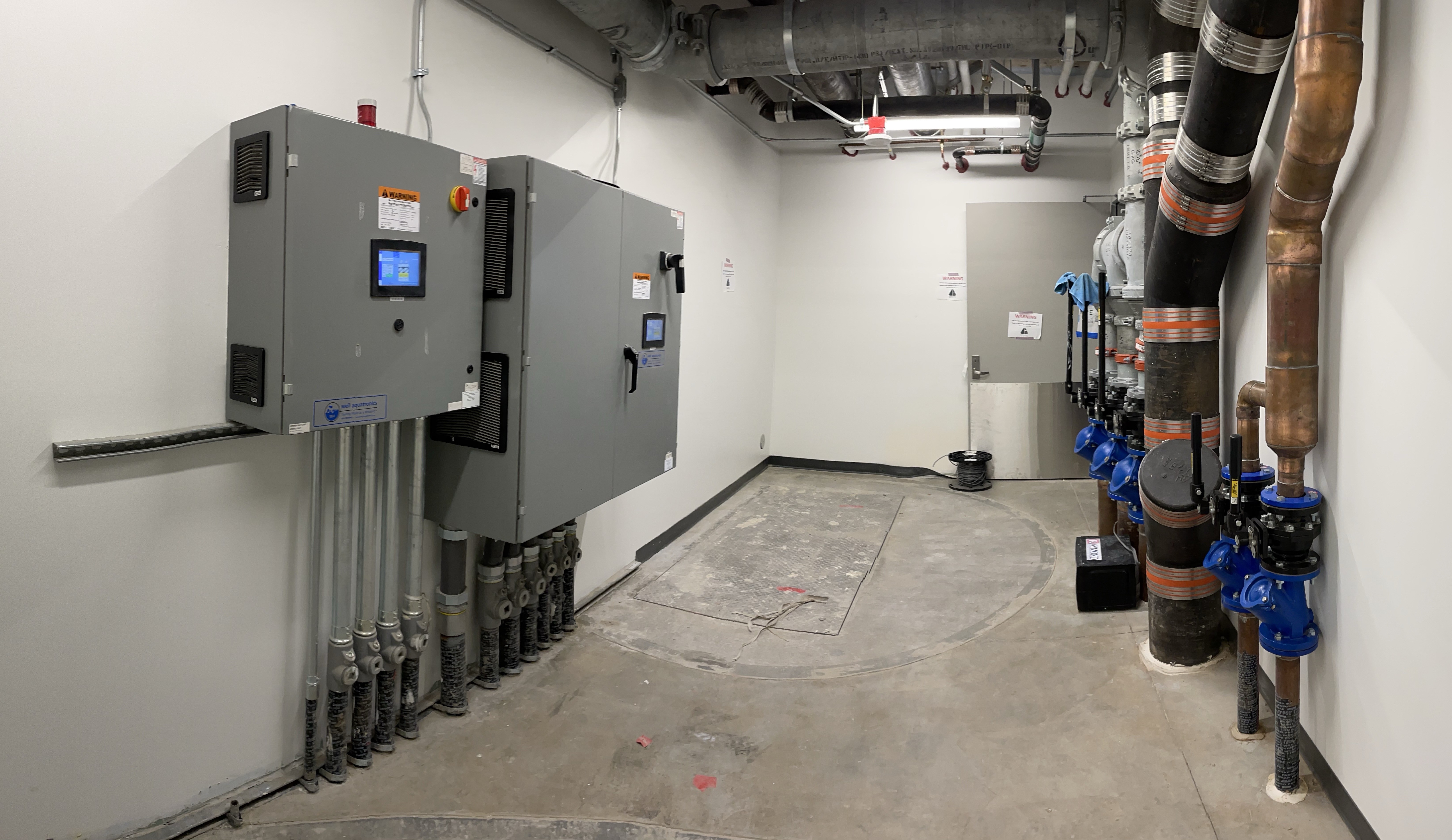
The sewage pump basins were sized to accept an absolute peak load that occurs at a football game halftime. Duplex constant speed pumps were chosen over VFD drive powered for the application because storm drainage flow rates can occur over several hours, while a halftime sewage flow is a quantifiable amount. Figure 1 is an example showing a sewage and storm pump system located in a dedicated room.
Metering faucets reduce water consumption at every use cycle, directly lowering both water and sewer utility costs across hundreds of public lavatory fixtures. The hot water recirculation system eliminates the need to purge cold water from distribution lines before each use, reducing both water waste and the energy required to heat replacement water drawn into the system.
The booster pump configuration was selected with operational efficiency in mind. Because domestic water demand rarely reaches absolute peak, the pumps spend most of their operating hours at approximately 20% of peak flow — a condition that places each pump near its most efficient point on the pump curve, minimizing electrical energy consumption during normal operation.
The automatic control valve configured as a PRV upstream of the booster pumps further reduces pump runtime and energy use by allowing municipal pressure to serve the high zone without pump operation.
 The benefits of exceeding code minimum
Exceeding Cal Green requirements for fixture flow rates, hot water return system design, pump split selections to save water, heating energy and electric energy was not all that difficult to achieve with minimal higher first cost, which is offset by water and energy savings.
Water and energy conservation strategies at SoFi Stadium carry significance well beyond the building itself. Southern California is a semi-arid region that relies heavily on imported water transported through an extensive network of aqueducts and distribution infrastructure — a system that is both energy-intensive and increasingly stressed by prolonged drought conditions and population growth.
The Los Angeles Basin is particularly vulnerable, as its water supply depends on sources hundreds of miles away, making every gallon conserved at the point of use a meaningful contribution to regional water security. At a venue the size of SoFi Stadium, even marginal reductions in per-fixture consumption compound into substantial volumetric savings over the course of a full event calendar.
Energy conservation is equally critical in this context. Southern California’s electrical grid serves one of the most densely populated regions in the country and is subject to significant demand spikes, particularly during summer months when cooling loads are at their peak.
By engineering the domestic water pressure zones to eliminate unnecessary pump operation — leveraging available street pressure to serve the middle and lower zones without booster pumps and configuring the high zone pumps to operate at their most efficient point on the pump curve during typical loading conditions — Henderson Engineers reduced the stadium’s parasitic electrical demand in a region where grid reliability and energy cost are persistent concerns.
Taken together, these strategies reflect a design philosophy that aligns building performance with the broader environmental and infrastructure realities of the Southern California region.
As hundreds of thousands of fans flocked to SoFi Stadium for the eight global soccer matches that took place at the venue, one thing they could count on was that the building systems behind the scenes were just as well thought out as the world-class architecture and amenities.
Warren Rosenbrook, PE, CPD, FASPE, Brandon Taylor, PE, CPD, and Brian Alessi, AIA, LEED AP BD+C, CPHC, are design and construction experts at Henderson Engineers, a national building systems design firm. Rosenbrook is a plumbing technical manager, Taylor is a venue sector practice director and Alessi is the firm’s sustainability director.