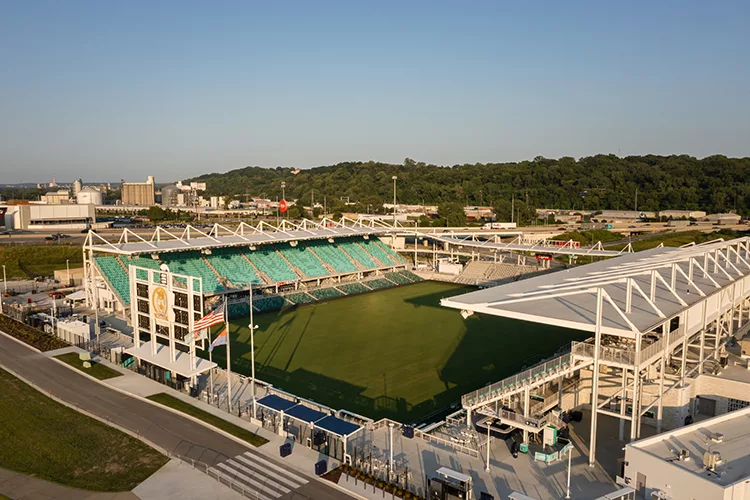
It’s hard to imagine that Kansas City, Missouri’s burgeoning KC Riverfront District was once largely discarded, serving as a tow lot and dumping ground for decades. Now the area is increasingly teeming with activity as residents make memories in new multifamily buildings, tourists flood into a new boutique hotel, amateur athletes compete on beach volleyball courts, locals stroll the Kansas City Riverfront Heritage Trail and revelers enjoy brews at a beer garden with breathtaking views of the Missouri River.
At the center of all this action is CPKC Stadium (www.cpkcstadium.com), which attracts 11,500 passionate fans to the area for perennially sold-out soccer matches during the annual eight-month season of the National Women’s Soccer League.
Opened in March 2024 and home to the Kansas City Current, CPKC Stadium is a game-changer well beyond the banks of the Missouri River. As the world’s first stadium purpose-built for a professional women’s soccer team, it set the standard for women’s sports globally.
The team behind the stadium’s development included Henderson Engineers, which served as the engineer of record for the $140 million project, overseeing the design of most building systems, including plumbing.
Plumbing fixtures
CPKC Stadium earned a LEED Gold certification from the U.S. Green Building Council, making it the first stadium in Missouri to achieve this milestone. Behind this accomplishment are a variety of sustainable design, construction and operational approaches, including on-site solar generation, zero-waste food service and access to public transportation.
On the plumbing design front, Henderson specified low-flow plumbing fixtures that meet the minimum WE prerequisites. The flow rates used include 1.5 gallons/minute (gpm) showers, 1.5 gpm sinks, 0.35 gpm lavatories and hand sinks, pint urinals and 1.28 gallons/flush (gpf) water closets.
Due to previous negative experiences with 1.0 gpf water closets and drain line carry on sports venue projects, Henderson recommended the use of water closets with a flush rate of 1.28 gpf. The CPKC Stadium site is flat, so the sanitary sewer installation is shallow relative to the finish floor of the facility. The Henderson team evaluated installing sanitary building drains at a 1/4-inch-per-foot slope, but found that this slope made it impossible to meet the available civil inverts.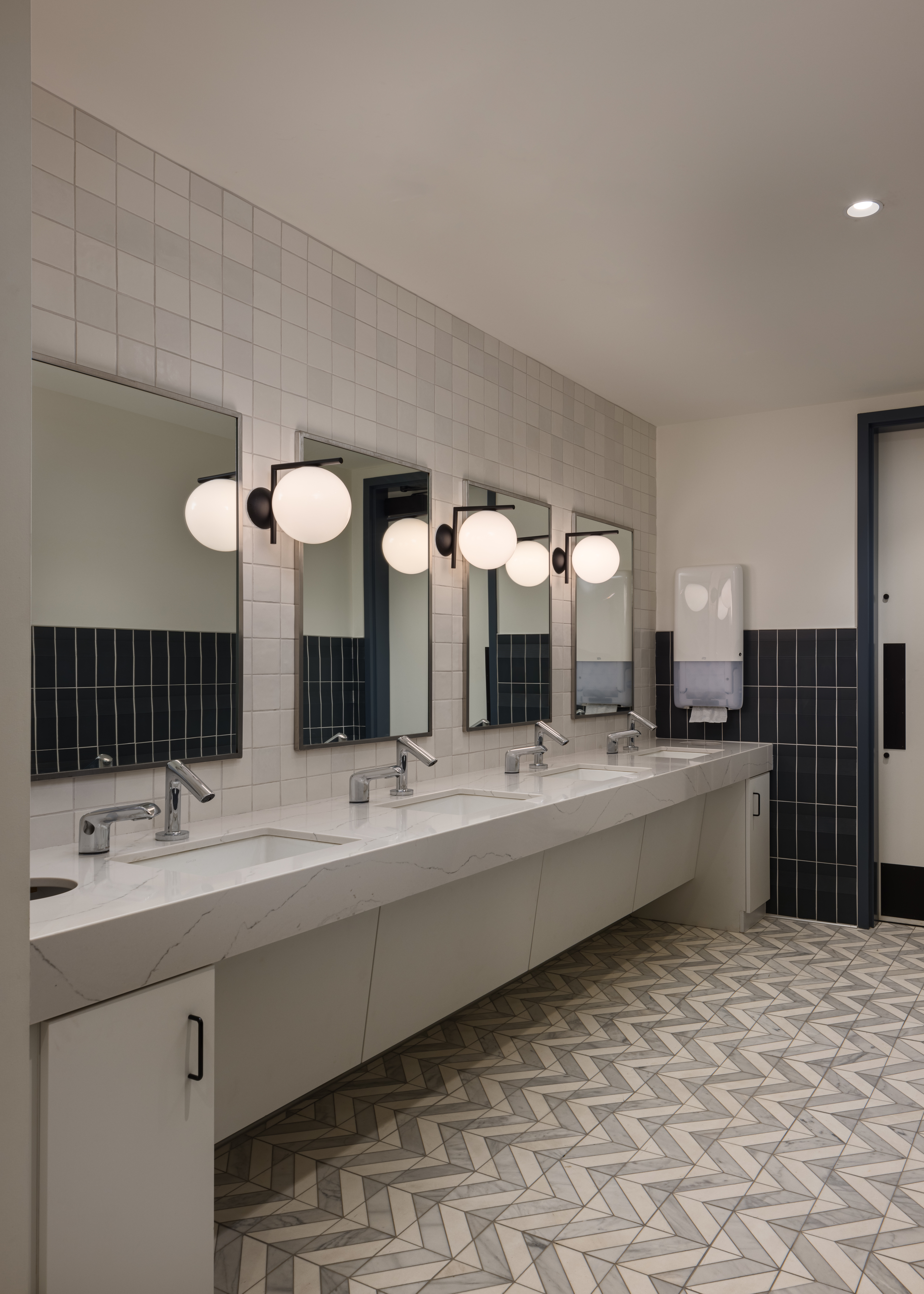 Wall-mounted urinals and water closets with exposed battery-powered electronic flush valves are used throughout the project. Lavatories are wall-mounted vitreous china or countertop types with single-temperature, battery-powered electronic faucets. Shower valves for athletes and referees are pressure-balanced. Sink faucets are 8-inch spread faucets with ADA handles where needed.
Henderson provided metering for domestic water, specifically for irrigation and domestic water heating. All the meters are capable of being interlocked with the building automation system. Both of these approaches comply with LEED standards.
Water service
Set beneath a U-shaped canopy, CPKC Stadium is comprised of four separate large buildings that house concessions and restrooms. These structures are single stories with slab-on-grade construction.
Taliaferro & Browne, the project’s civil engineer, specified a single water service with a water meter at the property line. This water service enters the largest building, where a reduced-pressure backflow preventer is located to isolate the stadium from the domestic water mains. Water lines exit the main building to feed the other buildings.
At 5 feet outside, civil engineers designated the water line as a loop around the stadium for better flow distribution and lower pressure losses. The other buildings are fed cold water from this loop with their own water service lines.
Gas service
The stadium has a single gas service appointed by the civil engineering team, with a gas meter at the property line. Natural gas is routed outside the facility’s footprint with service lines to each of the four buildings.
Polyethylene (PE) gas pipe is used for direct burial, with transition risers located outside each building to enter the building above grade via black steel pipe.
Rainwater drainage
Lower-level seating is located around the perimeter of the stadium, while the field is 8 feet below grade, and the concourse level is at grade. Seating rakers slope down to the lowest seating level at the field level. Henderson forewent area drains at the lowest seating level, given that the architect, Generator Studio, required a trench drain close to the seating around the perimeter of the playing field. Rainwater, therefore, washes down the seating rakers and spills onto the playing field to discharge to the trench drains.
This method was selected to prevent water from carrying debris onto the soccer pitch while allowing the underslab playing field drainage system to be sized solely for the playing field itself. The trench drain specified by Henderson was made of PE with ductile iron grate and frame, whereas the grate was Class C-rated with heelproof slots, a selection that can withstand wheeled traffic loads and not interfere with foot traffic.
The upper level of the stadium is made of steel with sloped rakers. Since there are no toilets or concession stands on the upper-level seating area, patrons must go down to the concourse level for concessions and restroom use.
The steel rakers slope down to the lowest seating level, where a gutter, provided by the architect, captures rainwater. Henderson specified cast iron drain, waste and vent piping to pick up the rainwater from the gutter and route it through the stadium to below the finish floor, where it’s connected to the storm sewer. In coordination with the architect, the Henderson team provided sheet metal outlets for connection to the storm piping system with an adapter coupling.
The U-shaped canopy roof sits above the upper-level seating and is sloped from the inside edge of the seating to the outside perimeter of the stadium. Around the outside perimeter of the canopy, the architect provided a gutter system sloped to 6-inch outlets. Henderson coordinated with the architect to provide 6-inch sheet metal outlets for connection to the storm piping system with an adapter coupling.
No strainers were provided at the outlets of the gutters, as it was determined that the roof was high enough that potential clogs caused by debris would not be an issue. Long runs of horizontal storm pipe were required to pick up the 6-inch outlets from the gutters. Henderson chose hubless cast iron pipe for this application because of its low coefficient of expansion. No thermal expansion joints, pipe alignment guides or pipe anchors were required for proper installation.
An ice-melt system was provided in the gutters to prevent ice buildup and ice dams over the public concourse below. Storm piping was insulated and provided with electric heat trace between the insulation and the storm pipe. The insulation was provided with aluminum jackets to protect it from punctures and prevent damage to the electric heat trace.
Food service
Since food is prepared in each of the four buildings’ concessions, Henderson included a grease waste system with dedicated grease waste piping and gravity grease interceptors sized per the local requirements. While a single grease interceptor was considered, it would have required long runs of underslab grease waste piping, which could cause clogs.
Henderson recommended individual grease interceptors for each concession to reduce the length of the grease waste piping, thus lessening the clog potential. Each building’s grease interceptor was coordinated with the architect to align with the stadium’s footprint.
Soccer pitch irrigation
CPKC Stadium’s soccer pitch was designed by a playing field consultant, whose scope typically includes field grading, soil and grass selection, and field drainage and irrigation. The consultant designed the field drainage system to include a grid of PVC drain tile and an irrigation sprinkler system.
To keep the grass green and growing during Kansas City’s frigid fall and winter, a heating system using hot air as the heating medium is installed under the playing field. While Henderson’s scope did not include any of these piping systems, the firm’s plumbing engineering team provided nonpotable water for the irrigation system.
Since the static water pressure at the site exceeded 80 pounds/square inch, a pressure-reducing valve and backflow preventer assembly were provided for the irrigation water connection. Henderson also provided natural gas to power heating boilers for the playing field.
Much like how teamwork is vital for the athletes who play matches at CPKC Stadium, the project’s development required seamless coordination between Henderson’s plumbing engineers and the rest of the development team, including the owner, architect, civil and structural engineers, and playing field consultant. The due diligence performed during design and construction resulted in a widely celebrated venue that was listed on Time magazine’s World’s Greatest Places of 2024.
Warren Rosenbrook, PE, CPD, FASPE, and Brandon Taylor, PE, CPD, are design and construction experts at Henderson Engineers, a national building systems design firm. Rosenbrook is a plumbing technical manager, and Taylor is a practice manager within the company’s venue sector.



