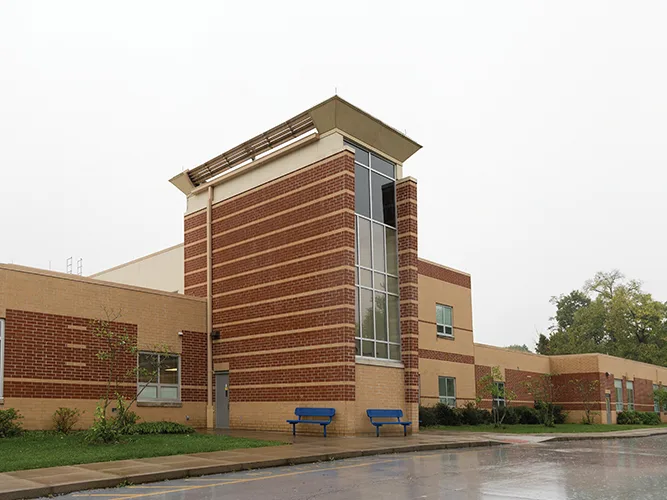
Cincinnati Public Schools (CPS) manages more than 3,000 faucets across its 66 school buildings. Overwhelmed by the number of mixing valves, the maintenance team spent valuable time and money replacing and reinstalling mixing valves to mitigate crossflow issues.
Because mixing valves are crucial for preventing scalding, thermal shock and Legionella, the CPS maintenance team required a timely and safe solution to protect students and staff while enhancing water efficiency.
When valve replacements become inefficient
The CPS team faced frequent maintenance calls as reports of inconsistent flow and lack of hot water increased district-wide. The source was corroded valves, as strainers were frequently clogged with calcium and lime deposits.
Crossflow occurs when hot and cold water unintentionally mix inside the valve, most commonly when internal checks fail over time due to natural wear, debris or mineral buildup that prevents the valve from sealing properly. When those checks fail, water follows the path of least resistance, often flowing from the higher-pressure hot water line into the cold line.
Instead of delivering properly tempered water to the faucet, the system can send untempered hot water directly to the fixture. This unwanted mixing creates inconsistent temperatures at the faucet, which can lead to scalding and wasted energy from overheating water, and also makes it difficult to determine which fixture is causing the problem.
Diagnosing fixtures for crossflow was a manual process that required testing each faucet individually. Each failed test then required the team to replace the mixing valve, a time-intensive process that required significant labor hours and left areas of the schools without hot water.
Buying new equipment took time and was costly. None of the parts in the existing valves could be cleaned or reused, leading to waste.
Because of this growing issue, CPS’s preventive maintenance plan became increasingly difficult to keep up with as the list of valves needing replacement grew longer. “I didn’t want to be a replacement plumber; I wanted to be a repair plumber,” says Todd Hoffman, plumbing foreman for Cincinnati Public Schools.
From a replace plumber to a repair plumber
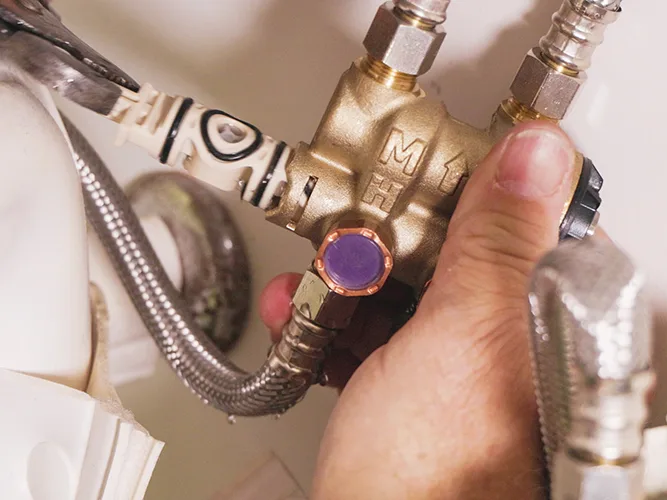
Looking for a faster, easier way to maintain valves, the district chose the new Watts LFUSG-CS. This point-of-use mixing valve installs quickly, is easy to repair and helps the team save time on every job. What sets it apart from traditional mixing valves is a first-of-its-kind serviceable cartridge with a replaceable strainer and a built-in visual indicator for crossflow detection, all designed to save time and extend product life.
“We turned and removed old tempering valves and put the advanced tempering valves in place,” explains Paul Lynch, a CPS plumber with 14 years of experience. He estimated that the installation took between five and seven minutes, continuing, “It was pretty quick with the braided supplies and everything else to do the changeout.”
If debris gets clogged after installation, the maintenance team can easily flush the line, clean the strainer and reassemble the valve. This new technology enabled the maintenance team to turn a laborious task into a quick, routine maintenance item.
Smarter diagnostics and safety compliance
With the new visual indicator technology, the maintenance team can anticipate when a new cartridge needs to be inserted rather than waiting for the next maintenance call. Instead of manually running and checking each faucet, a quick glance at the indicator is all that is needed to confirm a crossflow issue.
When speaking of the simple-to-read indicator, Hoffman remarks, “If we see that it's crossing over, we know that it’s one of the spots and we can shut that off and repair it.”
Scald prevention is a serious safety consideration when selecting a point-of-use mixing valve, particularly in facilities where children are present. In fact, Ohio plumbing codes require point-of-use mixing valves for this reason.
The LFUSG-CS enables maintenance teams to maintain compliance easily while keeping students safe.
Lessons in efficiency and long-term value
1. Simplicity drives productivity. The CPS maintenance team found that being able to reach and service the valve directly made a huge difference. With point-of-use mixing valves, a job that once required a full replacement or multiple replacements is now a simple repair completed in minutes.
2. Preventive maintenance pays off. The team can now stay ahead of problems instead of reacting to them. The LFUSG-CS mixing valve restored the ability to perform routine maintenance and prevent major issues before they arise.
3. Built-in diagnostics means quicker feedback. Plumbers no longer need to test each faucet individually. The visual indicator displays crossflow instantly, enabling the team to pinpoint problems more quickly and maintain system stability.
4. Safety remains central to efficiency. Meeting plumbing code requirements should never slow down maintenance. With the point-of-use mixing valve, CPS can maintain both efficiency and safety, keeping students and staff protected from scalding.
By using point-of-use mixing valves, Cincinnati Public Schools saw firsthand how a smarter design and quick visual checks made maintenance faster and more dependable across the district.
Shashwat Nath is a senior product manager at Watts, where he oversees the mixing, hydronics, relief valve and HVAC product categories. Over his 18-year career spanning the HVAC, Internet of Things, refrigeration, lighting and plumbing industries, Shashwat has blended technical expertise with a strategic, customer-focused approach to product development and innovation.



