Plumbing designers have choices when selecting pressure pipe materials for commercial plumbing systems, some old and some newer. In fact, the International Plumbing Code and Uniform Plumbing Code still allow the use of galvanized steel for hot- and cold-water plumbing distribution.
One of the newer pipe materials is crosslinked polyethylene (PEX), which was originally developed in Europe in the 1960s. PEX came over the Atlantic in the early 1980s, and the first American standard for PEX tubing, ASTM F876, was published in 1984. It was adopted into the BOCA National Plumbing Code in 1993 and then other code approvals followed.
Today, PEX is the most popular pressure pipe for residential plumbing across Canada and the U.S., with more than 65% of all new homes now plumbed with PEX, according to Home Innovation Research Labs.
When incorporating a flexible material such as PEX into commercial plumbing systems, designers and installers have options. They can purchase it in straight lengths and install it using couplings, tees and elbows, like metal pipes. They can take advantage of the flexibility and install it in long lengths without fittings, like wiring. Or they can use a hybrid approach that provides the best of both worlds, possibly integrating PEX with other materials.
The new “PEX Plumbing Distribution Systems Design and Installation Guide,” published in April 2026, explains the pros and cons of plumbing layout options known as trunk and branch (i.e., T&B), parallel (i.e., home-run), and zoned (i.e., remote manifolds) (https://bit.ly/4fxPH39). A joint industry publication from the Plastics Pipe Institute, the Plastic Pipe and Fittings Association, and Home Innovation Research Labs, with support and input from IAPMO and the International Code Council, the new guide contains knowledge learned from over 30 years of North American plumbing applications.
By carefully choosing the right piping organization and orientation for each application, the designer can produce a plumbing system that balances safety, performance and resilience, and provides timely delivery of hot water with minimal water waste.
Trunk and branch
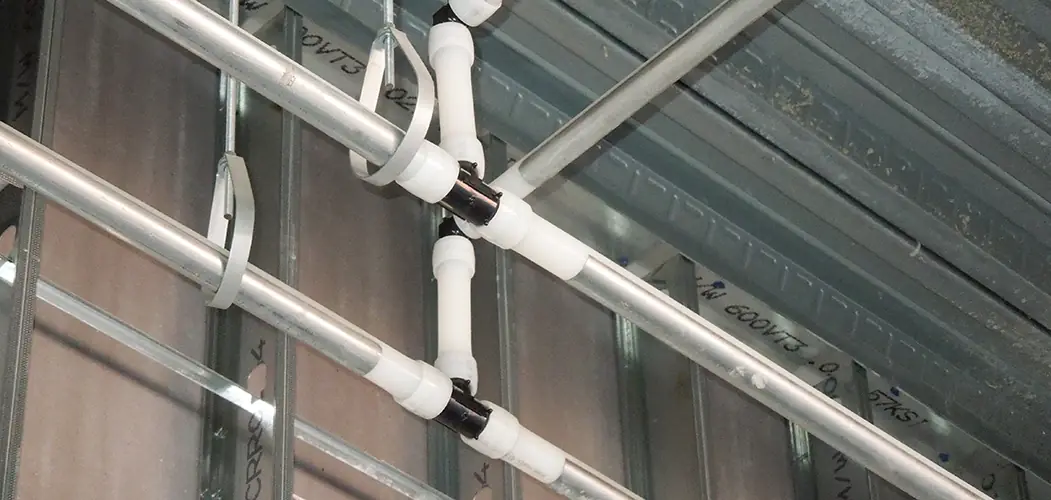
Trunk and branch (T&B) piping systems have been used by plumbers for water distribution systems for decades. PEX is available in nominal tubing sizes from 3/8 to 4 inches, so most flows can be accommodated with an all-PEX system (see Figure 1). Larger diameters are often supplied in 20-foot straight lengths and can be installed using pipe support channels that provide rigidity and prevent sagging, delivering a straight, professional-looking layout.
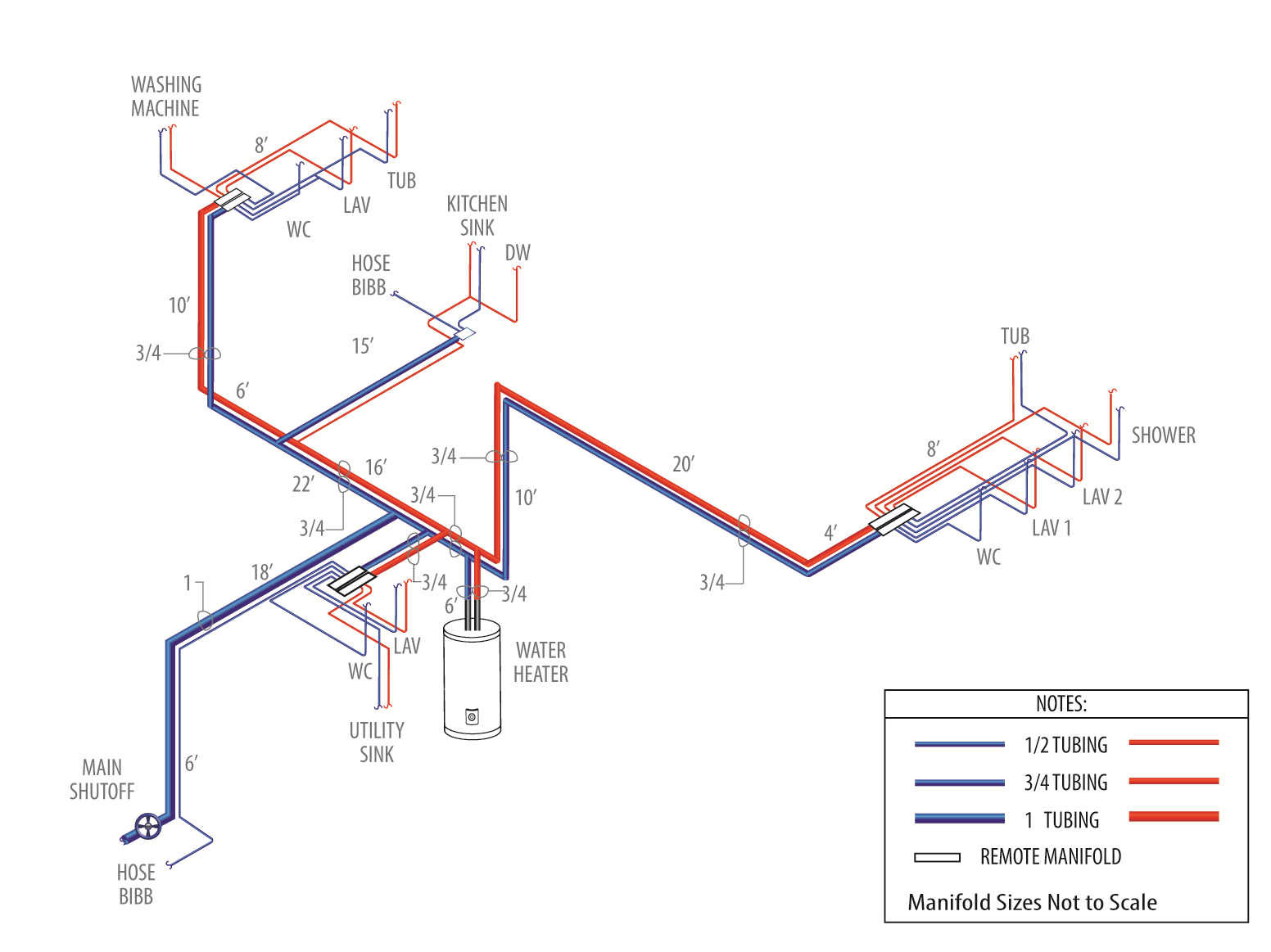
As with rigid piping systems, use of tee fittings allows for the connection of branch take-offs from the main trunk. However, unlike rigid pipe systems, elbows can be eliminated by bending the tubing to change direction. When installed with a snap-on support bend, the pressure drop through a 90-degree sweep is practically eliminated, equal only to the length of tubing within the sweep. Other deviations in piping position and direction can also be accommodated by bending the tubing.
Specific advantages of the T&B design using PEX include:
Simple system design with ability to integrate rigid materials;
Opportunities to reduce the number of fittings thanks to flexibility of the tubing.
One disadvantage: T&B layouts require the highest number of fittings, which may be costly and take time to install.
Parallel
The unique features of PEX tubing make it ideal for use in centralized manifold-type system designs, commonly referred to as parallel or home-run plumbing systems. In this layout, each fixture is supplied with a dedicated line that runs directly from central hot- and cold-water manifolds. Manifolds may be installed in any orientation.
In commercial buildings such as apartments or hotels, a central manifold may be installed in each unit, supplied by hot and cold headers running down the hallway. Because most, if not all, inline fittings are eliminated in parallel plumbing, pressure drop is minimized, potentially allowing the tubing size to be reduced for certain fixtures.
For example, depending on the hydraulic calculations and code allowance, nominal 3/8 tubing may be used for lower flow fixtures, with nominal ½ tubing recommended for longer lengths and higher flow fixtures.
The parallel system, also referred to as “home-run” because of its similarity to home-run electrical wiring, often provides more consistent pressure when flowing water to multiple fixtures, since each fixture has its own dedicated supply line. Smaller diameter tubing can result in quicker delivery of hot water from the water heater because there is less volume of water to be flushed. Reducing the amount of stagnant water in pipes also has the potential to improve water quality.
Specific advantages of the parallel design include:
Smaller diameter tubing supplying each fixture;
Quicker delivery of hot and cold water to fixtures;
Ability to isolate individual fixtures from a central manifold;
A more stable pressure to each fixture when operating simultaneous fixtures;
Opportunity to eliminate most or all fittings between the manifold and the fixture.
A disadvantage of parallel layouts is that they require the highest amount of tubing, which may necessitate more penetrations through structures and take more time to install.
Zoned
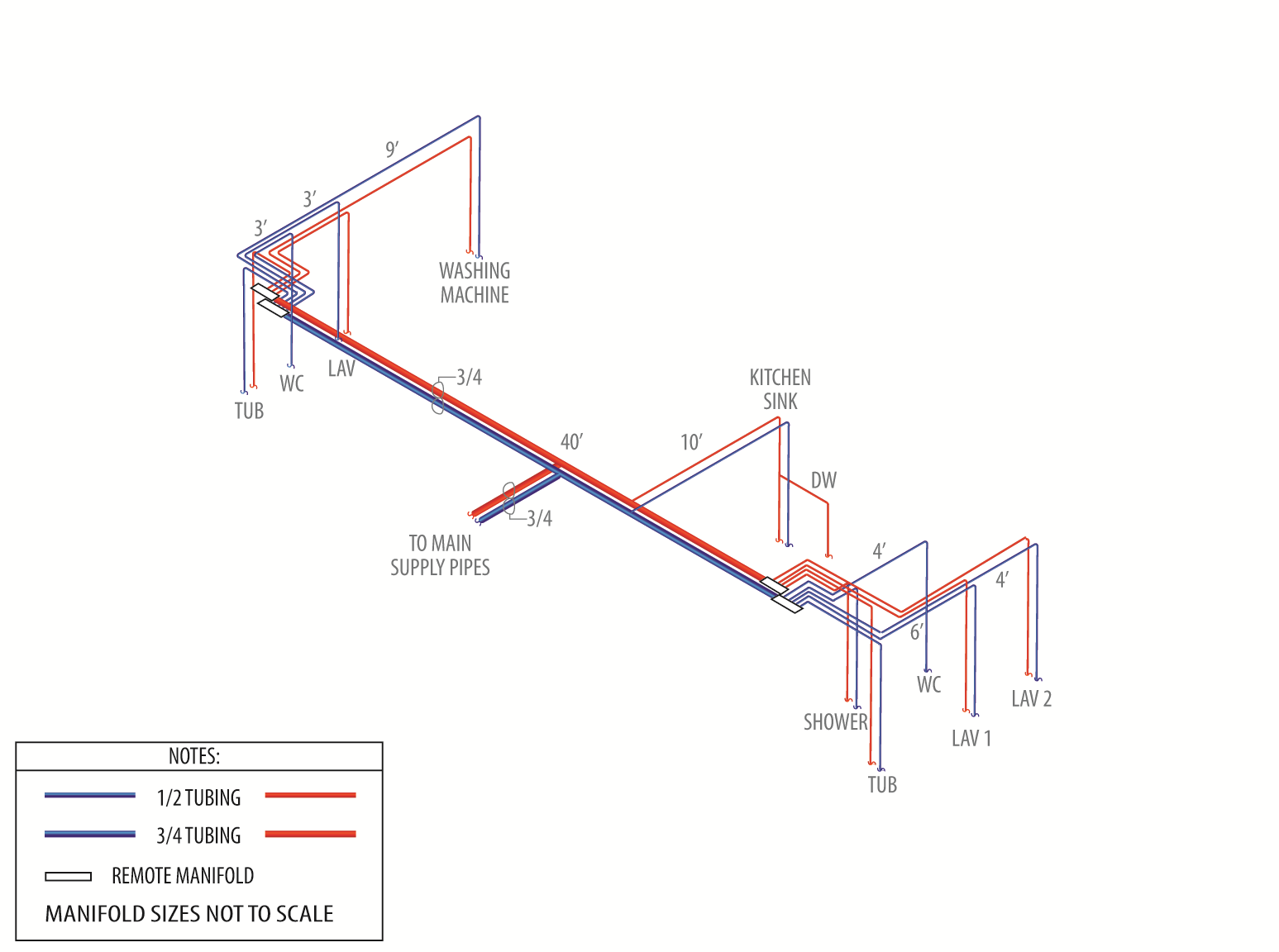
The zoned system layout is the third method for installing PEX systems, combining elements of the first two systems. Its basic approach runs hot and cold trunk lines to locations near multiple fixtures, such as a kitchen or bathroom group.
At this point, a small manifold or multi-port tee is installed on each trunk line, and individual branch lines, typically ½-inch tubing, are then run to each fixture.
The remote manifolds are basically multi-port tees and typically do not have valves, unlike the centralized manifolds used in parallel plumbing. These manifolds are available in flow-through or closed-end styles to optimize integration of fittings into one component.
The zoned system combines advantages of the T&B layout and the parallel layout and simplifies installation due to the reduced number of fittings and joints required. This layout uses far less tubing than parallel plumbing, with fewer penetrations through studs, joists, etc.
Specific features and advantages of the zoned plumbing layout include:
Opportunities to reduce the number of fittings installed;
Easier to implement hot-water recirculation than with parallel layouts;
Simple system design conversion from rigid piping to flexible PEX tubing.
A disadvantage of zoned layouts is that the trunk lines hold just as much water as a T&B system, so the same volume of water must be flushed when opening a hot-water fixture.
Hybrid piping
While an all-PEX system is possible for most buildings, some larger commercial plumbing systems integrate rigid pipes such as CPVC, polypropylene or copper for the larger mains (i.e., above 2 inch) with PEX for the smaller lines and branches.
This type of hybrid material approach can optimize resources while reducing installation time by using the flexibility of smaller diameter PEX and home-running coiled pipes to fixtures while eliminating most fittings and joints.
Selecting optimal layouts
Selecting among the three layout options often involves a balance of the key factors, since each project, installer and circumstance is different.
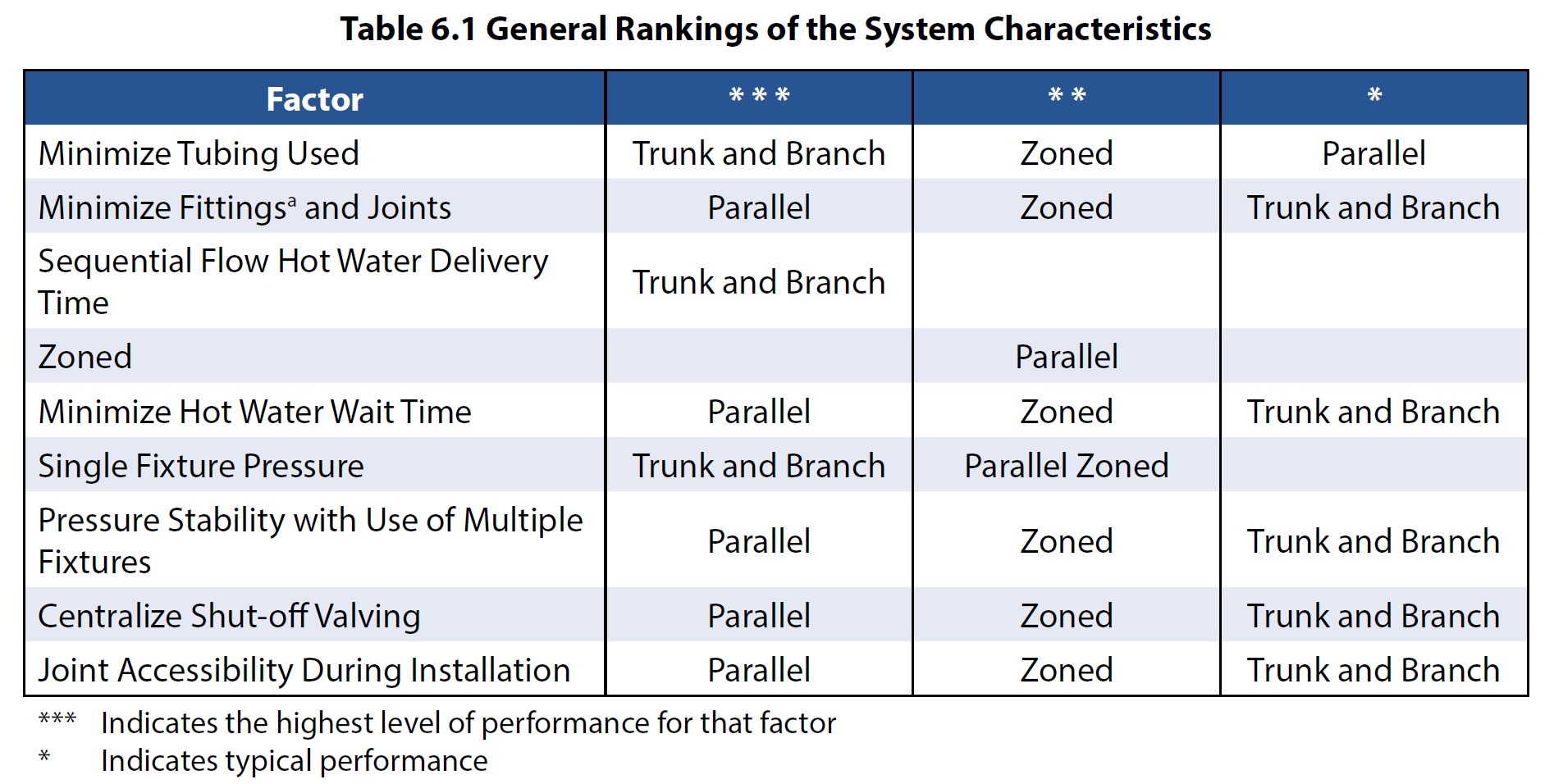
The general characteristics of the three major layout options are ranked in Table 6.1 of the guide (see Figure 3). The best way to use this table is to establish the relative priority of key factors and then use the rankings of system designs to provide a starting point for the system to be selected. Three stars indicates highest performance for each category.
For example, if a user determines that their top three factors are minimizing fittings and joints, centralized shut-off valving, and pressure stability with use of multiple fixtures, then—because the parallel system ranks at the top of all three—it is a logical place to start.
Important installation requirements
Chapter 9 of the new guide is all about installation methods for PEX and includes important tips to install PEX systems successfully. Designers should also be aware of these installation do’s and don’ts.
PEX tubing remains flexible and can still be bent at temperatures as low as -40 F. The free (unsupported) bending radius for PEX tubing, measured at the mid-point of the bend, should be no tighter than six times the outside diameter of the tubing, unless otherwise specified by the PEX manufacturer. Table 9.1 from the guide lists the minimum bend radius for each diameter (see Figure 4).
The typical rate of linear or longitudinal expansion of PEX tubing is 1.1 inches per 10 F per 100 feet length. For example, a 100-foot long section of PEX tubing that undergoes a temperature increase from 70 F to 120 F (a 50 F temperature increase) will see linear expansion of 1.1 x 5, which equals 5.5 inches.
For nominal tubing size (NTS) of 1 and smaller, temperature changes in typical plumbing systems are usually accommodated by the tubing’s flexibility and its ability to bend to accommodate expansion and contraction. It is recommended to allow 1/8 inch of slack per foot of installed tubing to allow for contraction when tubing cools. When the tubing gets warmer, it will simply expand within the available space.
Expansion loops and offsets can also be used to accommodate high rates of tubing expansion and contraction when needed for smaller diameters. Larger PEX diameters (e.g., NTS 1 or larger) are not as flexible, so when installed as hot-water lines, expansion loops, arms or legs may be needed to accommodate longitudinal thermal expansion.
This information in this article is included in Chapters 6 and 9 of the new PEX Plumbing Guide, available as a free download at plasticpipe.org/buildingconstruction.