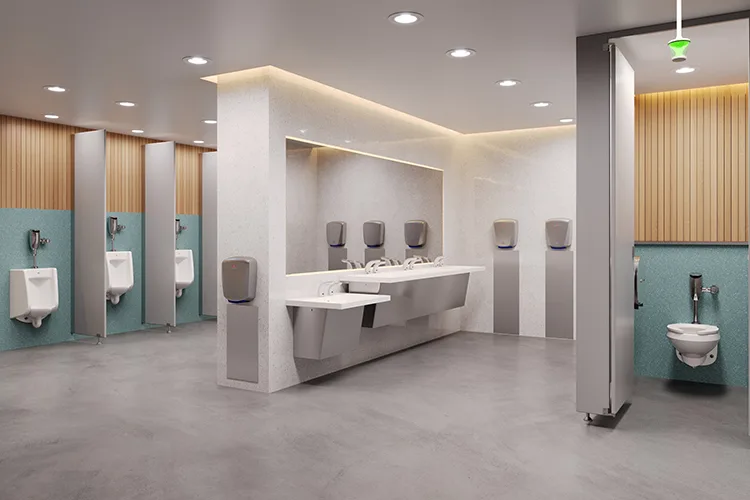
For many building owners and occupants, touchless plumbing technology is already part of everyday life. Sensor-operated faucets, automatic flush valves, hands-free bottle-filling stations and touchless hand dryers are commonplace in schools, airports, health care facilities, office buildings and entertainment venues.
But the value of touchless products goes far beyond hygiene and convenience. In many buildings, they also help conserve water, reduce maintenance demands and give facility teams better insight into day-to-day operations.
As the technology has improved, installers, building owners and facility managers are asking a different question: What additional value can it deliver? Reliability, sustainability and connectivity are reshaping how facility owners, managers and end-users think about plumbing infrastructure.
Reliability: The new baseline
Manufacturers of the first generation of touchless products heard the criticism — sensors occasionally failed to detect users, products sometimes activated unintentionally and maintenance was more complicated. Some facility operators reverted to traditional manual fixtures.
Today, manufacturers say those concerns have largely been addressed through advances in sensor technology, power systems and mechanical design.
“The obvious benefit is cleanliness and mitigation of spreading germs by eliminating the need to touch a handle to flush a toilet or wash hands,” says Eric Byrd, senior manager of connected customer success at Zurn Elkay Water Solutions. “End-users prefer touchless in most applications, and we see that in our consumer feedback and customer satisfaction reviews.”
“Accuracy, reliability and serviceability of sensor products will always be areas of concern that we continue to work on improving,” adds Mathias Bullmer, director of product management for Zurn Elkay’s finish plumbing business. “These are paramount as we continue to innovate, whether it’s our Hydro•X technology that generates renewable energy from water flow or our EZ Gear technology, a solenoid-free, gear-driven ceramic cartridge that resists debris and buildup to reduce service needs.”
Sustainability: Beyond water savings
Once users trust the fixtures to work, building owners focus on how much water, waste and labor they can help reduce. Visibility into what is happening inside the building helps conserve resources, improve efficiency and reduce operating costs.
“Facility owners and managers are taking a lot of variables into consideration: baselining restroom usage and water consumption, product health, waste and labor costs to service and maintain,” Byrd adds.
“Touchless technology prevents waste from valves left on or handles broken off,” Bullmer explains. “With manual products, building operators can lose hundreds of gallons of water before even knowing a valve is open. Building safeguards into the sensor electronics also reduces other preventable risks, like flood damage.”
Bullmer pointed to additional sustainability elements that make Zurn’s Hydro•X technology distinctive.
“Sustainable hydropower for hands-free plumbing devices simply makes sense,” he says. “By harnessing water flow, we can eliminate battery replacements for the life of the restroom, which in turn reduces landfill waste from batteries, minimizes maintenance costs and ensures reliable hands-free operation regardless of usage. All this plus avoiding the upfront cost of hardwired electrical infrastructure, so it’s as easy to install as it is to maintain.”
The sustainability benefits extend beyond faucets and flush valves. Hands-free bottle-filling stations encourage reusable bottles, reduce reliance on single-use plastics and support cleaner drinking water access in public spaces. Touchless hand dryers eliminate paper towel waste and reduce maintenance tied to replenishment and disposal.
As touchless technologies continue to evolve, manufacturers say creating a framework that allows connected products to work together will help facilities better manage water, waste and labor.
Connectivity: Smart buildings, smarter building managers
The next era for touchless technology is not just hands-free operation. It is information. Increasingly, these products serve as data-collection points that help facility managers understand how buildings operate.
Historically, plumbing infrastructure was largely invisible until something broke. Today, sensor-based systems can provide information about usage patterns, water consumption, maintenance requirements and system health.
Bullmer says many facility owners remain unaware of how much value these capabilities can unlock.
“Water savings and increasing hygiene levels for customers are the primary benefit,” he adds, “but involving electronics allows for other technologies to be integrated into the unit, such as IoT technology that allows for predictive maintenance, tracking high-use areas, flagging product failures that need immediate attention or programming auto-flush cycles to reduce Legionella risk.”
Connected plumbing is increasingly entering the same conversations as HVAC, lighting and other smart-building systems. Byrd says Zurn Elkay’s connected plumbing technologies provide facility teams with information on usage, maintenance needs, water consumption and operational performance at a critical time.
“Whether due to a shortage of plumbers and maintenance engineers or budget limitations, customers are managing their buildings with skeleton crews,” Byrd explains. “Technology is one of the only ways to solve this. By increasing the amount of real data available, building managers can move from reactive to proactive and better manage their teams’ workloads.”
Touchless systems can provide alerts before failures occur, identify abnormal usage patterns and help prioritize maintenance resources where they are needed most.
“In an environment where labor remains scarce and operating budgets remain tight, those insights can make a real difference,” Byrd says.
“Integrating IoT technology seamlessly into touchless products empowers managers with knowledge on how often the product is used, how long it’s used for and how the product performs overall,” Bullmer adds. “Touchless technology is the enabler for all things IoT.”
Unexpected benefits
In some cases, the most useful insights are the ones no one anticipated. Byrd recalled an example from a university customer using plumbSMART, Zurn Elkay’s connected plumbing platform.
“They saw restroom usage data in their library in the middle of the night, well after the library had closed,” he says. “After a few consecutive nights recording this data, they sent security to investigate and found an unhoused individual had been secretly sleeping in the library after hours. Security cameras and alarms didn’t catch him; flushing the toilet did.”
Data from touchless systems can help more than maintenance teams. It can contribute to cleaning schedules, security reviews, sustainability tracking and space planning. As plumbing infrastructure becomes more connected, the value extends well beyond the fixture itself.
The ceiling has yet to be reached
Despite the widespread adoption of sensor-operated products, both Bullmer and Byrd said touchless technology still has considerable room to grow.
“Given how many customers still rely on manually operated fixtures, touchless technology still needs to win over some skeptics,” Bullmer says. “Listening to and understanding these customers’ concerns helps us shape a better platform to address those issues and move them to a solution that works better for the end user, owner and facility manager alike.”
As facilities become smarter and more connected, touchless technology may be defined less by sensors and more by intelligence.
“We do have a great foundation of touchless plumbing products, but with technology, there never really is a ceiling,” Byrd says. “I feel with AI we can really uncover more opportunities to provide value with touchless technology.”
Touchless plumbing started with a simple promise: fewer hands on shared surfaces. Today, it is also helping buildings use less water, waste less material and give facility teams better information. For owners and operators looking beyond hygiene benefits, reliability, sustainability and connectivity are increasingly intertwined — and increasingly important.
With more than 25 years of experience in corporate communications, Kevin Shermach has been a comms leader for Zurn Elkay Water Solutions since 2022. Based at the company’s headquarters in Milwaukee, Shermach leads internal and external communications and manages the copywriting function of the company’s marketing efforts.