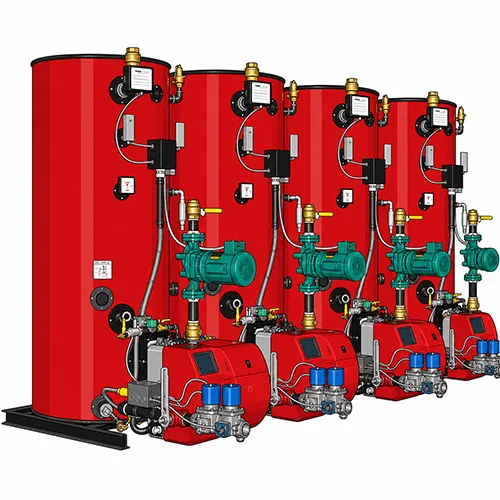
The first modular boiler room I walked into had four small boilers. My immediate reaction was, “Why would anyone buy four boilers when two larger ones would do the same job?” Thirty years later, after designing, selling and servicing modular boiler systems, I’ve learned the answer: four smaller boilers can often outperform two larger boilers in efficiency, reliability, installation cost and long-term operating savings.
When I started in the industry, it was common to see a single boiler serving an entire commercial building. During the shoulder seasons of spring and fall, that boiler would cycle on and off like a chandelier in the hands of a toddler discovering a light switch. If it failed, usually on a Friday afternoon around 3 p.m., the building owner and service contractor scrambled to locate parts and restore heat.
To reduce the risk of a total no-heat call, designers began installing two boilers instead of one, providing redundancy. The next question was how much backup capacity was needed. Locally, most designers sized each boiler between 66% and 75% of the building’s peak heating load, with most leaning toward 75%. If one boiler failed, the building would still have heat. It might not maintain full comfort on the coldest day of the year, but it wouldn’t freeze.
While this improved reliability, it created a significant new problem. By sizing each boiler at roughly two-thirds to three-quarters of the peak load, the plant became 32% to 50% oversized overall. This oversizing extended to the gas piping, venting systems, electrical service, pumps, expansion tank and combustion air openings. As outdoor temperatures rose and the building load decreased, the degree of oversizing became even more pronounced.
Let’s compare two approaches for a building with a heat loss of 2,000,000 BTUH.
Option 1: Two boilers at 75%: Each boiler must provide 1,500,000 BTUH output. Assuming 83% efficiency:
Boiler input = 1,807,000 BTUH each
Total plant input = 3,614,000 BTUH
Option 2: Four boilers at 25%: Each boiler provides 500,000 BTUH output. Assuming 83% efficiency:
Boiler input = 602,000 BTUH each
Total plant input = 2,408,000 BTUH
The four-boiler plant requires roughly one-third less total input capacity while still providing 75% backup capacity if one boiler is down.
Reliability through redundancy
One of the greatest advantages of modular systems is layered redundancy. In a four-boiler plant, if one unit fails, 75% of the heating capacity remains available. If two boilers are down, the building can often continue operating at reduced capacity.
In a two-boiler plant, the loss of one unit immediately cuts the heating plant in half. For schools, hospitals, nursing homes, manufacturing facilities and other critical buildings, this additional redundancy is invaluable. For service technicians, modular plants often mean fewer true no-heat emergencies:
Superior part-load efficiency: Most heating systems operate at design conditions only a few days each year. For the other 95% to 98% of the heating season, the building requires far less heat. This is where modular systems truly shine.
Beyond redundancy, modular boilers excel at part-load conditions. A traditional two-boiler plant often operates at low fire and cycles frequently during shoulder seasons. Frequent cycling increases wear, wastes fuel and shortens equipment life. Modular systems stage boilers on and off as needed, closely matching the actual building load. Each operating boiler runs nearer to its most efficient firing rate, greatly reducing short cycling.
Turndown ratio provides another clear advantage:
Two boilers with a 5:1 turndown ratio deliver an effective plant turndown of 10:1.
Four boilers with a 3:1 turndown ratio deliver an effective plant turndown of 12:1.
That 20% improvement allows the heating plant to track changing loads more accurately, reducing fuel consumption, emissions and standby losses. The low fire capacity of one of the four boilers would be 165,000 BTUs, while the two-boiler plant’s low fire capacity would be 300,000 BTUs. The result: The smaller boiler would run longer, providing better seasonal efficiency, reduced cycling and more accurate tracking of the required water temperature.
Easier installation: A 1,800,000-BTUH boiler often requires rigging, wall removal, special lifting equipment and significant labor. Four smaller boilers can usually be moved through standard doorways. In retrofit projects, this makes installation simpler, faster and less expensive.
Easier maintenance and longer equipment life: With modular systems, one boiler can be serviced while the others continue operating. Maintenance can be scheduled during normal working hours instead of on overtime. Smaller boilers are generally easier to service and use readily available components.
Reduced cycling also extends equipment life. Only the lead boiler may operate during light-load conditions, reducing thermal stress on heat exchangers, burners, controls and refractory materials. Modern control systems automatically rotate lead-lag operation, distributing wear evenly across all units.
Smaller footprint and greater flexibility: Large boilers consume valuable mechanical room space. Many fire-tube boilers require additional clearance for tube removal, often equaling the boiler’s own footprint. Modular systems can be arranged side-by-side or configured to fit challenging spaces. Individual boilers can often be replaced through a standard doorway without major demolition. They also integrate well with condensing boilers, water-source heat pumps and hybrid heating systems.
A real-world observation
Over the past three decades, I have sold numerous modular boiler systems for schools, commercial buildings and institutional facilities. Many owners were initially skeptical. After the first heating season, however, most became believers. They appreciated the lower fuel bills, the simplicity of servicing individual boilers and the peace of mind that a single failure would not shut down the entire heating plant.
In my experience, fuel savings of 15% to 25%, compared to traditional two-boiler systems, are not uncommon when the systems are properly designed and controlled.
However, no system is perfect. Modular installations may involve:
Higher initial equipment costs.
Additional piping and controls.
More individual components to maintain.
Greater dependence on proper staging controls.
Lower heating capacity if the outdoor temperatures are below the design temperature for an extended time.
Poor system design can eliminate many of modular boilers’ advantages. Nonetheless, in most commercial and institutional applications with varying loads, the long-term benefits far outweigh the drawbacks.
The purpose of a boiler plant isn’t simply to produce heat. It’s to provide reliable, efficient and economical heat every day of the heating season. Modular boiler systems accomplish that goal exceptionally well. They deliver redundancy, superior part-load efficiency, easier maintenance, installation flexibility and lower operating costs. It’s why many engineers today aren’t asking, “Why use four boilers instead of two?” They’re asking, “Why wouldn’t you?”




