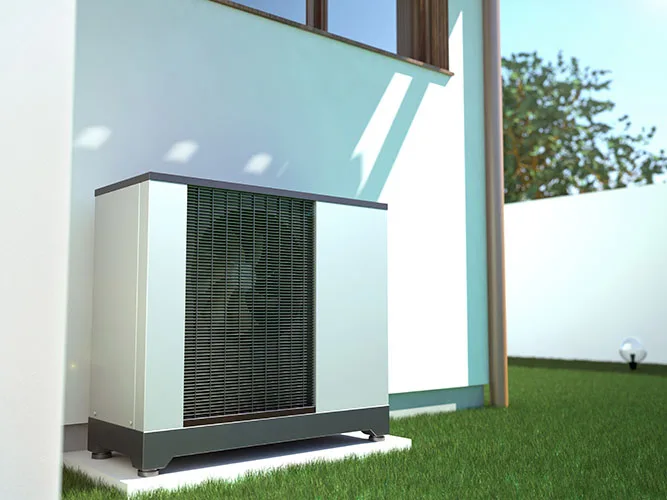
Ever notice how each player in a football game has a different specialty? The coach doesn’t want the quarterback kicking field goals or the punter throwing passes. Each one performs best in a specific role suited to his expertise. That’s exactly the idea behind a hybrid heating system, pairing an air-to-water heat pump with a traditional boiler to heat a hydronic (hot-water) loop. The heat pump handles the lighter loads efficiently, while the boiler steps in during the deepest cold snaps. The result? Dramatically lower energy bills, reduced emissions, longer equipment life and built-in backup heat.
For more than a century, most hydronic heating systems were designed using 180 F supply water on the coldest design day of the year. The return water temperature is typically 20 to 30 degrees lower. That’s where a boiler shines; it can do that all day long.
However, most heating systems only need the maximum water temperature during a small percentage of the season, around 2% of the time. In my area of Pittsburgh, we have about 4,000 heating hours per year. Two percent would equal 80 hours per year when the temperature is at or below the design temperature. On milder days, the building’s heat loss drops significantly.
If the system continues delivering 180 F water when the building can be heated using 140 F, the boiler may short-cycle, reducing efficiency and increasing wear and breakdowns.
That’s where outdoor reset controls come in. These smart controls lower the supply water temperature as the outside air warms up. A common reset schedule is a 1-to-1 ratio: for every degree the outdoor temperature rises, the loop temperature drops one degree.
For example, if your system was designed using 180 F at the design outdoor temperature of 0 F, the reset curve might drop the supply to 170 F at 10 F outdoors, 160 F at 20 F, and so on. This single change can dramatically reduce boiler cycling and improve seasonal efficiency.
Now consider how an air-to-water heat pump operates. Instead of burning fuel, it transfers heat from outdoor air into the hydronic loop using a refrigeration cycle. Its efficiency is measured by the Coefficient of Performance (COP), often 3.0 or higher in mild weather. This means it delivers three units of heat for every unit of electricity used.
As outdoor temperatures drop, both the available heat and the COP decrease. Most air-to-water heat pumps deliver good performance up to about 140 F supply-water temperature. Beyond that, capacity and efficiency fall off sharply. Cold-climate models are improving, but even they benefit from a partner on the coldest days.
So, what happens when the building needs 180 F water during a January cold snap?
This is where the boiler steps up. Think of it like a relay race. The heat pump starts the race, efficiently heating the loop up to around 140 F. At that point, the baton is passed to the boiler, which heats the loop from 140 F up to the 180 F the emitters need. As the weather warms and the required loop temperature drops, the boiler hands the baton back to the heat pump, providing a synergistic heating combination.
This strategy allows each heat source to stay in its wheelhouse. The heat pump handles shoulder season weather and lower water temperatures efficiently. The boiler manages peak demand and extreme cold.
Hybrid systems are especially attractive in existing buildings with radiators, convectors or baseboard systems. Replacing all emitters to run ultra-low temperatures can be expensive. A hybrid approach often allows owners to keep much of the existing system while reducing fuel consumption.
Controls are critical to success
A properly designed control package may switch lead and lag between heat pump and boiler operation based on:
- Outdoor air temperature;
- Required supply water temperature;
- Utility electric rates;
- Runtime balancing;
- Occupancy schedules.
For example, the heat pump may remain the lead heating source until the outdoor temperature drops below a selected balance point. Then the boiler becomes the lead and the heat pump the lag.
Another major advantage of the hybrid partnership is redundancy.
If the heat pump is offline for service, the boiler can continue heating the building. If the boiler requires maintenance, the heat pump may still cover part of the load during milder weather. Building owners appreciate backup options.
Condensing or noncondensing boilers?
This decision requires some thought. Condensing boilers condense only when the water temperature is low enough to sustain flue gas condensation, right at the peak of heat pump efficiency. You have the quarterback kicking field goals. In the area where the boiler is needed most, condensing boilers aren’t condensing; they are about 85% to 88% efficient.
Conversely, when the heat pump is offline for service, a noncondensing boiler will short-cycle. The condensing boiler will cycle less as it will match the heat load.
We have all seen buildings with oversized heating systems, especially older ones. If insulation, windows and air sealing are upgraded, the heating load drops. Existing radiators or baseboards often become effectively oversized. In most cases, they were oversized initially. This means the same building may now heat comfortably with lower water temperatures.
A practical test is to gradually lower the supply temperature on mild days and observe comfort. If the building still maintains setpoint, the reset curve may be reduced, confirming the heat emitters are oversized.
For example, if you expect to need 153 F water at 32 F outdoor temperature, but the building heats fine at 143 F, the entire reset schedule may be adjusted downward. This creates a larger operating window for the heat pump and lower heating costs. Lower required water temperatures favor the heat pump and reduce boiler runtime.
Hybrid heating is not one-size-fits-all. Utility rates, climate, emitter capacity, controls and installation quality all matter. However, in many buildings, the question is no longer heat pump or boiler. A better question may be, why not both? When designed correctly, a hybrid system lets each technology do what it does best.




