
On July 1, 1976, President Gerald Ford dedicated the Smithsonian’s National Air and Space Museum as “a perfect birthday present from the American people to themselves.” More than 1 million visitors passed through its doors in the first six weeks.
Five decades and over 350 million visitors later, the building is receiving a gift of its own: the most expansive modernization in Smithsonian history, timed to coincide with both the museum’s 50th anniversary and the United States’ 250th.
The numbers tell part of the story: nearly $1 billion in total project cost; 687,000 square feet of renovated exhibition, theater, office and support space; 20 new or redesigned galleries; and millions of new annual visitors.
However, for plumbing engineers, the most telling figures offer a different perspective: approximately 20 miles of new piping installed throughout the building; two 100,000-gallon underground cisterns capturing rainwater from nearly four acres of roof and non-pedestrian spaces; and a complete replacement of every potable, non-potable, sanitary and storm system — all in a building that has remained open to the public throughout most of its renovation.
Since 2013, Mueller Associates has provided mechanical, electrical and plumbing (MEP) engineering services for the museum’s renovation, working alongside the architects at Quinn Evans and construction manager CSC (a joint venture of Clark Construction, Smoot Construction and Consigli Construction).
The plumbing scope of this project is one of the most consequential in the Smithsonian’s portfolio — not just for its scale, but for what it represents: a fundamental rethinking of how a major cultural institution manages water.
Aging systems, open doors
When the National Air and Space Museum opened for the nation’s bicentennial 50 years ago, its construction had been famously fast-tracked. The building opened on time and on budget, but, as Quinn Evans’ Principal, Leora Mirvish, has noted, “It’s been paying the price ever since.”
By the early 2010s, the original plumbing systems had reached the end of their service life. Leaking pipes had become routine. The building envelope’s failures hindered humidification control, while inconsistent environmental conditions threatened the irreplaceable artifacts the museum was built to protect.
Mueller Associates had been working in the building for more than two decades, performing incremental upgrades. During that time, the firm consistently advised the Smithsonian against piecemeal solutions. Mueller’s team recommended against replacing the original steam piping, knowing that a comprehensive renovation would ultimately make steam the wrong approach.
That strategic patience paid off. In 2015, Congress allocated $650 million for the infrastructure and building renovation, and the Smithsonian raised an additional $250 million from private sources to renovate the galleries. The new MEP systems would be redesigned, while the museum remained open during nearly all of construction.
This last constraint shaped every HVAC and plumbing design decision that subsequently followed. The original project plan called for a seven-year, zone-by-zone renovation that would have kept individual galleries sequentially closed. Working with the construction team, the Smithsonian and design team refined this approach into a two-phase strategy, allowing entire sections of the building to remain open, while others were closed off.
The simplified approach trimmed a full year off the construction schedule, yet it placed unusual demands on the HVAC and plumbing engineering scope. Every system replacement had to be coordinated with temporary service arrangements that maintained continuity for the visitors on the other side of the wall.
Rainwater harvesting: From roof to reuse
The defining plumbing feature of the museum’s modernization is a rainwater harvesting system that is among the most ambitious in the Smithsonian’s inventory. The opportunity was inherent in the building’s design.
Nearly four acres of impervious roof — approximately 165,000 square feet — provides a substantial collection surface, and the architecture of the building naturally lent itself to a symmetrical system made up of east and west components. Areas such as roadways and walking paths are excluded from the harvesting system, due to the likelihood of contamination.
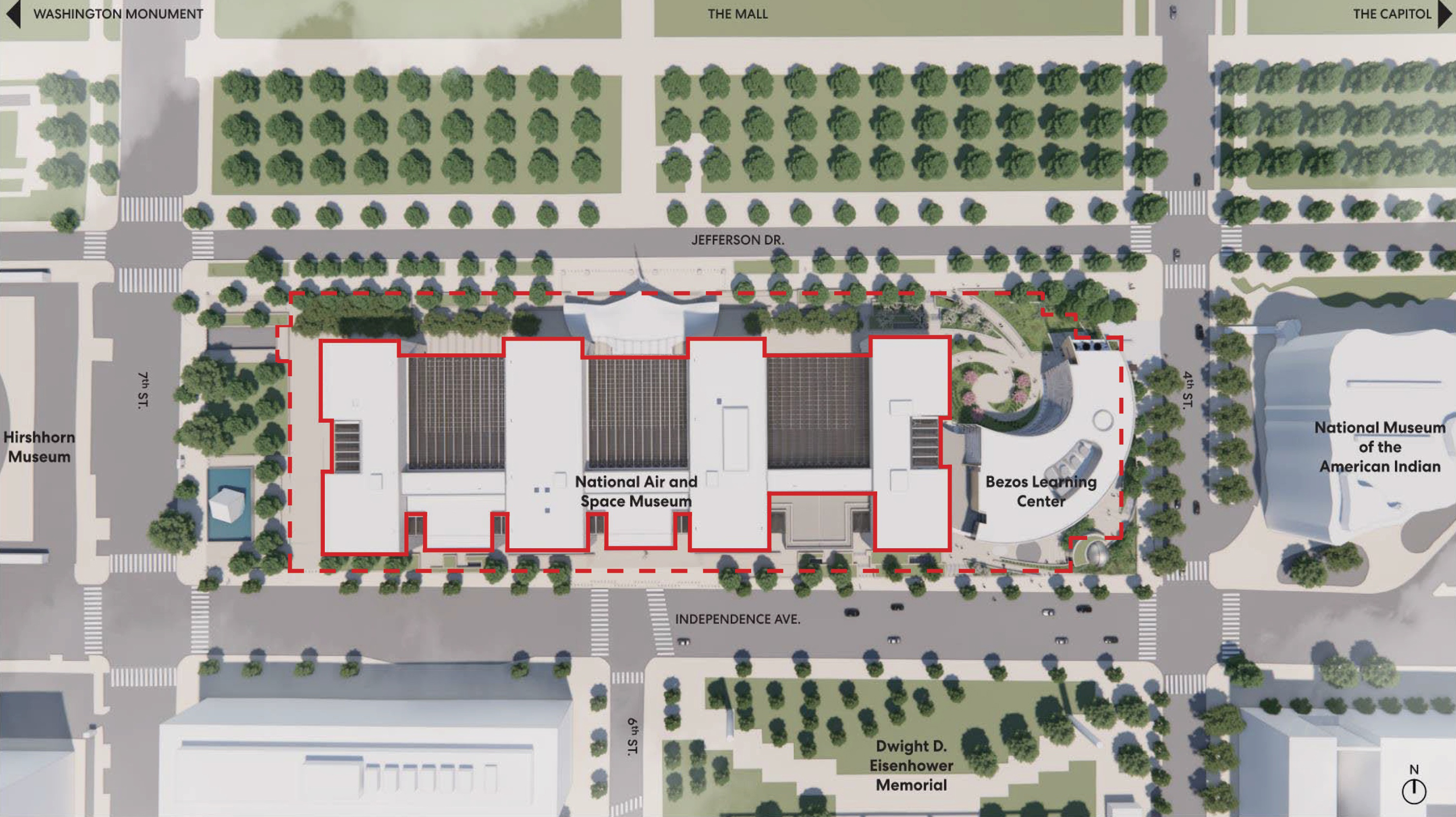
Two 100,000-gallon concrete cisterns are positioned at the eastern and western ends of the building. The west cistern is located beneath a decorative fountain at the new main entrance; the east cistern is located beneath an exterior plaza. Together, they are estimated to collect approximately 4.4 million gallons of rainwater annually (see Figure 1).
That captured water serves three uses throughout the building: irrigation of the surrounding landscape, makeup water for the cooling towers and flushing of toilets and urinals.
Rainwater harvesting at this scale requires careful integration across multiple disciplines. Roof and skylight drainage, along with condensate from the air conditioning system, is conveyed to the harvesting system.
In accordance with the Smithsonian’s facility design guidelines published during the design phase, which referenced the 2015 International Plumbing Code at the time, rainwater from occupied surfaces, such as sidewalks and pedestrian areas, is diverted to the city storm drainage system, rather than the harvesting system, which protects visitor and staff safety by preventing potentially contaminated runoff from entering the reuse loop.
The collected water is routed above ground through the basement parking garage to hydraulic separation filters that provide prefiltration, removing debris, sediment, leaves and contaminants. From there, the flitered water flows to the underground cisterns.
Duplex multistage transfer pumps within each cistern convey water to four 1,500-gallon day tanks located within a basement mechanical room. From the day tanks, the harvested water is recirculated through a self-cleaning filter and ultraviolet treatment before being routed to its end uses (see Figure 2).
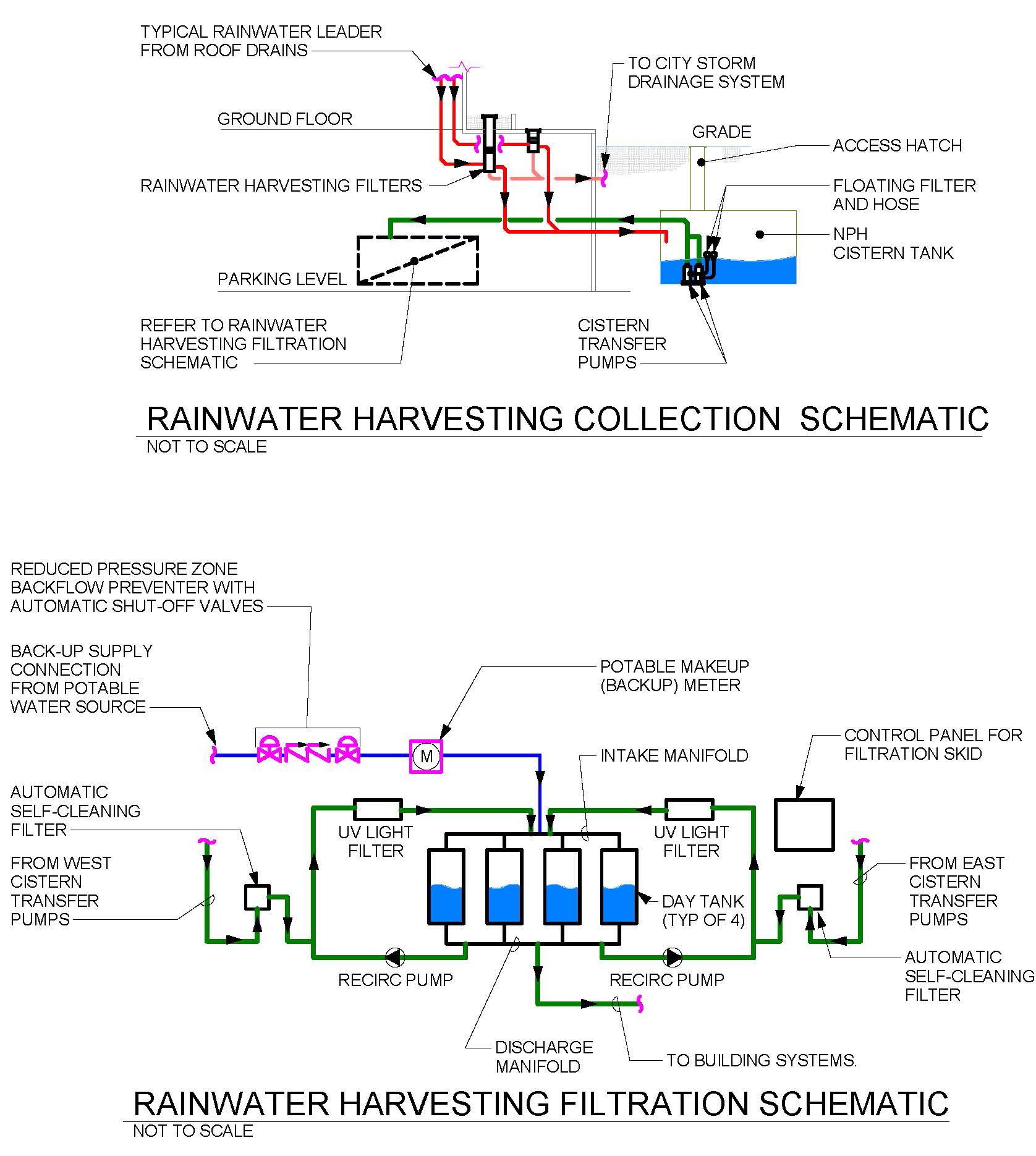
The robust filtration design eliminates the need for chlorine or harsh chemicals — an important consideration in a building where water quality affects everything from cooling tower performance to the surrounding plantings.
Distribution from the day tanks to building services is handled by quadplex booster pumps with variable frequency controllers and a hydropneumatic tank. A dedicated control panel ties the entire harvesting system to the building automation system (BAS), allowing the facility’s staff to monitor cistern levels, pump operation, filter status and consumption metrics in real time.
When rainwater is unavailable — during extended dry periods or peak demand — the system draws from the building’s potable water service as a backup. A reduced pressure zone (RPZ) backflow preventer separates the potable water distribution system from the non-potable reclaimed water, preventing any possibility of cross-contamination.
The complexity of the rainwater harvesting system illustrates why advanced building information modeling was essential to the design process. Routing the harvesting piping required coordination with structural beams, HVAC ductwork, electrical conduit and the building’s existing infrastructure that could not be relocated.
The 1.5 miles of rainwater harvesting gravity drain piping and 1.7 miles of filtered non-potable distribution piping had to efficiently share space with the building’s other systems, all while maintaining the slope requirements that gravity drainage demands.
Domestic water service: Engineering reliability
The museum’s domestic water service was completely reconfigured with two new water service entrances and associated RPZ backflow preventers replacing the existing components — one service on the north wall of the parking level and one on the south wall. Both services route through the main mechanical room.
The new RPZ backflow preventers incorporate a feature that addresses a specific failure mode: each includes an automatic shut-off valve that closes if it senses a significant amount of water being discharged through the relief chamber.
In a conventional RPZ installation, a relief chamber discharge indicates a backflow event, and the chamber between check valves is relieved to atmosphere to protect the potable water supply. In the event of a catastrophic failure, such as debris preventing a check valve from closing, the failed valve will allow a significant amount of water to vent through the atmospheric chamber. For backflow preventers of this size, this could mean hundreds of gallons per minute which may overwhelm the normal drainage in the room, affecting critical mechanical equipment.
Each automatic shut-off valve is connected to the BAS, allowing the museum’s staff to receive immediate notification of any backflow event.
A separate but related design consideration was the quality of the incoming municipal water. Sediment in the municipal mains led Mueller’s team to specify whole-building duplex bag filters in stainless steel housings, sized for 600 gpm. The duplex configuration allows automatic changeover when one filter becomes loaded, ensuring continuous water service during routine maintenance.
This filtration represents a significant departure from typical commercial water service design, but it addresses a specific local condition that would otherwise affect every downstream component, from fixture sensors to humidifier elements.
A triplex domestic water booster-pump system in the main mechanical room provides pressure to the building’s fixtures and equipment. The system includes variable frequency controllers, a hydropneumatic tank, piping headers and a control panel with BAS interface. The booster pumps serve a wide range of demands: sinks, showers, electric water coolers, mechanical system makeup, the domestic hot water (DHW) system, and the rainwater harvesting system backup supply, when needed.
Building water meters in each service main with valved bypasses for maintenance are monitored by the BAS. Separate meters track water usage for each mechanical system makeup connection and the rainwater harvesting system, providing the granular data necessary for both efficiency analysis and accurate use monitoring.
Miles of pipe in a working museum
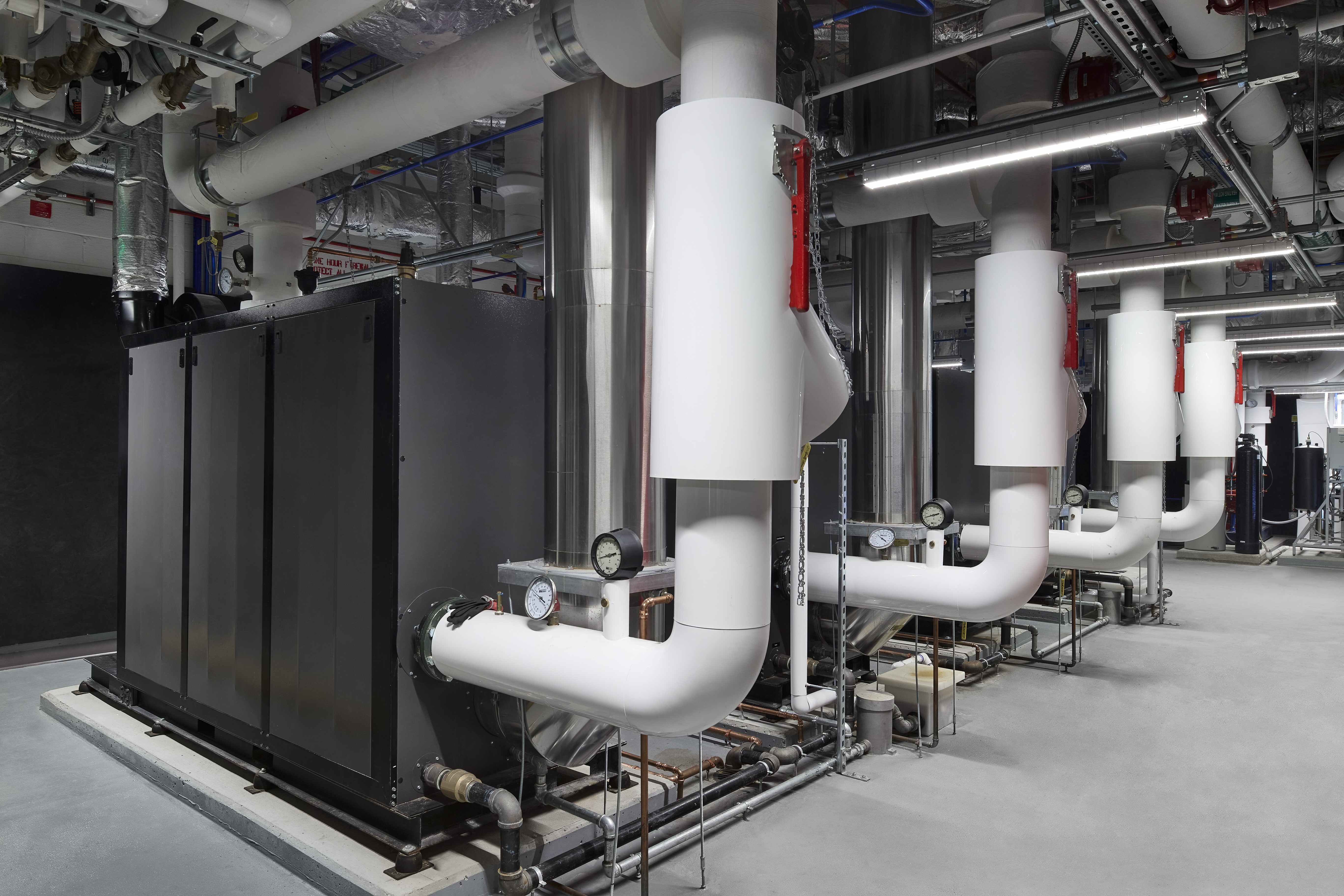
In addition to the rainwater harvesting and domestic water service, new condensing natural gas-fired water heaters serve the DHW system. Reverse osmosis water is provided for humidifier makeup, ensuring that mineral content in the source water does not affect humidification equipment or the precise humidity levels the galleries require. Compressed air systems serve select exhibits, supporting the interactive installations that have become essential to contemporary museum experiences. In total, the plumbing scope encompasses:
3.1 miles of cold-water pipe
1.1 miles of hot-water pipe
0.8 miles of hot-water recirculation pipe
2.9 miles of sanitary-gravity drainage pipe
3.8 miles of primary stormwater pipe
1.3 miles of secondary stormwater pipe
1.7 miles of vent pipe
1.5 miles of rainwater harvesting gravity drain pipe
1.2 miles of non-potable harvested pipe
Add the condensate drains, the natural gas distribution, and the smaller specialty systems, and the total approaches approximately 20 miles of piping.
Installing that volume of piping in an occupied building required engineering decisions that extend beyond conventional design. Every system had to be replaced in coordination with temporary service arrangements that maintained continuity on the public side of the construction barriers. Sequencing demolition and installation required close coordination between Mueller’s plumbing engineers, the construction team and the museum’s operations staff.
DHW: Matching the source to the demand
DHW generation for the museum matches the heating source to the demand it serves. Rather than relying on a single centralized approach, Mueller’s design pairs high-efficiency condensing storage water heaters with point-of-use electric tankless water heaters, deploying each where it makes the most engineering sense.
Natural gas-fired condensing storage water heaters serve the building’s primary domestic hot water demand. Condensing technology extracts additional heat from the combustion process that non-condensing water heaters waste through the flue, achieving efficiencies that conventional equipment cannot match.
The storage configuration allows the system to meet the variable draw patterns of a building serving millions of annual visitors — handling the peaks of restroom and food service demand while maintaining the reserve capacity that a facility of this scale requires.
Where DHW demand is isolated, intermittent or located far from the central plant, point-of-use electric tankless water heaters provide a more efficient solution. Routing recirculated hot water across the full 687,000-square-foot building to serve a remote fixture would mean continuous temperature losses through long piping runs — energy expended to keep water hot in pipes that may be used only occasionally.
By generating hot water on demand, directly at the point of use, the tankless units eliminate those distribution losses entirely. The result is a hybrid DHW system that minimizes both energy consumption and the miles of recirculation piping the building would otherwise require.
Integrated engineering: When plumbing meets HVAC
The museum’s plumbing systems do not operate in isolation. The cooling plant integration illustrates how the boundaries between plumbing and mechanical engineering blur in projects of this complexity.
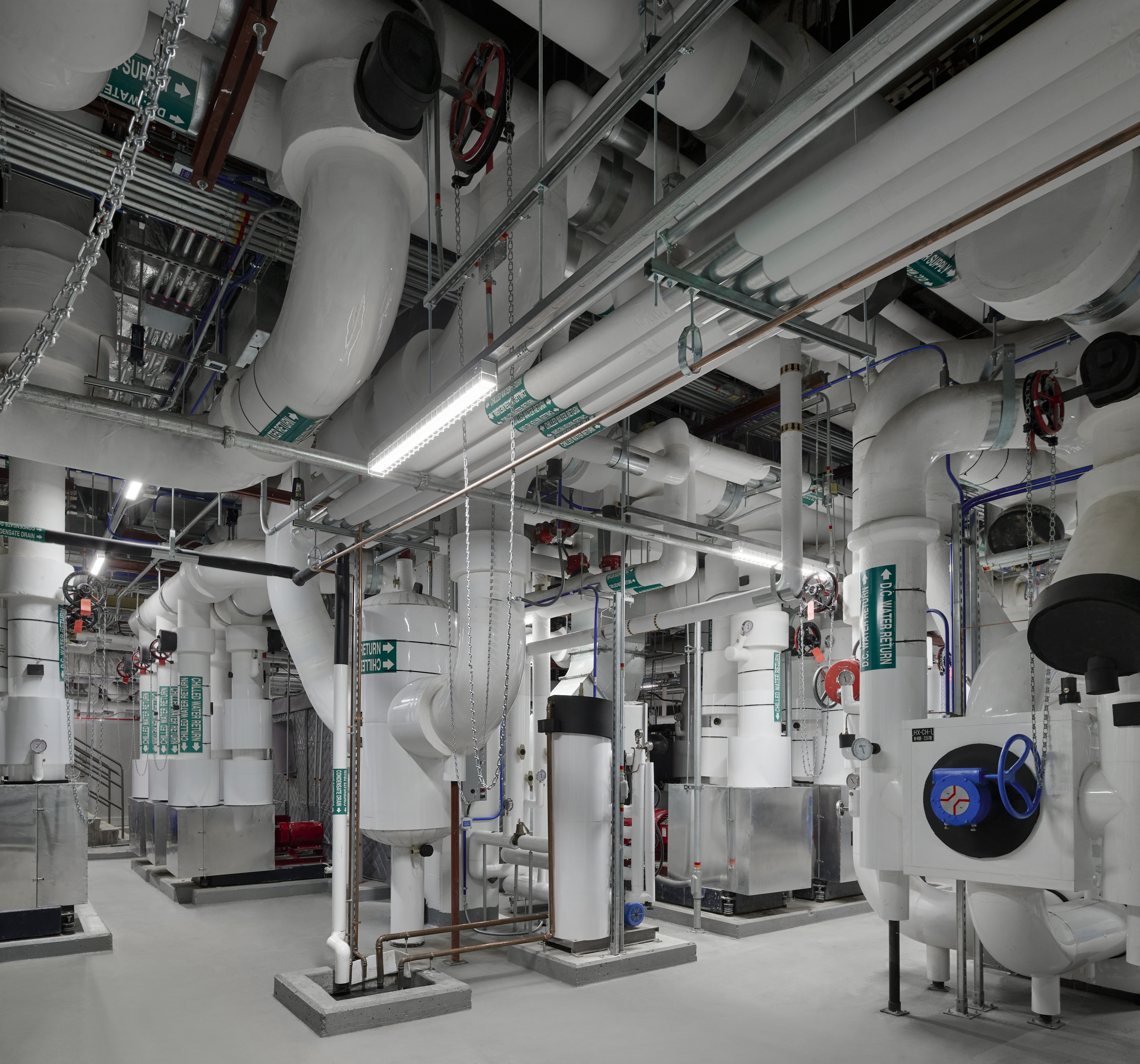
Mueller’s cooling plant design combines a variable-speed high-efficiency centrifugal chiller, a dedicated heat recovery rotary chiller, and the General Services Administration (GSA) chilled water service. Although the on-site chiller plant capacity is only half of the building’s peak load, it provides more than 80% of the annual chilled water capacity. GSA service handles peak demand when needed.
The dedicated heat recovery chiller (DHRC) supplies approximately 85% of the building’s annual heating energy. The DHRC is the system’s most distinctive component, addressing four engineering challenges with a single piece of equipment:
Eliminates the need for boiler operation during summer cooling;
Eliminates the need for GSA chilled water during winter heating;
Provides supplemental heating in winter;
Delivers supplemental cooling in summer.
What makes the DHRC relevant to plumbing engineering is that its operation depends on the cooling tower system that the rainwater harvesting program supplies. The cooling towers reject the heat that the DHRC captures and reuses; the rainwater system provides the makeup water.
A failure in the harvested water distribution system would impact cooling tower performance, which would then affect the heat recovery system and ultimately reduce both heating and cooling capacity. The interdependence of these systems requires plumbing design decisions to account for mechanical loads, and mechanical design decisions to account for plumbing capacity.
In essence, the four-acre roof becomes part of the heating plant.
The museum’s galleries themselves are served by a high-performance variable air volume (HPVAV) system featuring dedicated outdoor air system (DOAS) pretreatment, air-side enthalpy energy recovery, adiabatic humidification, MERV-15 filtration and demand-based control strategies. The DOAS approach addresses the gallery dehumidification loads, allowing air-handling units to reset supply air temperature based on sensible cooling loads and substantially reducing reheat energy. Adiabatic humidification replaces traditional steam humidification, providing precise humidity control at a fraction of the energy cost.
The triple win
The project’s success can be measured against what the design team has called the triple win: protecting artifacts, reducing energy consumption and maintaining visitor comfort, all simultaneously.
The modernization project is on track to achieve a 47% reduction in site energy use intensity compared to industry benchmarks, and a 38% reduction in greenhouse gas emissions. It has already earned LEED Gold certification.
For the plumbing engineering, the triple win takes a particular form:
• The rainwater harvesting system reduces potable water consumption, while supporting the cooling and heat recovery systems that make the building’s energy targets possible.
• The new domestic water service provides the reliability that climate control depends on, and that climate control is what allows the museum to display its artifacts in conditions that will not damage them over the next half-century.
• The complete replacement of the original plumbing systems eliminates the leaking pipes that were threatening the collection, while the strategic integration of the new systems supports a building that must remain accessible to 7 million visitors a year.
Fifty years from now, when the museum approaches its centennial, the engineers who designed these systems will be (hopefully) long retired. However, the rainwater that falls on the roof will still be filling the cisterns. The cooling towers will still be running on harvested water. The artifacts that visitors come from around the world to see will still be displayed in the conditions that preserve them.
That is the work of plumbing engineering at its highest level: invisible to the visitor, essential to the institution and built to last.
Charles Swope, PE, CPD, LEED AP BD+C, is chief mechanical engineer at Mueller Associates, where he has led plumbing and fire protection engineering for the Smithsonian Institution, the Baltimore Museum of Art, and other major cultural and higher education institutions. He is the former president of the Baltimore Chapter of ASPE and is the current Chair of the Board of Governors and Treasurer. He can be reached at: [email protected].
The author thanks the following Mueller team members for their contributions to the National Air and Space Museum modernization: Todd Garing, PE, LEED AP BD+C, the project’s principal-in-charge; Rebecca Fischer, PE, project manager and lead mechanical engineer; Pathros Cardenas, PE, Mueller’s chief electrical engineer, who oversaw the museum’s electrical power and distribution design; and Karen Schulte, PE, CPD, LEED AP BD+C, who was also integral in the design of the project’s plumbing engineering systems.



