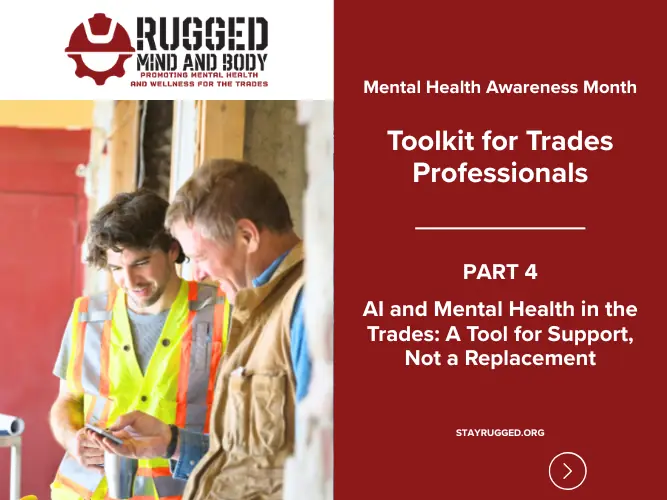
As Mental Health Awareness Month comes to an end, RUGGED Mind and Body is sharing the final article in our Toolkit for Trades Professionals series. This series focuses on the real challenges of trade work and ways to support both mental health and job performance. This final article looks at AI and mental health support. AI can be a helpful tool, but it is not a replacement for professional care. Read on for recommendations compiled by RUGGED Mind and Body from established health and research organizations on using technology in a safe and informed way.
Missed the earlier articles? Catch up on:
• Managing stress under pressure
• Breaking the stigma around mental health care
Mental Health Awareness Month highlights the importance of support and the different ways people look for help. AI tools are becoming more common and can offer quick, private support during a busy workday. For trades professionals working under pressure and tight schedules, that convenience may be appealing.
However, AI is not a mental health professional. Understanding its limits is important.
Use AI for Simple Support, Not Medical Care
The American Psychological Association has published guidance on the risks and limitations of AI in psychology, noting that AI tools should not be used as a replacement for a qualified mental health care provider.* Instead, AI can help with simple, non-medical tasks that reduce stress or help organize thoughts. Appropriate uses can include:
Organizing thoughts after a difficult service call
Providing journaling or reflection prompts
Offering general stress-management tips
These uses are similar to wellness practices like journaling and reflection, which organizations like the Mayo Clinic support for managing everyday stress.**
AI should not be used to diagnose or treat mental health conditions. The Centers for Disease Control and Prevention provide general guidance that people with concerns such as depression or anxiety should seek evaluation and care from a qualified health care provider or mental health professional.***
Understand the Limits of AI
AI responses can sound accurate and confident, even when the information is incomplete or incorrect. The World Health Organization notes that using AI in health care involves risks and requires strong safeguards to ensure it is used safely and appropriately.**** Important reminders:
Treat AI responses as general information, not personal advice
Avoid relying on AI during serious emotional distress
Double-check any information related to health or well-being
The American Psychological Association has also noted that AI has limits and should not be used as a replacement for professional mental health care.***** These limits are especially important in high-stress trades where focus, safety, and decision-making matter every day.
Protect Privacy and Know When to Get Human Support
Mental health conversations may include private personal or work information. To protect yourself, the World Health Organization recommends******:
Do not enter personal, customer, or company information into AI tools
Remember that some platforms may store conversations
Reach out to a mental health professional if issues continue or become serious
In emergencies, human support is essential. The 988 Suicide & Crisis Lifeline provides free and confidential support 24/7. These services are staffed by trained counselors who can provide human support for crisis situations.
AI can play a role in managing everyday stress by helping trades professionals organize thoughts and reduce mental overload. Its value comes from convenience, not medical expertise. When used responsibly, AI can support healthy coping habits. But without clear limits, it can also create risks. Getting the right support matters, and for mental health care, trained human professionals remain essential.
Interested in learning more? Connect in two ways to stay informed on trade-focused mental health and wellness content:
Subscribe to PHC News magazine for quarterly print and digital issues
Sign up for the monthly RUGGED Mind and Body e-newsletter
Sources
***https://www.cdc.gov/reproductive-health/depression/treatment.html
****https://www.who.int/news/item/16-05-2023-who-calls-for-safe-and-ethical-ai-for-health
******https://www.who.int/news/item/16-05-2023-who-calls-for-safe-and-ethical-ai-for-health