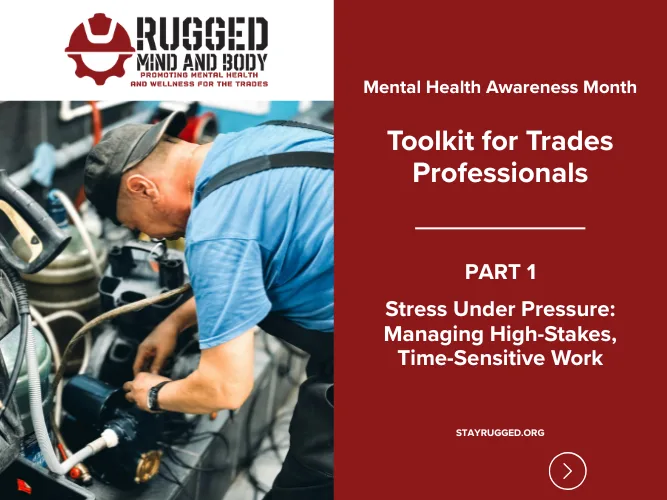
Mental health affects how people work, think, and stay safe on the job. In the trades industry, the pace is fast, the work is physical, and pressure can build over time in ways that are not always obvious.
During Mental Health Awareness Month, RUGGED Mind and Body is sharing a Toolkit for Trades Professionals. This series is focused specifically on the challenges faced in these roles.Each article is practical and grounded in real working conditions, with the goal of supporting both individual well-being and overall job performance in the field. Part one focuses on an issue that affects nearly every role in the industry: stress under pressure. Read on for actionable tips you can apply starting today.
Stress Under Pressure: Managing High-Stakes, Time-Sensitive Work
Stress is a constant in trade work, where urgency, changing conditions, and customer demands are part of the job. Trades professionals often move from one high-pressure situation to the next. Over time, that pace can affect judgment, communication, and safety. Below are some simple, practical habits that can help manage stress throughout the workday and beyond.
Recognize Early Signs of Overload on the Job
Stress rarely appears all at once. It builds gradually and can be easy to overlook in a fast-paced work environment. Common early signs include:
Irritability or reduced patience with customers or coworkers
Difficulty concentrating or second-guessing routine decisions
Physical symptoms like muscle tension, headaches, or fatigue
Early recognition can help prevent escalation into burnout or errors.[1] Furthermore, unmanaged stress can reduce focus and increase mistakes, especially in high-pressure settings.[2]
Use Quick Reset Techniques Between Service Calls
On a schedule-driven day, long recovery breaks are not realistic. Short, evidence-based resets can still lower stress in the moment.
Useful options include:
Controlled breathing, such as slow inhales and longer exhales
Stepping away from the immediate work area for a few minutes
Resetting attention by focusing only on the next task, not the full workload
Controlled breathing can activate the body’s relaxation response and reduce stress in real time.[3] In addition, short breaks and breaking work into smaller tasks can help to improve focus and reduce cognitive overload.[4]
Set Realistic Expectations With Customers and ColleaguesA large share of job stress comes from unclear or misaligned expectations, not the work itself. Practical steps include:
Communicating clear timeframes, including possible delays
Avoiding overpromising when under pressure
Confirming scope before starting to prevent mid-job surprises
Clear communication and boundary-setting are key ways to reduce work-related stress.[5] In addition, uncertainty and lack of control are major stress drivers, and that clarity helps reduce both.[6]
High-pressure work is part of the trades, but unmanaged stress does not have to be. Small, consistent actions such as recognizing early warning signs, taking brief resets, and communicating clearly can reduce strain without reducing productivity.
These practices are most effective when used year-round as part of normal professional work, not just at certain times of year.
Interested in learning more? Connect in two ways to stay informed on trade-focused mental health and wellness content:
Subscribe to PHC News magazine for quarterly print and digital issues
Sign up for the monthly RUGGED Mind and Body e-newsletter
[1] https://www.mayoclinic.org/healthy-lifestyle/stress-management/basics/stress-relief/hlv-20049495
[2] https://my.clevelandclinic.org/health/diseases/11874-stress
[4] https://www.apa.org/monitor/2019/01/break
[6] https://www.health.harvard.edu/mind-and-mood/taking-control