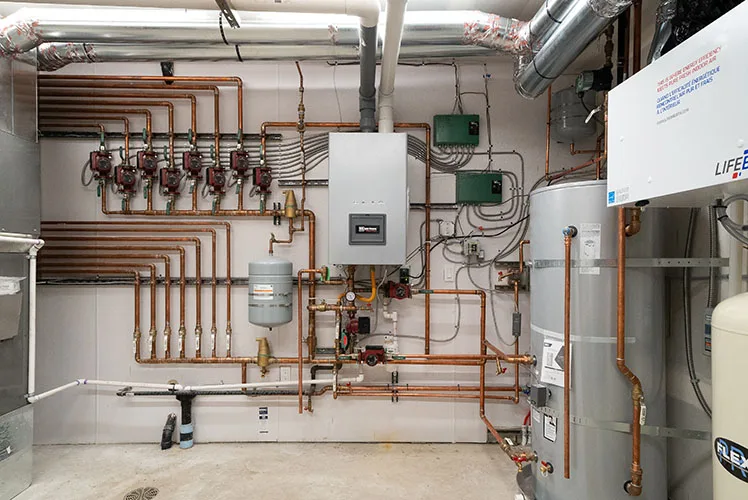
The mechanical room has always been the invisible heart of a building. It has been defined by heavy iron and the steady hum of combustion, a ‘set it and forget it’ world that is rapidly changing. Today, the boiler room is evolving into the command center of the building, transforming from a collection of isolated parts into a responsive, integrated control room.
For those of us in the PHCP industry, this change is more than a technical upgrade; it is a fundamental transformation of our business model and our leadership mandate. Whether you are a contractor on the front lines; an engineer designing a high-efficiency system; or a wholesaler navigating supply chain complexities the takeaway is the same: The future belongs to those who prioritize system integration over individual components.
The 2026 landscape: beyond the spec sheet
For decades, we have been chasing a percentage point on a data sheet, but 2026 has exposed that as a superficial metric. A unit that performs in a lab is useless if it can’t handle the real-world chaos of fluctuating energy loads or the pressure of new decarbonization mandates. We’ve moved beyond simply circulating water; we’re managing a digital conversation between traditional hydronics and renewable sources. If the system can’t provide actionable data, it isn’t efficient, it’s just obsolete hardware.
From hardware to “brainware”: redefining the system
A future proof system is defined by its intelligence and its serviceability. Our Alta family represents the pinnacle of this brainware shift. With the USB Connect app, we’ve moved the technical library and commissioning tools from a dusty binder to the palm of a technician’s hand, making installation, troubleshooting and maintenance generally simple for the contractor.
This isn’t just about flashy software; it’s about making sure systems are performing optimally and eliminating downtime. USB Connect enables over-the-air firmware updates and precise diagnostics to ensure peak performance from day one. By collecting thousands of data points, we’re building a predictive future where anomalies like irregular flame signals are identified and fixed before they ever trigger a hard lockout.
Bridging the gap: retrofitting the future
One of the most significant challenges we face in 2026 is the duality of our infrastructure. We are tasked with applying high-tech, integrated solutions to century-old buildings. This is where true industry leadership is tested and expertise shines.
We must be hydrogen-ready and electrification-aware, but we can’t lose sight of the practical realities of the existing housing and commercial stock. Future-proofing isn’t about discarding the past; it’s about creating a bridge. We are developing hybrid systems that can transition and be ready for the carbon-neutral fuels of tomorrow.
A visionary mandate: leading the workforce
As we push these technical boundaries, we can’t ignore the human element. The talent gap is the single greatest headwind facing our industry in 2026. Leading through transformation also means making the PHCP industry attractive to a new, tech-savvy workforce.
Data-driven shouldn’t mean replacing human judgment; it means empowering it. We want to make this industry appealing to a new generation of technicians who can quickly adapt to AI-powered smart technology to get the job done right the first time and get out of the basement faster. To support this, we have revolutionized our approach to education. We make training available to technicians whenever and wherever it is easiest for them. Whether it’s on-site through the USB Connect app’s technical library or remote digital modules.
Designed for all the condensing boilers across the Burnham Holdings brands, the USB Connect and Boiler Connect apps streamline installation and troubleshooting for increased efficiency, ease of use and uptime. By reducing the need for onsite labor and slashing commissioning times, often by more than two-thirds, we aren’t just increasing efficiency, we’re significantly cutting back on costly callbacks that eat into a contractor’s bottom line.
The engineering challenge: precision and resilience
To the engineering community, 2026 is an exercise in precision. We’re moving away from oversizing as a safety net, which is the old habit of over specifying just to cover our tracks. Today, that’s just wasted capital. Integrated design does not drive down the total cost of ownership, but let’s be honest, it puts the pressure back on the front end by demanding a rigorous level of planning that many firms aren’t used to. Instead, we are moving toward right-sized, modulated systems that respond to real-time demand rather than cycling at full capacity against minimum demand.
This level of precision is impossible without resilience. The internal data across the manufacturing landscape tells a clear story: In a flat market, you don’t survive by bidding more. You survive through conversion, turning high-probability designs into secured, long-term partnerships. We must have the courage to invest in R&D and stay committed to quality, even when market pressures tempt a race to the bottom.
A call to action
The year 2026 proves to be a pivotal chapter for the PHCP industry. We are no longer just the “heating people” or “the plumbing people.” We are the stewards of healthy, efficient, and sustainable environments.
Future-proofing our industry is not a passive act. It requires:
Strategic anticipation: Identifying market shifts before they become crises.
Systemic thinking: Moving away from component-based sales toward integrated solutions.
Coordinated intelligence: Utilizing data and market insights to navigate geopolitical and economic shifts.
The work we are doing right now will dictate whether we’re still relevant five years from now. It’s time to stop looking at the boiler room as a dark, difficult-to-reach corner of the basement and start seeing it for what it is: the high-tech heart of a modern building.
Bryan O’Toole currently serves as senior vice president, business development at Burnham Holdings Inc. and is based in the Lancaster, Pennsylvania, corporate office. In his role, O’Toole leads business development initiatives, supports growth opportunities across our portfolio, and works closely with executive and operational leadership to advance strategic objectives. O’Toole has been with Burnham for 13 years and has been in the engineered product manufacturing industry for more than 30.