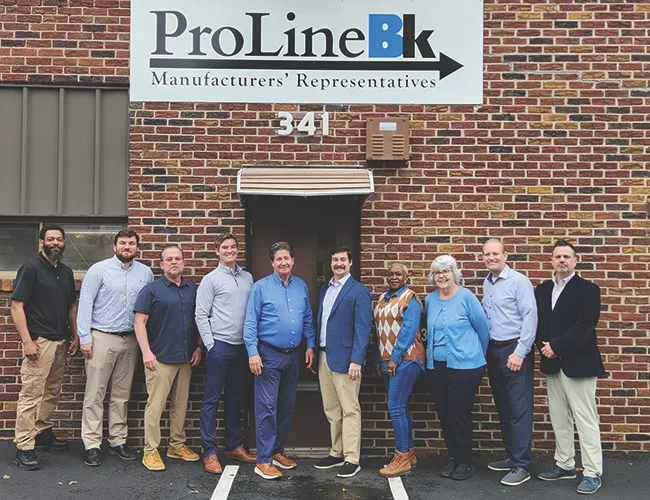
There’s a particular kind of confidence that doesn’t announce itself. It doesn’t walk into a room demanding attention or lead with a highlight reel. It shows up at 7 a.m., knows every wholesaler by first name, and has been doing so since before your current sales manager was born. Greg McLaren has that kind of confidence. And after sitting down with him recently, I left wondering if the plumbing and heating industry fully appreciates what it has in agencies like his — or if, like most good things, we only truly value them when they’re gone.
I’ll admit, I came into this conversation with a bias. As a second-generation rep myself — I’m now building something alongside my two brothers, trying to honor what our father built. The family business is a strange animal. It’s equal parts blessing and burden, legacy and liability. Greg McLaren has been navigating that terrain since 1989, and he makes it look easy.
A different kind of entry
Greg didn’t exactly sprint into the family business. His father, by his own admission, wasn’t sure the rep model had a future. Threats from the big-box era loomed large, and the old man wasn’t about to hand his youngest the keys to something he thought might be a burning building. So, Greg spent six years at Norton Abrasives selling grinding wheels and sandpaper across the Mid-Atlantic and the Carolinas. Not glamorous work. But it built something — a work ethic, a sales instinct and a healthy respect for earning your seat at the table.
He eventually joined the business when his first son was born. Something about becoming a father has a way of clarifying priorities. The furniture plant managers he had been calling on told him he should become a rep. His father’s partner was retiring. The timing aligned, and Greg McLaren stepped into a role he would eventually redefine across three decades.
Here’s where my Northeast sense of humor kicks in: Greg joined an industry that was still handwriting orders and mailing them. Mailing them! Today his agency manages 28 lines. The same job, but exponentially more complex, and somehow the relationships have only gotten deeper. That’s not an accident. That’s culture.
The power of tenure
What separates McLaren’s agency isn’t a proprietary CRM or a slick sales deck. It’s tenure. His team averages 15 to 20 years of service, with a range running from 10 to 36 years! There are manufacturers whose entire sales departments have turned over four times in that span. Meanwhile, Greg’s team has been quietly, consistently showing up — knowing the engineer on the commercial job, the contractor at the counter, the wholesaler in the back office who makes the decisions.
That’s the tribal knowledge Greg talks about. And it’s disappearing fast across the channel as the retiring generation walks out the door. The reps who remain — the tenured ones, the relationship builders, the ones who have been around long enough to remember what didn’t work — are becoming irreplaceable. Greg sees this clearly. He’s optimistic about the rep’s role over the next five years, not in a cheerleader way, but in the quiet, confident way of someone who knows exactly where the bodies are buried and has the Rolodex to prove it.
The next generation steps in
And then there are the boys.
Greg Jr. came from commercial lending at PNC Bank. Analytical, process-oriented, comfortable with numbers. He runs the residential side now — builders, contractors, wholesale. Christopher came from copier sales, which Greg describes with unmistakable admiration. Copier sales — the rejection factory. If you can survive cold-calling businesses to sell them a machine they already have and didn’t ask to replace, you can handle just about anything a mechanical engineer throws at you. Christopher runs the commercial side — architects, engineers, the big mechanicals.
Both had to work elsewhere first. Both had to initiate the conversation about joining the business. Greg didn’t recruit them — he waited. That’s a discipline most family business owners don’t have, and it’s the reason the entitlement problem — the thing that quietly destroys more family businesses than any market downturn — never took root.
I enormously respect that. My brothers and I had a version of that same conversation. There’s a moment in every family business transition where you stop being someone’s kid and start being a colleague. It’s awkward, it’s necessary, and when it works, there’s nothing like it.
More than a vendor
Here’s what I want manufacturers to hear, because I think it gets lost in the noise of quarterly reviews and pipeline reports: An agency like McLaren’s is not a vendor. It’s not a contract that renews annually or monthly. It’s a living institution — one that carries your brand into rooms you’ll never enter, advocates for your products with people who’ve trusted them for decades, and insulates you from the chaos of a channel that never stops moving. The relationships Greg’s team has built at the wholesale, contractor and engineer levels were not built overnight, and they cannot be replaced overnight.
When a manufacturer loses a rep agency, AIMR’s research suggests they lose at least two years of momentum. In a market where relationships are the currency, that’s not a setback — it’s a crisis.
The manufacturers who have earned a spot in McLaren’s portfolio should understand what that means. It means someone has done the work, built the trust and made your brand part of the fabric of a market. That is worth more than any commission structure can fully capture.
Don’t let this approach fool you. The agency is forward-thinking and utilizes several outsourced technologies to help drive its success, while at the same time maintaining the “family business” atmosphere. Greg points to AIM/R as a cornerstone of that success, believing it has had the single greatest positive influence on the agency outside of its four walls.
In the end, the story hasn’t changed — just grown — from those early days of grinding it out on the road to a third-generation agency still doing business the same way it always has: one relationship at a time.
Cullen McCarthy, CPMR, is president of Walter F. Morris Company and also serves on the AIM/R board of directors.