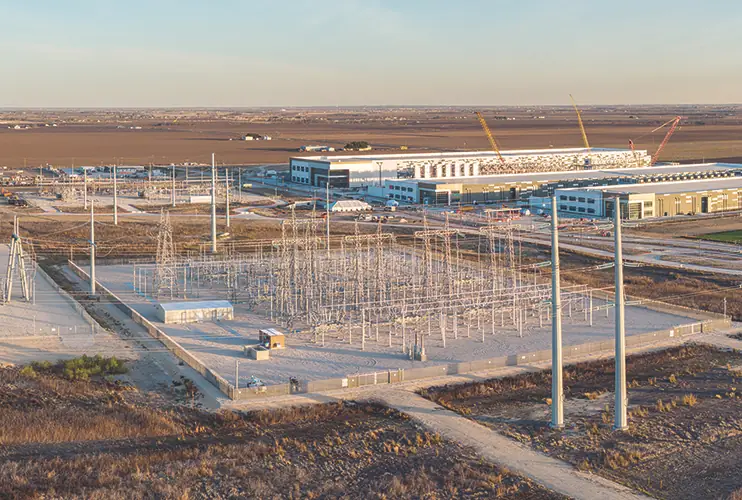
The data center surge remains the single most powerful driver of industrial spending worldwide as it enters the back half of 2026. Industrial Info Resources (IIR) is tracking more than 9,600 active capital data center projects worldwide, with a combined investment value of about $6.76 trillion.
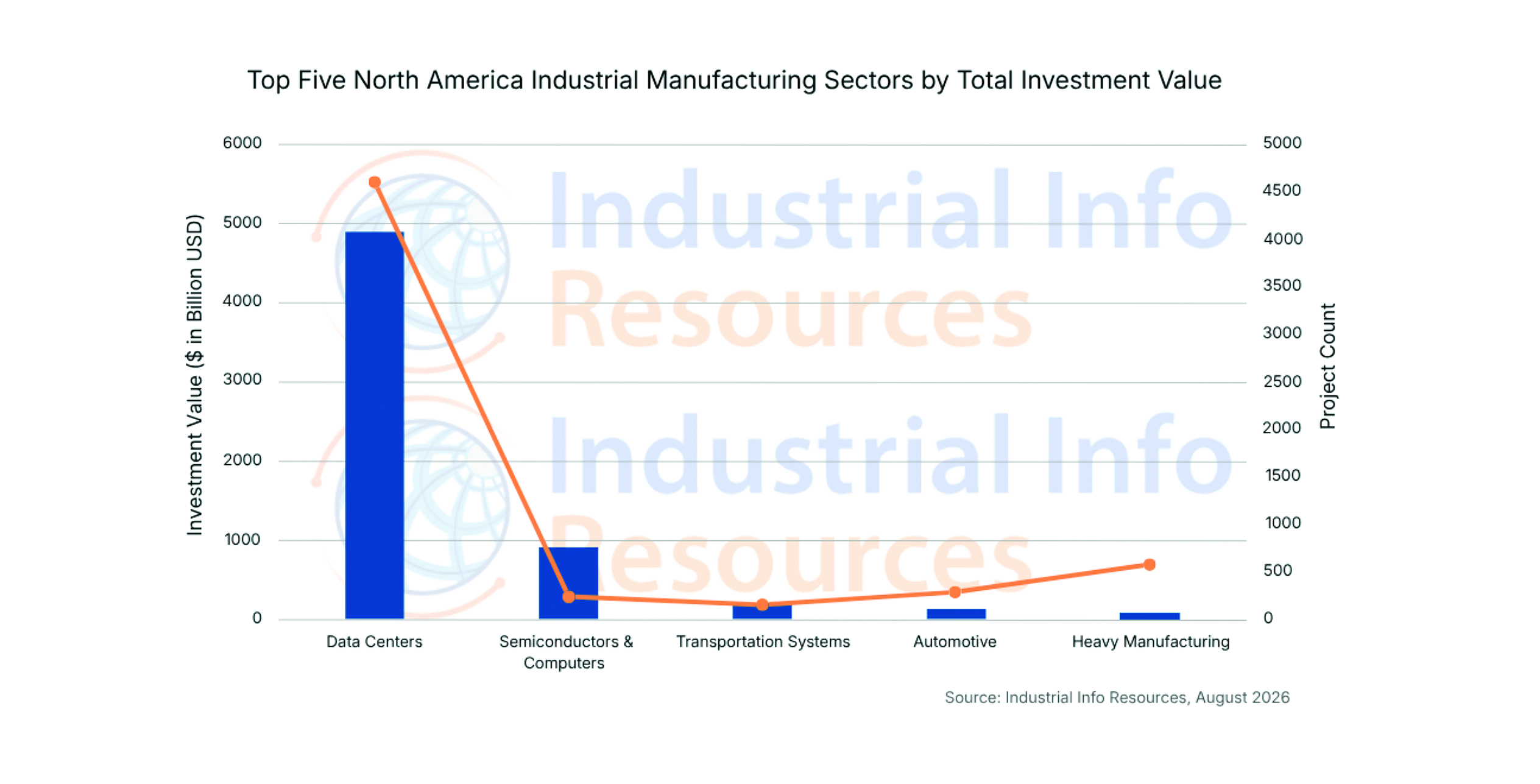
In the United States and Canada, active capital data center projects number more than 4,600, with a combined value of $4.91 trillion. This includes 429 projects, worth $337.65 billion, that were already under construction. All but 17 of those 4,600 projects include pipe, valves and fittings among their key equipment needs.
In the industrial manufacturing arena, data center projects dwarf all other sectors. The semiconductor sector comes in a distant second place, with 210 projects worth about $919 billion.
The top five states in terms of total investment amounts include:
Texas — $2.2 trillion (3,596 projects)
Arizona — $817 billion (700 projects)
Virginia — $546 billion (1,276 projects)
Ohio — $486 billion (974 projects)
Georgia — $423 billion (962 projects)
And although the longer-term development of U.S. data centers may face some headwinds, massive capital outlays show no sign of slowing.
In July, the Bureau of Economic Analysis, a branch of the U.S. Department of Commerce, released new data on actual capital expenditures (capex) on U.S. data centers for the second quarter, showing a 22% gain over comparable year-earlier investments. Four large technology companies — Alphabet (parent to Google), Amazon.com, Meta Platforms and Microsoft Corp. — are expected to build a significant portion, but not the majority, of U.S. data centers over the next three years.
Looking out over the three-year period between January 2026 and December 2028, IIR is tracking plans by these four hyperscalers to begin construction of 548 data centers in the United States, valued at $513 billion, according to IIR’s Global Market Intelligence platform.
Permitting pushback creates new headwinds
Industrial Info cautions that not all projects will be built as planned. A rising level of postponements and cancellations is caused by growing popular resistance to planned data centers and by city, county, state and federal efforts to slow planned construction. Power supply is also an issue.
The Trump administration has strongly backed data center construction. A late-2025 executive order from the administration sought to preempt states and local authorities from regulating or limiting data center construction. However, there are unanswered legal questions about a president’s ability to intervene in interstate commerce.
Data centers have emerged as a flashpoint in communities across the nation, potentially limiting Congress’ ability to pass legislation on this hot-button topic. New York was the nation’s first state to temporarily pause permitting of new data centers, and approximately a dozen other states are considering similar measures. Such opposition is due to factors including rising electricity and water bills, among others.
Even in Texas, whose leaders have welcomed data centers with open arms in the past, signs of caution have emerged. Earlier this year, Texas Gov. Greg Abbott issued a moratorium on new data center approvals in the state until a “comprehensive verification and audit” is performed for each facility addressing issues including power and water use, community impact (noise, light, etc.), ownership verification and tax breaks being received.
The directive was issued to the Texas Public Utility Commission and Electric Reliability Council of Texas, which operates the power grid for around 75% of the state’s land area and carries around 90% of its power load. Applications for new power interconnections have exceeded the grid operator’s peak operating capacity several times over.
That moratorium, however, will presumably have little effect on what is currently under construction and permitted in the state. IIR data indicates that more than $78 billion in data center construction is currently underway in Texas, with other projects at some stage of planning or engineering.
Construction is led by Taylor County, home to Abilene, where the flagship Stargate Project data center campus is taking shape. Stargate is a massive network of artificial intelligence (AI)-driven data centers across the country. Announced by President Donald Trump on January 21, 2025, the undertaking, as originally planned, called for $500 billion in investment by 2029.
Power supply emerges as a critical constraint
Power supply issues can also challenge the development of data centers. The search for enough electricity to power the energy-hungry sector has had a variety of turns. According to the U.S. Energy Information Administration’s Annual Energy Outlook 2026, published in April, electricity demand “has increased by 2.1% per year, on average, over the last five years. We project electricity consumption will continue growing through 2050 at a rate of 0.9% to 1.6%, with data center server energy use a major factor.”
In the eastern U.S., wholesale power costs in the PJM market are poised to continue surging, given the results of that grid manager’s electric capacity auction. PJM, which operates the regional transmission network across 13 states and the District of Columbia, said it would pay electricity generators about $16.4 billion in capacity payments over a 12-month period starting June 1, 2028. An independent monitor said about $6.3 billion of those costs stemmed from data centers.
GE Vernova, which manufactures power turbines, reported this summer that its natural gas-fired turbines are sold out for the next few years, leaving little room for further near-term growth in this booming segment of the company, which has benefited largely from increased baseload power demand driven by AI data centers.
IIR data shows that at least $71.8 billion in U.S. gas-fired power projects plan to use GE Vernova equipment or are presently constructing plants that will use it. The largest development in the planning process is a 4.5-gigawatt plant in Homer City, Pennsylvania; it will use seven 650-megawatt gas turbines to power a data center campus that could include more than 20 buildings.
In North Carolina, Amazon raised the eyebrows of state regulators and Richmond County residents when the company applied for permits for 645 emergency backup diesel generators to provide power until its new data center campus’s grid connections are completed. And that’s for just one data center.
Some developers are working to develop “behind-the-meter” power sources that don’t rely on utility power grids. In West Texas, a Chevron Corp. subsidiary plans to develop a large natural gas-fired power plant near the Waha gas hub to provide electricity for a planned Microsoft data center.
Brian Ford is editor in chief at Industrial Info Resources and has been with IIR since 2014. With global headquarters in Sugar Land, Texas, and 18 offices worldwide, IIR is a provider of global market intelligence specializing in the industrial process, heavy manufacturing and energy markets. To contact IIR, visit www.industrialinfo.com or call 713-783-5147.