The rise of artificial intelligence (AI) and data centers has led to significant industrial growth across the United States.
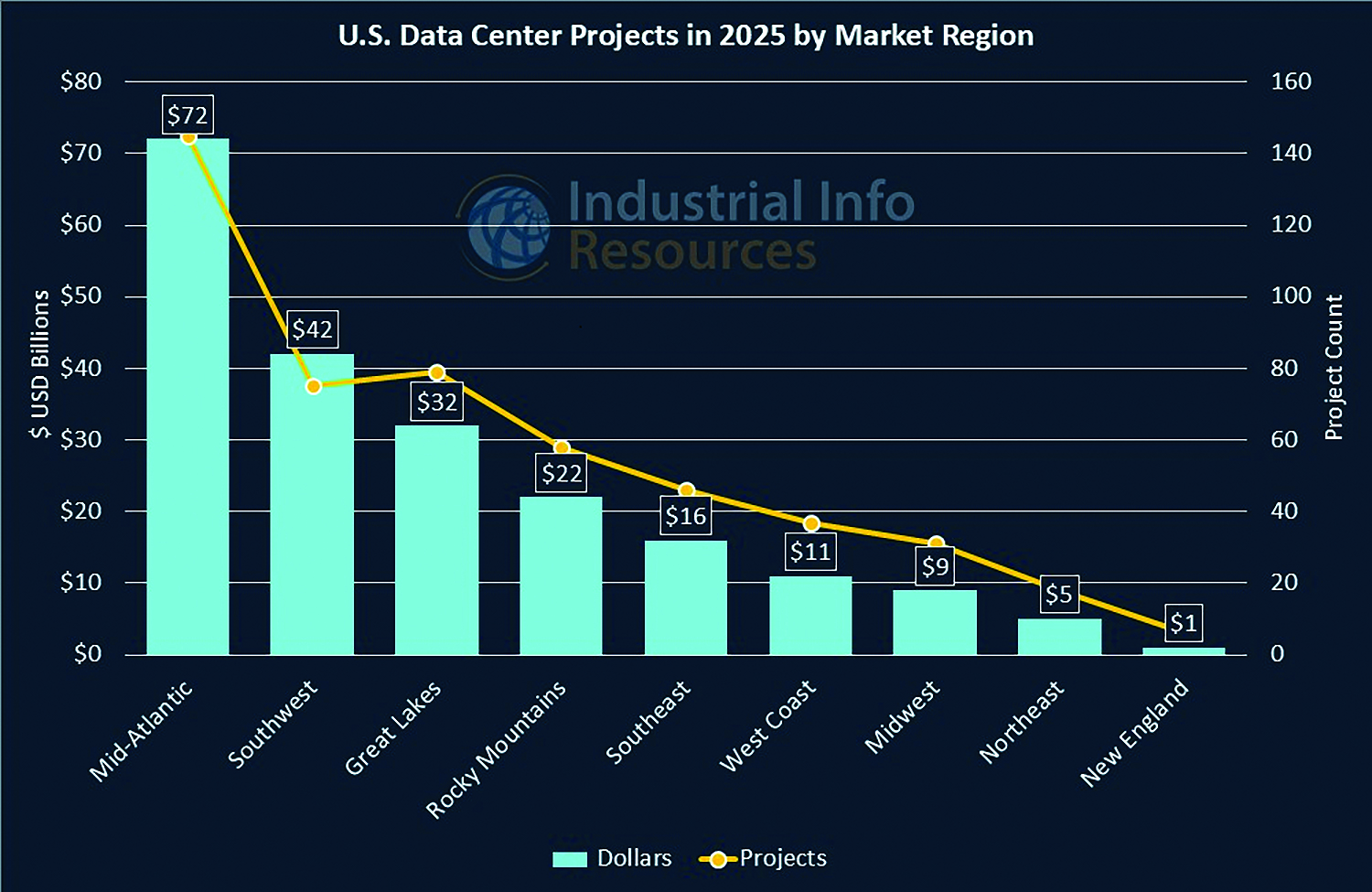
Industrial Info Resources (IIR) is tracking a whopping 495 U.S. data center projects, with a total investment value of $212 billion, that are planned to kick off construction this year and have pipe, valves and fittings equipment needs. To be sure, not all of these projects will kick off this year, but 71 of them are assessed as having a high probability (81% to 99%) of moving forward, and 414 have a medium probability (70% to 80%) (See Figure 1).
Of the industries tracked by Industrial Info, data centers currently rank third in total project spending, after power generation and mining. However, by the end of this year, data centers could be much closer to the top in spending levels, according to David Pickering, IIR’s vice president of research for industrial manufacturing.
For data centers planned for 2025 across the globe, North America leads the way, accounting for 50% to 60% of the world’s projects. The top location is Virginia, as it is near Washington and the government’s massive databases.
In addition to AI and related work, other functions of data centers include data storage, e-commerce and additional data processing functions. Redundancy — the duplication of data across multiple servers to prevent loss in the event of a catastrophe at a single location — increases the need for capacity. This is also true of cloud computing and software-as-a-service, where both software and data reside in a data center, rather than on computers or servers in an office.
It will be no surprise that U.S. internet giants Microsoft Corp. (Redmond, Washington) and Amazon (Seattle) are at the top in terms of project development, with Google (Mountain View, California), Blackstone (New York, New York), Meta Platforms (Menlo Park, California), DigitalBridge Group (Boca Raton, Florida) and Tract (Denver) rounding out the top seven.
The frantic buildout of data centers in recent years has caused some investors to wonder whether it was all too much, too fast; recent dial-backs by data firms have added to that concern. Microsoft, however, states it remains committed to spending an announced $80 billion on AI and cloud capacity in this fiscal year.
How will they be powered?
Power usage at U.S. data centers could double or triple, consuming up to approximately 12% of the country’s total electricity by 2028, according to the U.S. Department of Energy (DOE), which reported this in December 2024.
The report notes that data centers are expected to account for approximately 6.7% to 12% of total domestic electricity usage by 2028. In addition, total data center electricity usage climbed from 58 terawatt-hours (TWh) in 2014 to 176 TWh in 2023; the agency estimates an increase to between 325 TWh to 580 TWh by 2028.
According to a related press release, the DOE’s “key strategies” for meeting data center demand are as follows:
Enabling data center flexibility by using onsite power generation and storage solutions;
Leveraging energy community opportunities to re-use infrastructure at retired coal facilities for data centers and associated power infrastructure;
Engaging with stakeholders on innovative rate structures to support data center expansion while maintaining affordability;
Commercializing key enabling technologies, such as next-generation geothermal, advanced nuclear, long-duration storage and efficient semiconductor technologies.
According to a Goldman Sachs report, worldwide data center workloads have been increasing significantly for about a decade. However, while their workloads nearly tripled between 2015 and 2019, increases in energy efficiency kept the total power load about 200 TWh/year worldwide.
Since 2020, efficiency gains have shrunk and data center power consumption has skyrocketed, reaching 400 TWh in 2023, and is expected to mushroom past 1,000 TWh by 2030. By 2028, Goldman Sachs expects AI to account for about 19% of global data center demand.
Technology companies, including the industry giants, are increasingly signing power purchase agreements (PPAs) and partnering with renewable energy developers to source renewable and low-carbon forms of power.
Gas-fired power projects double the value of 2023 projects
However, renewable forms of energy won’t be enough to meet the needs of power-hungry data centers. Earlier this year, Industrial Info’s Vice President of Energy Market Solutions Shane Mullins stated that major natural gas midstream companies predict data center power requirements will raise natural gas demand by 6 to 10 billion cubic feet/day by 2028.
After several close calls and repeated warnings from reliability organizations and utility regulators about the need to build more dispatchable electric generation, developers and electric utilities have responded with a bevy of new-build, gas-fired power generation projects. As many as 29,700 megawatts (MW) of gas-fueled generating capacity could come online between January 2025 and December 2027, according to data tracked by IIR.
IIR is tracking about 160 proposed U.S. new-build, gas-fired power projects, worth $73.8 billion, scheduled to kick off construction starting this past January.
Citing Industrial Info data, Britt Burt, Industrial Info’s vice president of research for the global electric power industry, notes that gas-fired power plant construction kickoffs this year could reach $18.1 billion, nearly four times last year’s total and double the value of projects kicking off construction in 2023.
Across the nation, electricity demand is expected to grow about 2% per year, which is “remarkable” and more than double the annual growth of recent years, Burt continues. Plans to build new data centers, AI facilities, Bitcoin mines and other industrial projects are among the factors driving growth.
As the general power grid becomes increasingly strained, the largest data center players have made headlines with major off-grid power sourcing initiatives.
Natural gas midstream firm Energy Transfer (Dallas) announced a long-term agreement with Denver-based CloudBurst Data Centers for the energy supply to serve a data-center development in Texas. In addition, Blackstone Energy Transition Partners, part of New York-based Blackstone, has agreed to acquire the Potomac Energy Center, an 813.5-MW natural gas power plant in Loudoun County, Virginia, to power data centers.
The multibillion-dollar Stargate AI project, announced by President Donald Trump in January, includes constructing two buildings in Abilene, Texas, which will be connected to the grid. However, they will rely on their own simple-cycle gas turbines as backups, and possibly for some base power.
The new Three Mile Island and small modular reactors
Demand by data centers may also spark a resurgence in nuclear power.
Microsoft Corp. is involved in restarting Unit 1 of the Three Mile Island nuclear plant, now known as the Crane Clean Energy Center, in Pennsylvania. The company plans to invest $20 billion in co-locating data centers with solar, wind and battery-power projects.
In February, the three largest electric utilities in Arizona joined a small but growing group of utilities, data centers and states in announcing an interest in investigating new nuclear generation. The utilities say they would consider small modular reactors (SMRs) capable of generating up to 300 MW, as well as larger-sized traditional nuclear units.
Industrial Info’s Burt states that Google and Kairos Power (Alameda, California) have an agreement for Kairos to build SMRs and supply power to Google through a PPA. Amazon had an agreement with X-energy (Rockville, Maryland) to supply power from SMRs.
Even the coal industry could benefit from the data center and AI surge. The outlook for U.S. coal mining has brightened in recent months, coal company officials told a mining conference earlier this year in Denver. That optimism had several drivers, including the strong growth in electric demand coming from data centers, AI and cryptocurrency mining.
Brian Ford is editor in chief at Industrial Info Resources and has been with IIR since 2014. With global headquarters in Sugar Land, Texas, and 18 offices worldwide, IIR is a provider of global market intelligence specializing in the industrial process, heavy manufacturing and energy markets. To contact IIR, visit www.industrialinfo.com or call 713-783-5147.