Keeping commercial buildings warm in Cordova, Alaska, is no small task. Located on the edge of Prince William Sound and surrounded by mountains and glaciers, the community experiences long winters, heavy snowfall, more than 100 inches of annual rainfall and temperatures that regularly test the limits of building systems.
For Cordova Electric Cooperative (CEC), providing reliable power to the commercial fishing town’s roughly 2,600 residents has meant balancing resilience with sustainability.
Unlike many electric cooperatives, CEC generates most of its own electricity. Approximately 85% of its power comes from locally sourced hydropower, giving the community access to a largely renewable electric grid.
The challenge
Heating, however, has historically been a different story. Many facilities have relied on diesel-powered equipment creating significant operating costs while limiting opportunities to reduce fossil fuel consumption.
“About 60% of the household budget in Cordova goes toward heating homes, businesses and industry,” says Clay Koplin, CEO of CEC. “It really is a huge economic impact.”
CEC wanted to transition one of its facilities away from fossil fuel heating while taking advantage of the area’s abundant renewable electricity. The challenge was finding a commercial heat pump capable of delivering dependable hydronic heating performance in one of the country’s most demanding climates.
The solution
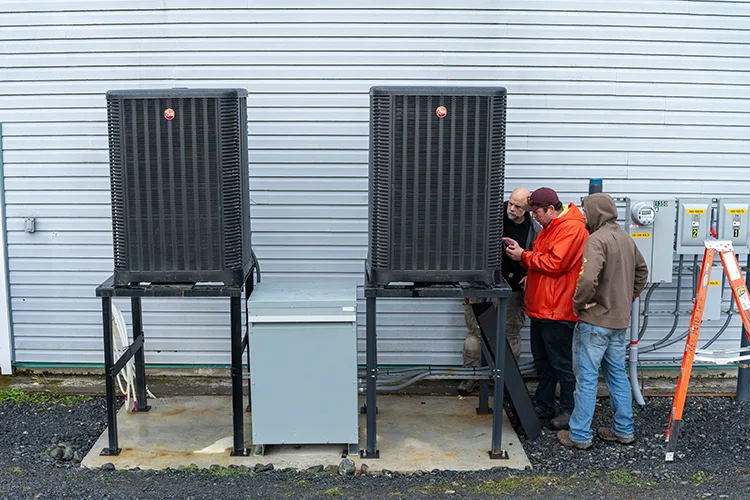
CEC selected the Torin commercial air-to-water heat pump from Rheem to serve the cooperative’s alignment facility.
Designed with smart inverter capacity control, an intuitive touchscreen interface and remote monitoring, the Torin was a sensible choice for the project as it added efficiency, intelligent operation and dependable performance.
“For this heat pump, the innovation we were working toward was offering a technology that typically struggles in cold climates to actually be efficient and deliver a positive value to buildings,” says Hillary Heyerdahl, senior manager of product management at Rheem.
Cordova’s climate makes it an ideal proving ground. While local temperatures generally range between 15 F and 70 F, Torin operates at -13 F to 110 F and delivers water temperatures up to 150 F.
For Russ Goss, manager of generation at CEC, the technology fills a long-standing need. “This product has been needed and attempted for a couple of decades now. I truly feel like Rheem figured it out,” he noted.
“The Torin line can do hydronic heating, floor heating and radiant panel heating. It can also make domestic hot water for showers, in the kitchen, laundry and for the bathroom,” says John Trauger, senior district training representative at Rheem. “It even allows for connection of up to 16 units to ensure redundancy and meet the needs of larger demands.”
Beyond cold-weather performance, installation considerations also factored into the project. Torin’s compact footprint is, on average, 36% smaller than comparable competitive units, making it easier to accommodate where mechanical room space is limited.
“We immediately noticed substantial differences,” Goss says. “For one, it’s so compact. You barely need a nine square foot spot.”
Because the packaged unit connects to the building through two small-diameter pipes, installation can be simpler than replacing or installing a conventional boiler.
“Unlike installing a boiler, the heat pump is a packaged unit, and the only thing penetrating into your building are two very small diameter pipes that connect to your existing hydronic system,” Goss says.
The outcome
For CEC, the project demonstrated that commercial air-to-water heat pump technology can perform reliably under conditions that have traditionally challenged electrified heating systems.
“Since deploying these heat pumps, we’ve seen them operate on our coldest days and our hottest days,” Goss says.
The installation enables the cooperative to capitalize on its abundant hydroelectric generation while reducing dependence on diesel fuel for building heating. For a community where heating costs represent a substantial portion of overall energy expenses, electrification offers both operational and environmental benefits.
The project also illustrates how advances in cold-climate heat pump technology are expanding options for engineers, contractors and building owners seeking to reduce the carbon load at commercial facilities without sacrificing performance.
“Rheem has taken our 100 years of experience in making hot water and making air cold — all of that technology and knowledge has gone into these heat pumps,” Trauger says.
As commercial building owners continue evaluating pathways to electrification, the Cordova installation demonstrates that cold-climate heat pump technology can provide a practical solution where renewable electricity is available. In one of North America’s harshest operating environments, Torin has shown that high-efficiency hydronic heating can deliver reliable performance while helping reduce fossil fuel use, offering a model that other commercial facilities and utilities can adapt as they pursue similar sustainability objectives.
Hillary Heyerdahl is senior product manager at Rheem.