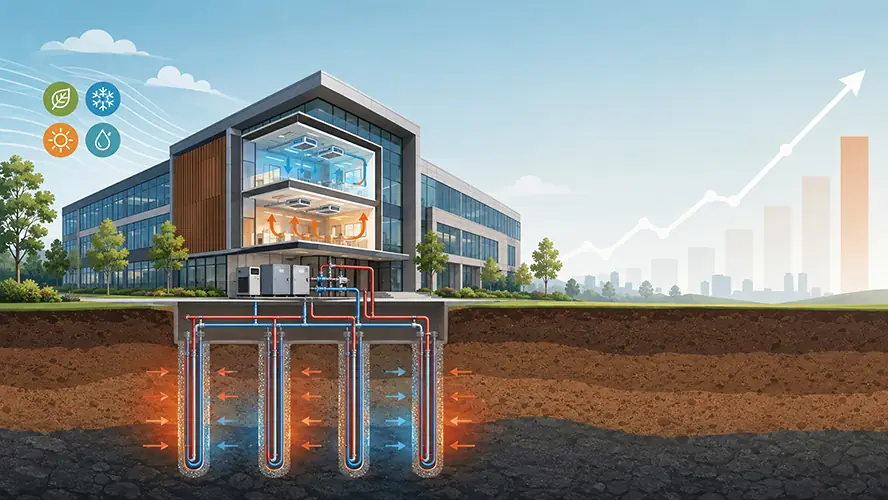
Increased energy costs have driven HVAC designers to consider the implementation of other, more efficient systems to lower operating costs. Different solutions may vary based on building program, first cost, project location, available resources and more. The higher the building’s energy consumption, the greater the incentive to improve performance. Regardless of federal decarbonization incentives, many clients and designers still seek to create more sustainable buildings.
While most buildings experience heating and cooling seasons, the magnitude of heating and cooling can vary dramatically, based on the amount of ventilation needed for the building programs. Office buildings have minimal ventilation, so the total amount of heating and cooling relates more to the building size. By contrast, laboratory buildings have much higher ventilation rates that, depending on the climate, can drive significant heating and cooling loads. The larger the loads, the more effective these systems become.
With the move away from carbon-generating sources such as natural gas toward electric-based systems, the energy market is seeing power demand like never before. Energy producers are working to upgrade aging infrastructure to keep up with demand, so it is no surprise that electricity rates have been increasing steadily across the country.
While some have considered adding renewable energy sources to lower energy costs, HVAC and other industries have been looking to the very earth they build on to maximize energy reuse. One such sustainable system that is often considered is a geothermal hydronic system.
How geothermal hydronic systems work
The Earth’s mass provides exceptional energy storage and can maintain a stable temperature year-round once we reach sufficient depth. Geothermal hydronic systems harness this consistency through heat transfer between the building and the ground via geothermal wells and fields. In winter months, heat is extracted from the earth and boosted to provide beneficial heating to the building. This process of heat extraction cools the ground below its average temperature.
In summer months, excess heat rejection from the building is transferred back into the earth. This heat rejection then warms the ground above its average temperature, preparing it for the winter months to come.
For geothermal systems to be effective, the buildings they serve need to have a balanced heating and cooling load profile throughout the year. These are often seen in mixed climates, with balanced heating and cooling, but can also be found in slightly cooler or warmer climates if the load profile and field size support the application. This approach enables the production of heated or chilled water for building heating and cooling with minimal reliance on outdoor conditions.
This makes geothermal energy far more dependable than weather-dependent renewable sources such as wind or solar.
Boise, Idaho, has the oldest geothermal heat source loop in the United States, circulating more than 170 F hot water from a local spring, maintaining a district loop in which one party supports multiple unrelated buildings. Epic Healthcare Corporate Campus in Wisconsin is a prime example of a traditional campus geothermal system serving multiple buildings of a single owner.
There can also be standalone installations, such as the Dallas-Fort Worth Bridge, which use a geothermal heat pump approach to manage de-icing in the wintertime.
Besides being separated by scale, geothermal systems are also divided by type. As with other hydronic systems, there are two main categories: open-loop and closed-loop.
Open-loop geothermal systems: Benefits and challenges
The Boise, Idaho, district heating system is an open-loop system that draws hot water from a local hot spring to provide heating before returning it to the aquifer at a different location. Open-loop systems are the least common type of geothermal loop due to their dependence on local regulations and conditions. If not properly managed, maintained and isolated, there is a risk of contamination.
Bodies such as the Environmental Protection Agency or local jurisdictions may also have concerns related to the impact on water temperatures and the potential for sediments to be disturbed in the wells for other parties.
Open geothermal systems are heavily dependent on the existing water quality and water availability, as an average of 1.5 gallons/minute/ton is required to support a heat pump heating and cooling system. During warmer seasons or in warmer climates, this water flow rate could increase.
The open nature of the system requires sediment filtration to protect the longevity and effectiveness of system equipment. Water quality also plays a role in whether an open-loop system is applicable, as water pH levels must remain within a specified range to avoid heat exchanger corrosion. The presence of minerals or hard water could result in equipment scaling and reduced effectiveness over time.
If this trended data over a year is not readily available, the time to acquire it for feasibility studies could make an open-loop system less than ideal.
Regardless of these challenges, open-loop systems remain in use and can be effective choices. In 2009, the Greensburg, Kansas, City Hall installed an open-loop geothermal system in conjunction with a rooftop photovoltaic system and lowered its energy use intensity per square foot to 41.4 by 2012.
Toronto has a deep lake water-cooling system, drawing cold water from deeper into the lake to support district cooling and returning the warmer water to a higher location to minimize temperature variations within the lake.
Pond and lake loops: Bridging open and closed systems
Bridging open and closed geothermal systems is the closed-loop pond/lake arrangement. Similar to open systems, this approach uses a body of water as the heat sink, with geothermal piping running from the building into the body of water. Not only does this require proximity to a water source to limit costs, but it can also require significant depth of the geothermal piping in the body of water (on average, 8 feet below surface in colder climates to protect against freezing).
An assessment is also required to ensure that water levels stay relatively constant year-round, and the loop’s location is not heavily impacted by vegetation in the pond. A pond/lake system can also face restrictions from local regulations due to potential impacts on the fish and plant ecosystem.
This approach is more commonly used on private bodies of water, as public bodies of water are at higher risk of potential damage from watercraft above. In some reported cases, boat anchors and even boat propellers (if water levels drop low enough) have cut submerged piping, allowing chemically treated geothermal loop water to enter the body of water. While there are many things to consider, these systems tend to achieve higher efficiency rates as water is a better energy conductor than the earth.
Pond/lake loops also require far less disruption to landscaping and can entail lower costs and manual labor, as trenching and material needs are minimized. All this needs to be balanced with impacts on the environment and ecosystems.
Horizontal closed-loop systems and land use tradeoffs
Horizontal and vertical closed-loop geothermal systems are the most common types of systems installed. Similar to closed-loop pond/lake systems, horizontal closed-loop systems are installed horizontally in the ground, while vertical closed-loop systems use vertical bores that can reach depths of more than 600 feet and are spaced at intervals of 20 feet or more.
Like the open-loop and pond/lake loops that require water assessments, horizontal and vertical arrangements need to start with an assessment of the soil. The type of soil and the moisture content can all impact the heat transfer rate available to the buried system. For vertical arrangements, these soil tests can be more costly as sample well(s) are required to evaluate soil conditions across the larger geothermal field.
The horizontal arrangement is a more cost-effective approach but is less efficient because the geothermal pipe is buried in shallow trenches, typically 4- to 6-feet deep. These shallow depths are subject to more frequent temperature variations, and in colder climates where the ground can freeze, this arrangement may not be ideal or could require deeper trenches to protect them.
For example, the National Laboratory of the Rockies (formerly the National Renewable Energy Laboratory) Alaska Campus successfully installed a 17.6 kW horizontal geothermal field in 2013 by trenching an additional 9 feet deeper than traditional systems. The challenge with horizontal systems is that they can require a significantly larger field area and limit future development in densely populated areas. Horizontal closed-loop system sizes need to be balanced with available space to ensure flexibility for future development.
Vertical closed-loop systems: The most common and robust option
The last of the geothermal arrangements, but the most popular across markets, is the vertical loop arrangement. While taking up less room, the vertical geothermal arrangement is often the most expensive and time-consuming geothermal option. Drilling the bores requires specialized equipment and, depending on the depth of the bore, could stretch out construction schedules.
A failure of a vertical bore is more likely during construction and may require additional bores. Vertical geothermal loops, however, are the most protected from temperature fluctuations and seasonal changes and are the ideal option for harsher climates.
As energy costs rise and sustainability goals become more pressing, hydronic systems — particularly geothermal solutions — are proving to be a resilient and forward-thinking choice for the HVAC market. The ability of geothermal heat pump systems to deliver consistent performance across their associated climate zones, reduce carbon emissions and integrate with diverse building types makes them a compelling option.
While upfront costs and site-specific considerations remain challenges, the long-term benefits in efficiency, reliability and environmental impact position geothermal hydronic systems as a cornerstone of future-ready building strategies. For designers and owners committed to lowering operational costs and meeting decarbonization targets, looking to the earth below our feet is a trend that continues to age well.
Megan Kittredge is a mechanical engineer at SmithGroup’s Phoenix office. She has been in the industry for over 7 years designing systems for various building types.