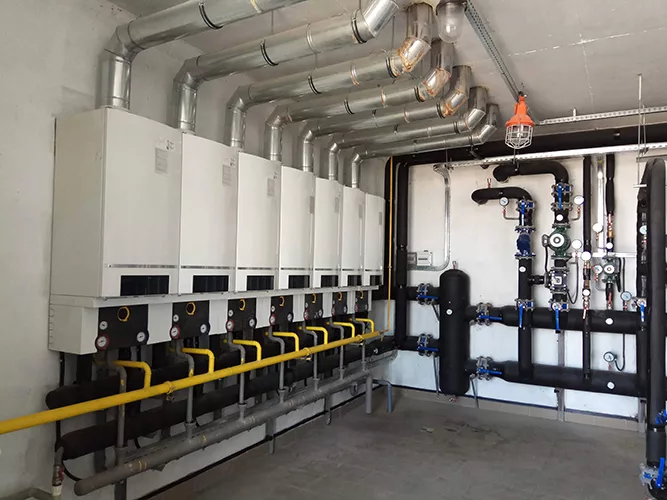
For decades, geothermal heat pump (GHP) and ground heat exchanger (GHEX) systems have been recognized for delivering exceptional efficiency and long-term performance. Yet, despite their technical promise, high energy use, inconsistent operation and ongoing maintenance challenges are often traced to design shortcomings and a shortage of skilled professionals capable of optimizing these complex systems.
As a result, much of the industry remains focused on incremental improvements of 2% to 10% instead of embracing the transformational advances now within reach through innovation in design, modularization and control.
True progress will come not from adding more complexity, but from rethinking how these systems are designed and built. History shows that the most significant technological breakthroughs emerge through simplification and integration. When Henry Ford transformed transportation, he didn’t give people the faster horse they asked for — he reimagined the very concept of mobility.
Decades later, HP took a similar approach with its modular LaserJet printers, capturing the market by focusing on the essential features users truly needed through simple, scalable design rather than overengineering for unnecessary complexity. These same principles now guide the evolution of geothermal systems toward broader adoption and lasting performance.
The geothermal industry continues to face several persistent challenges. With the scheduled expiration of the residential energy tax credit for geothermal heat pumps, a slowdown in residential adoption is anticipated. However, commercial projects remain eligible for federal incentives of up to 50% through energy credits, continuing to drive investment and innovation in that sector.
At the same time, the industry faces a shortage of certified designers and contractors, particularly for larger commercial installations, which limits overall capacity for growth. A modular, standardized solution based on a proven system architecture can help bridge this gap by reducing design complexity and the level of specialized engineering knowledge required, while simplifying installation and commissioning.
From standards to integration: Evolving geothermal design practice
The first International Ground Source Heat Pump Association (IGSHPA) standards, published in 1997, established the foundation for geothermal design, emphasizing soil conductivity, bore spacing, antifreeze concentration and hydraulic balance. However, these early documents focused primarily on geotechnical aspects and offered little guidance on system optimization within buildings.
Standard CSA/ANSI/IGSHPA C448-2025, Design and installation of ground source heat pump systems for commercial and residential buildings, builds on earlier efforts, continuing to refine the technical foundations of geothermal design rather than shifting toward full system integration. It broadens previous standards to include updated procedures for energy foundation testing and documentation, and defines steps for system verification, commissioning and decommissioning.
The standard also acknowledges the influence of variable-speed pumping and advanced controls on efficiency, though it stops short of offering detailed design criteria for their application. The design methods presented in this article address these gaps with practical guidance on pumping optimization, hydraulic separation and control strategies to enhance performance, reliability and long-term system value.
Ideal applications for modular geothermal systems
Factory-built pump stations, manifolds and hydronic panels simplify installation and ensure consistent performance across projects. By moving assembly into a controlled environment, these modular components cut onsite labor, shorten schedules and reduce reliance on specialized geothermal expertise. Standardization across building types also improves cost predictability, helping geothermal systems compete more directly with air-source alternatives, where upfront costs remain a key factor.
Modular geothermal systems are especially effective for large residential and light commercial buildings ranging from roughly 5,000 to 30,000 square feet. This range includes nearly 89% of U.S. commercial buildings with heating or cooling systems.
In Climate Zone 6, a 5,000-square-foot home might require about 7.5 tons of capacity, while a 30,000-square-foot office typically needs around 60 tons. Within this scale, systems can operate efficiently without exceeding the limits of today’s high-efficiency ECM circulators.
A 60-ton system divided into three 20-ton GHEX circuits can be serviced with a standard flush cart, simplifying commissioning and maintenance. For larger facilities, dividing systems into 60-ton modules maintains these advantages while keeping designs straightforward and cost-effective.
Variable-speed pumping and hydraulic separation
Traditional GHEX layouts, dating back 30 years, are illustrated in Figure 1. Originally developed for single-family homes, geothermal pump stations combined the GHEX and GHP source fluids within a single loop, powered by one or two circulation pumps. As building sizes increased, the single-loop concept remained largely unchanged, though fixed-speed pumps were later equipped with variable frequency drives to provide variable-speed capability.
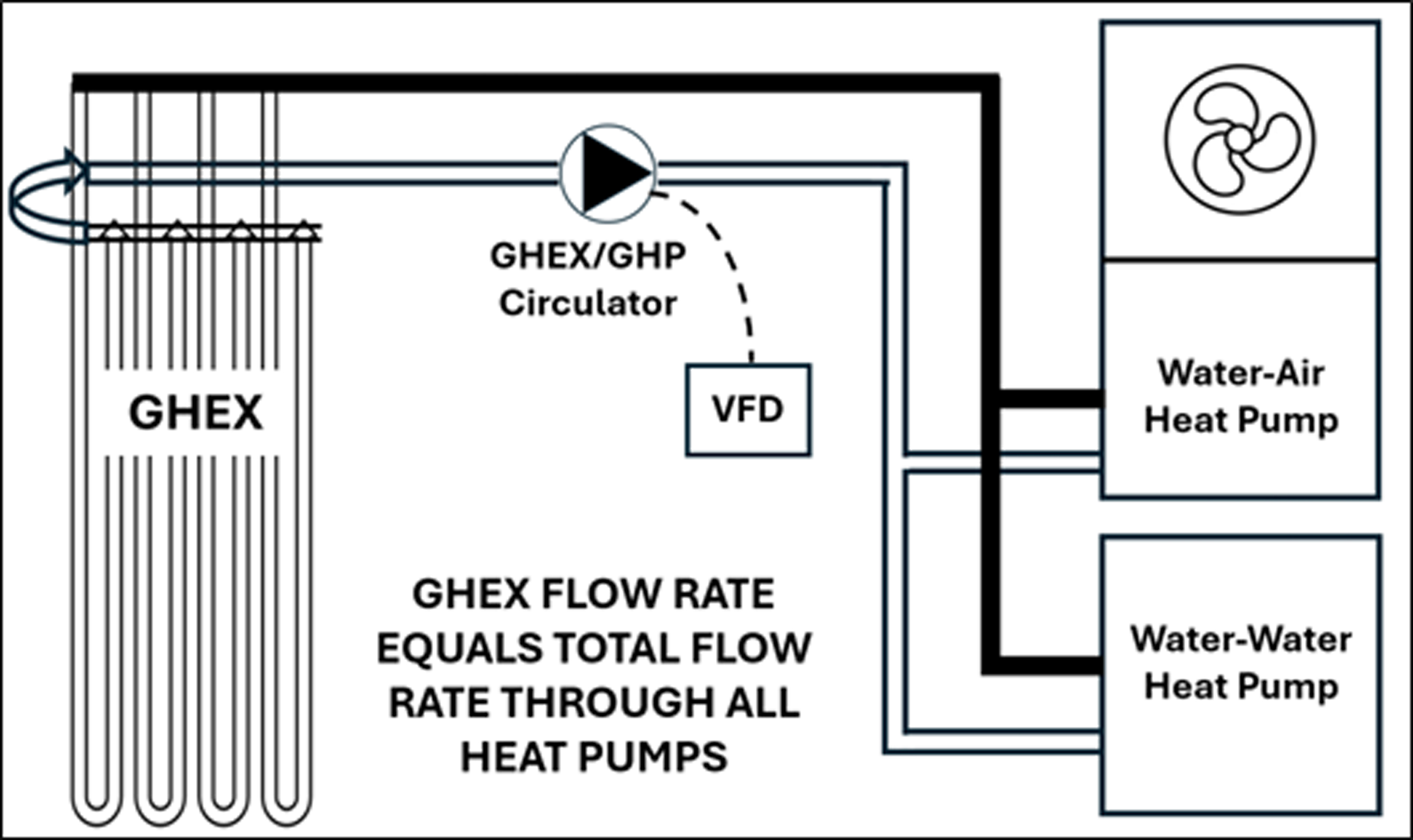
While this approach works adequately, it remains energy-intensive and assumes that the optimal GHEX flow rate equals the GHP flow rate. In practice, balancing the GHEX and GHP circuits — as required by the CSA/ANSI/IGSHPA C448-2025 standard — is difficult to achieve. The result is often oversized pumps, complex balancing valve arrangements and unnecessarily complicated controls — adding cost and complexity and increasing maintenance requirements.
In recent years, the U.S. Department of Energy, the Oak Ridge National Laboratory, the American Society of Heating, Refrigerating and Air-Conditioning Engineers and the New York State Energy Research and Development Authority have emphasized the importance of balancing efficiency with practicality. Their emphasis is on designing geothermal systems that deliver reliable performance, minimize installation and operating costs and remain easy to maintain, recognizing that while systems are typically designed for full load, they operate at partial load conditions approximately 87% of the time.
Their research confirms the optimized design approach first reflected in Energy Environmental Corp.’s (EEC) patented work beginning in 2012 and most recently, U.S. Patent No. 12,188,676. It highlights the advantages of hydraulically separating the GHEX from the GHP source circuits while applying differential temperature (ΔT) and differential pressure (ΔP) control strategies to improve thermal stability, system efficiency and overall reliability.
By decoupling the circuits, designers can maintain higher heat pump flow rates within the building for offsetting loads while optimizing lower GHEX flow rates to match net load conditions. For engineers, this approach transforms theoretical performance into practical results that deliver comfort, reliability and cost-effective operation.
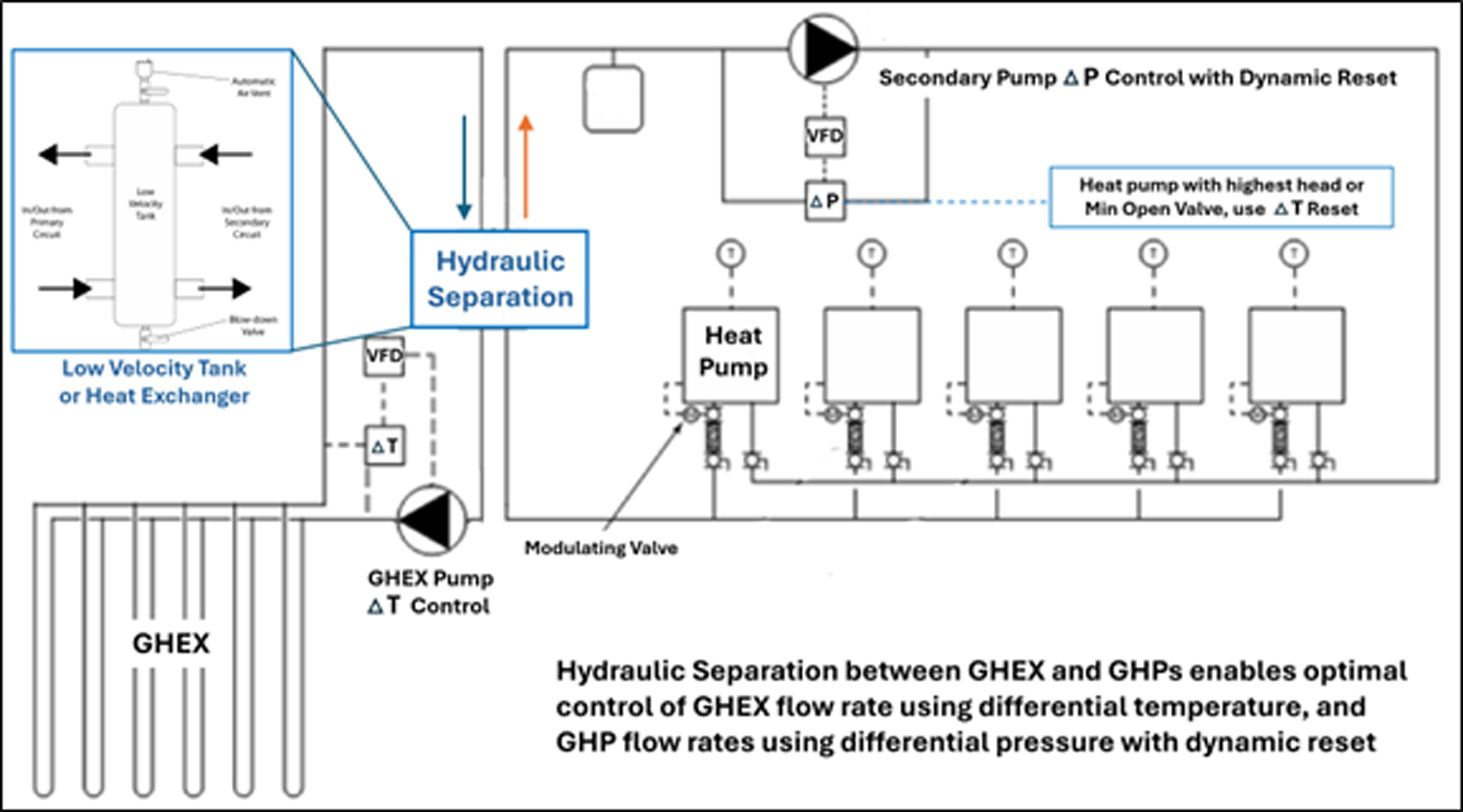
A high-performing GHEX pumping system regulates flow based on the ΔT across the loop, using real system loads rather than fixed flow rates to maintain thermal balance and long-term stability. This is easily implemented by adding a return temperature sensor and configuring the pump for ΔT control — speeding up as building loads rise to maintain the target ΔT.
On the source side, geothermal heat pumps use modulation valves and pump controllers that regulate flow by ΔP with dynamic reset logic. Minimum open valve and ΔT reset strategies ensure proper flow to each unit, preventing overpumping and maintaining manufacturer-recommended conditions. The result is smoother operation, reduced noise and up to 50% lower annual pumping costs at approximately $600 per year for an 180-gallon/minute (gpm) system.
Factory-built modular pump stations and hydronic distribution panels
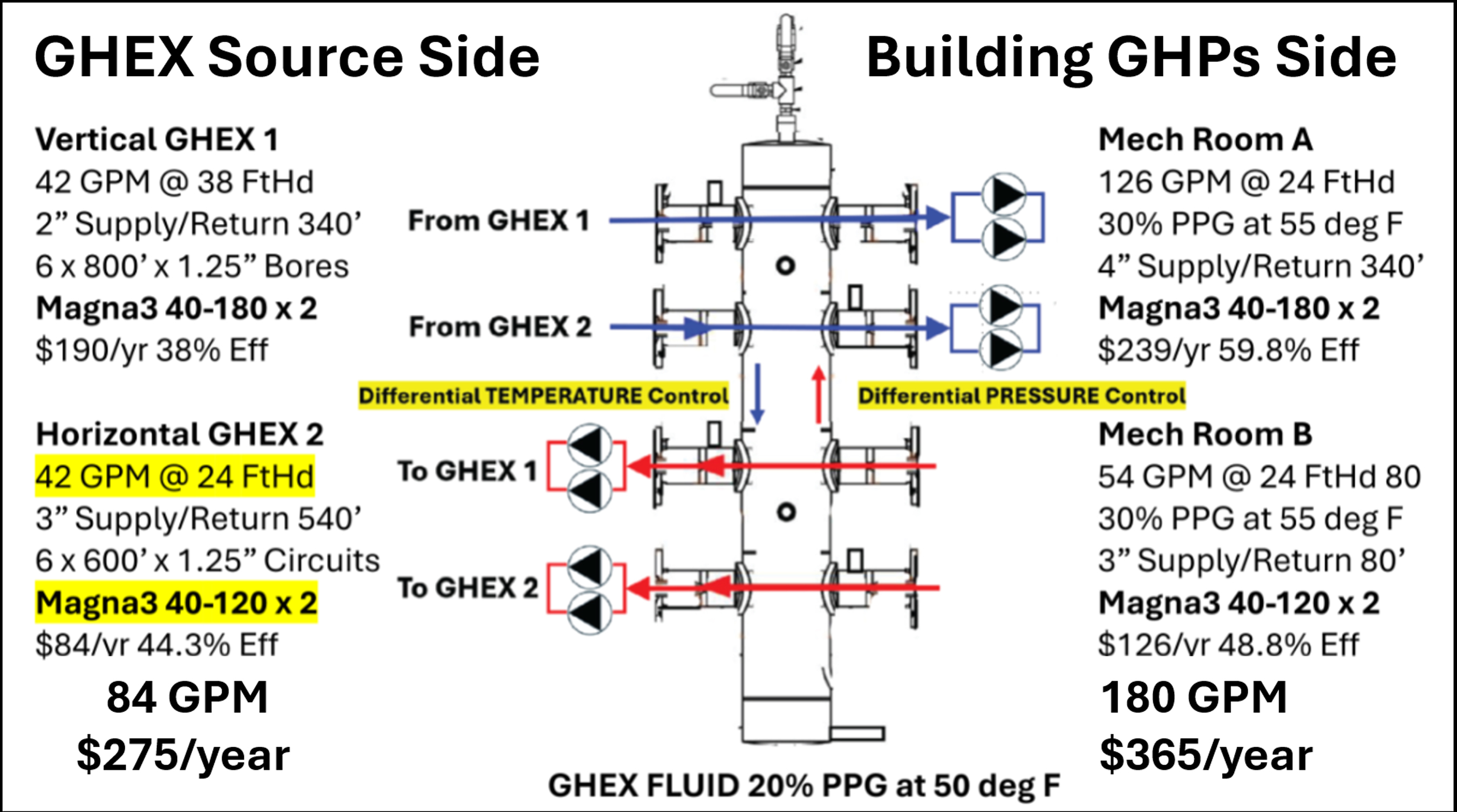
Building on these control strategies, recent advances in geothermal and hydronic design have shifted toward modular, factory-built solutions, such as preassembled pump stations and large hydronic panels that simplify installation, boost reliability and ensure consistent performance. Designed by EEC and manufactured by Geo-Flo Corp., these integrated systems combine controls, manifolds and sensors into a compact vertical assembly, designed for quick, consistent field connections.
Capable of handling up to 60 tons (or 180 gpm) with multiple circuit options, modular pump stations transform the way geothermal systems are constructed, commissioned and maintained. The example shown in Figure 3 allows higher flow rates to offset heat pump loads within the building while maintaining a lower GHEX flow for actual loads.
When zoning for heating and cooling, hydronic distribution provides a highly effective alternative to traditional forced-air ductwork. Factory-built SimplyRadiant panels simplify zoning, enhance comfort and support both radiant and fan-coil heating and cooling applications. This approach is especially attractive for projects prioritizing components manufactured in the United States, since most variable refrigerant flow and mini-split systems are produced overseas.
A manufactured 16-zone panel, shown in Figure 4, can be installed in a single day — compared to nearly a week for site-built alternatives. Panels are available in 12-, 18- and 24-zone configurations, with the 24-zone model capable of serving up to 10,000 square feet.
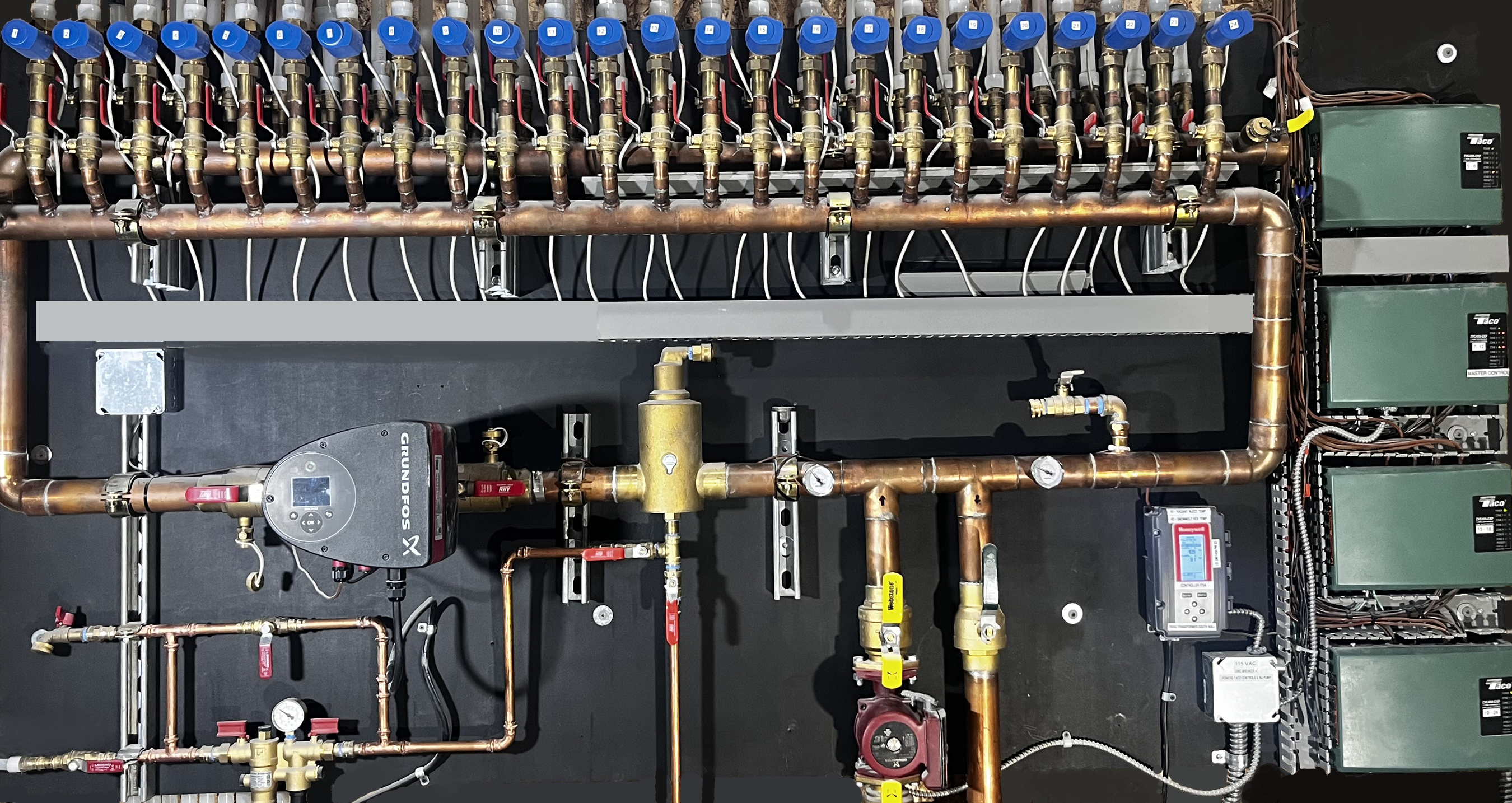
Based on this sizing, the 30,000-square-foot office example discussed earlier would require three panels. Each panel includes an injection pump for precise temperature control in radiant heating and cooling applications, along with a variable-speed system pump operating under ΔP control.
The precision and quality control achieved through factory assembly — where components for control, monitoring and service are preinstalled — deliver consistently high performance without relying on field-built systems that may vary in contractor installation quality or hydronic expertise. Maintenance is simplified, with standardized components correctly located and easily accessible service ports.
This shift toward modular prefabrication represents more than an incremental improvement; it is a redefinition of how geothermal systems are delivered. By treating GHEX infrastructure as a product rather than a one-off design, the industry can achieve economies of scale similar to those that transformed the HVAC and plumbing markets decades ago.
The path forward
The convergence of geothermal and hydronic technologies offers engineers a rare opportunity to redefine energy efficiency and performance in the built environment. With on-board digital controls, variable-speed pumping and modular construction now mainstream, the tools for transformation are already in hand.
The challenge — and the opportunity — is to move beyond one-off projects and focus on perfecting the process itself: developing standardized, repeatable designs that deliver high performance across thousands of buildings.
Now is the time for the plumbing and mechanical engineering community to lead by simplifying systems, scaling innovation and making geothermal the new standard for sustainable building design.
References
• ASHRAE (2022). Addendum r to ANSI/ASHRAE/IES Standard 90.1-2022: Energy Standard for Buildings Except Low-Rise Residential Buildings. American Society of Heating, Refrigerating and Air-Conditioning Engineers, www.ashrae.org.
• Geo-Flo Corp. (2025). Tackling large jobs and retrofits with variable-speed pumps; presented at the IGSHPA Annual Conference. www.geo-flo.com.
• IGSHPA (1997–2025). Design and installation standards for ground source heat pump systems. International Ground Source Heat Pump Association, www.igshpa.org.
• National Renewable Energy Laboratory, New York State Energy Research and Development Authority and Oak Ridge National Laboratory (n.d.). Field monitoring reports on geothermal system optimization.
• U.S. Department of Energy (2017 and 2024). Energy savings potential and RD&D opportunities for commercial HVAC systems. U.S. Department of Energy, Office of Energy Efficiency and Renewable Energy, www.energy.gov/eere/office-energy-efficiency-and-renewable-energy.
• U.S. Energy Information Administration (2021). Commercial buildings energy consumption survey (CBECS): 2018 microdata and preliminary results, www.eia.gov/consumption/commercial. (Note: The CBECS data show that approximately 88% of the 4.3 million commercial buildings that use heating and cooling in the United States are under 50,000 square feet.)