
As technology evolves in buildings, more systems are generating data about their own performance, and our knowledge of how to operate buildings more safely and sustainably continues to grow with it. For consulting engineers who design and specify these systems, this creates both an opportunity and an obligation: the tools now exist to deliver buildings that operate as one system, but realizing that value, requires understanding of what a building automation system (BAS) is, what it does and critically, where it still falls short.
The complexity of maintaining buildings and meeting compliance obligations is also growing, which makes the case for adaptive control and a systems approach more compelling than ever.
This article, the first in a two-part series, defines what a building management system (BMS) is, how it has evolved, and why plumbing systems have been left behind. Part two will focus on how a properly implemented BMS can be applied to strengthen water management plans in buildings.
What is a BMS — and what does it do?
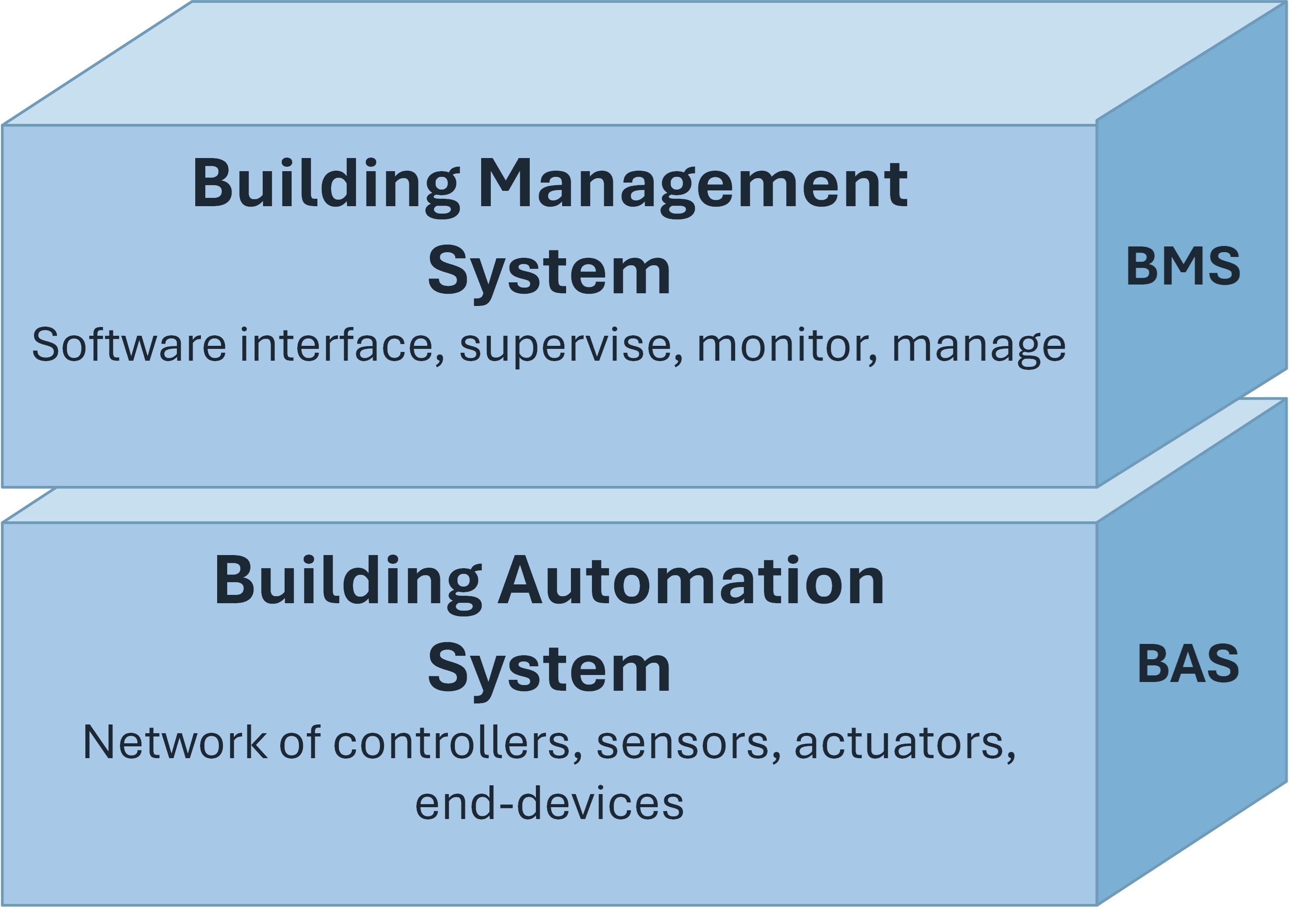
A BAS is the centralized control and monitoring infrastructure for a building’s environmental systems. ASHRAE Guideline 13, Specifying Building Automation Systems, provides industry-standard definitions for the BAS and its related term, the BMS and serves as the foundational reference for engineers specifying these systems.
At its core, a BAS comprises input devices (sensors and meters), output devices (actuators, valves), and controllers that serve as the decision-making layer between them. Those controllers are networked back to a supervisory front end BMS providing data analysis, reporting and analytics. The BMS may or may not be provided by the same BAS contractor.
How a BAS is specified and configured is a foundational engineering decision that is frequently overlooked, particularly on small scale equipment replacements where the interface is left to the incumbent control contractor to define without the design intent and requirements being clearly detailed.
A modern building can exist anywhere on a spectrum — from a collection of standalone direct digital control (DDC) systems with no interconnection, to a fully integrated building platform with cloud connectivity and advanced analytics. The advantage of connecting these systems through a common BMS or third party software platform is to give operators a unified view for daily building operation, work order creation, preventive maintenance planning, alarm notification and diagnosis of issues with proposed actions to resolve them — rather than forcing them to navigate separate interfaces for every piece of equipment.
The integration of multiple systems into a single user interface through a BMS offers the promise of simplifying a building operator’s job while providing a central data repository for analysis and compliance reporting. However, not all building systems have benefited equally from that integration — and as control system engineers, we have a particular stake in closing that gap for plumbing systems.
The focus on integrating building systems into a BMS has historically centered on energy savings and HVAC performance — and for good reason. But domestic water systems are often an afterthought in this conversation, despite carrying significant operational and public health risks.
Engineers responsible for specifying plumbing systems should ask why the same integration philosophy that transformed HVAC operations has not yet been applied with equal rigor to the water distribution systems in our buildings and work with their control system engineers to address this.
How the BAS evolved — starting with HVAC
The BAS industry has its roots firmly in HVAC control. Starting with pneumatic systems in the mid-20th century and transitioning through DDCs in the 1980s and 1990s, the primary purpose of a BAS was to automate HVAC — controlling air handling units, chillers, boilers and terminal units to maintain comfort while managing energy.
That mission has not changed, but the scope of what a BAS/BMS can do has expanded enormously. Now we need implementation practices and contracting structures in the industry to continue to adapt.
Over the past two decades, the industry has progressively integrated additional building systems into the BMS framework: lighting controls, electrical metering, elevator monitoring, life safety interfaces, access control and power management. The logic is straightforward — the more systems connected to a central platform, the more useful that platform becomes, whether that platform is the BMS or not.
Most may think that BMSs today and all the systems they are integrated to provide an end user with all the data points needed, and the focus should be on how to provide value and actionable understanding from that data. That point is arguable in this case, because the lack of system level data being monitored for domestic water systems today is due to lack of intentional sensor deployment with a mission to address the safety, efficiency and risks in these systems.
Understanding how plumbing systems work, areas of risk, etc., are all critical before determining how and where to apply sensors and devices to give owners and operators an understanding of the system and not just more data points.
The more systems connected to the BMS, the more advanced features become valuable. Fault detection and diagnostics, or FDD, — the automated identification of equipment faults, degraded performance and proposed steps for resolution — works best when it can draw data from multiple interrelated systems simultaneously.
Building analytics platforms, advanced reporting dashboards and, increasingly, artificial intelligence applications, all depend on a large variety of inputs and large volumes of historical data so that patterns and anomalies can be readily identified. We first have to ensure that the data foundation exists.
Much of the equipment purchased for buildings today already has onboard automation and integration capability from the manufacturer. The key specification decision that determines whether that capability can be leveraged is communication protocol and interoperability requirements that need to be specified and verified/enforced during the submittal phase of onboard equipment controls.
By specifying widely adopted open protocols — BACnet for building automation controllers, Modbus for equipment integration, and MQTT (Message Queuing Telemetry Transport) for sensor networks and Internet of Things (IoT) devices — engineers ensure that systems from different manufacturers can communicate with a common BAS.
Conversely, specifying or accepting proprietary protocols or system networks locks the owner into a single vendor ecosystem, which is usually not feasible for existing buildings and generally challenging on projects that are not sole-sourced. This is again an area of improvement for the plumbing industry, with manufacturers developing meaningful and valuable software for automated management of plumbing systems, but their software, in some cases, only works with their end-devices.
There is absolutely a place for specialized automation systems in buildings because the expertise required for every system and equipment can’t land on the BAS contractor, but the interoperability with other manufacturers’ end-devices and software platforms is a must for a BMS to be effective. That is critical to advancing our industry and the outcomes we aim to achieve.
The goal is for the technology and those that support the software to provide value and be integrated into a facility team’s processes — not just integrated into a BMS. The people behind the technology/software are just as important to successful implementation and specifications should take this often-overlooked evaluation into account.
Once data is collected by the BMS, it is stored in a database — either internal to the BMS platform or in an external database server. The choice of which depends on the applications that will be used to access the data, and how accessible the BMS database is to third party applications.
For engineers specifying new systems, it is worth considering database architecture alongside controller selection. The two decisions together determine how much operational value the owner can extract from the BAS investment over time.
Establishing structured database access opens the possibility of using the BMS for recordkeeping and compliance reporting. Dashboards can be created that show how building metrics compare to code and certification benchmarks.
More importantly, the process of reporting on building performance and demonstrating compliance with programs like a building’s water management plan can become substantially more automated, providing a record of performance over time. A well-architected BAS, with intentional data retention and reporting requirements, can help tell a story of historical hardware, software and system performance records.
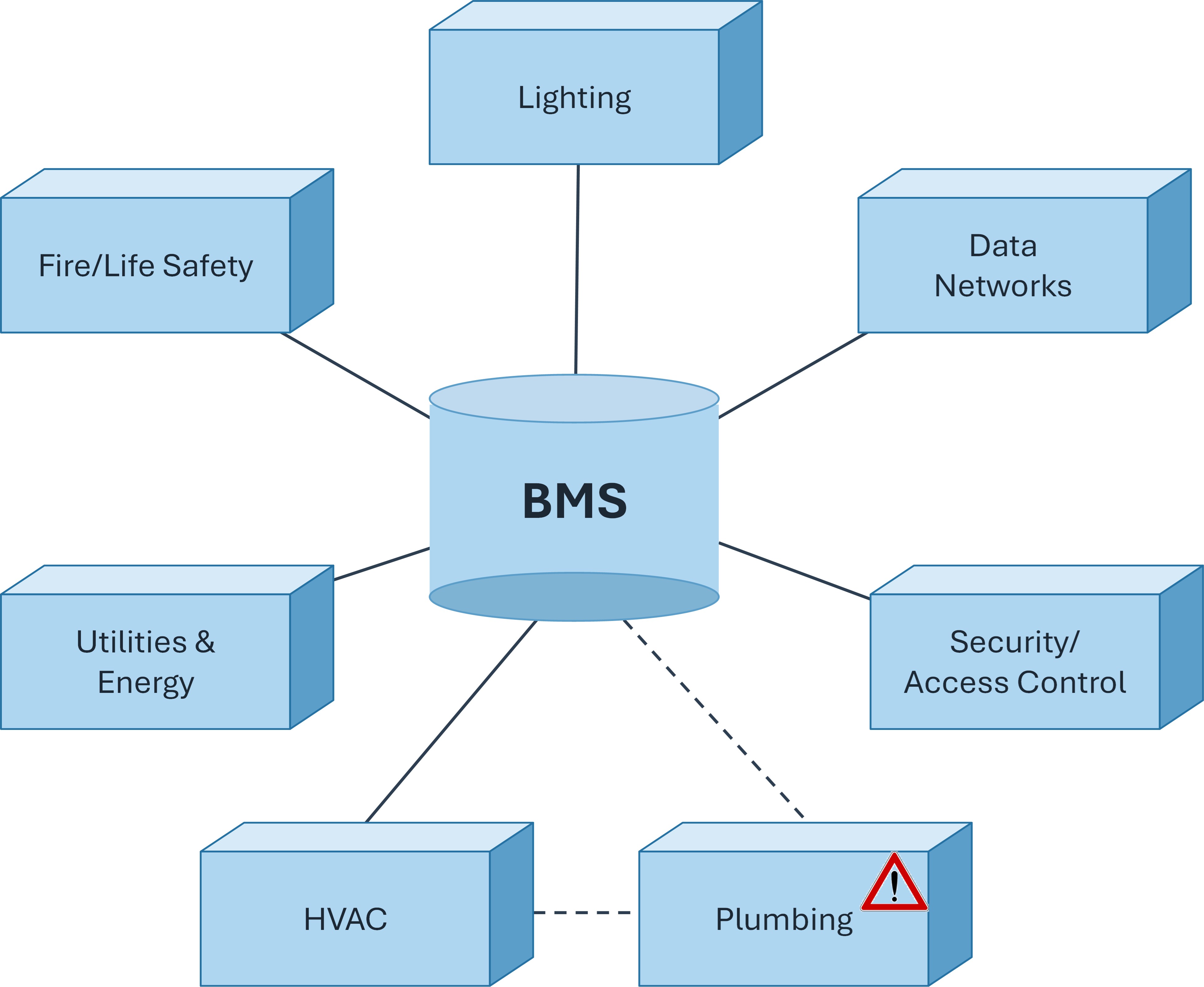
By combining open protocols, connected automation, distributed sensing and a well-structured data architecture, a robust BMS can be built that becomes far more than a control interface. It becomes an operational assistant, supporting daily operator decisions, enabling automated fault detection and compiling the documentation that building owners need for record archives and regulatory compliance.
This is the level of integration that the HVAC and energy management disciplines have been working toward for decades. The question for plumbing engineers is why wait to bring domestic water systems into that same framework.
For example, fault detection and diagnostic requirements in the latest International Energy Conservation Code are greatly expanded but are still primarily focused on HVAC systems and not plumbing systems. The energy consumption and operational impacts of HVAC systems should not outweigh the importance of health, safety and operational efficiency of plumbing systems. We need to consider engineering requirements even if not explicitly required by the code while also contributing to the improvement of industry codes and standards.
Looking ahead
What has been missing is a clear engineering framework for how to specify and implement BMS monitoring and control of domestic water systems with the same intentionality that we bring to HVAC controls design. The technology to close this gap exists. The standards that create urgency for closing it — ASHRAE Standard 188, Legionellosis: Risk Management for Building Water Systems, and the Centers for Disease Control and Prevention’s Developing a Water Management Program to Reduce Legionella Growth & Spread in Buildings toolkit — are well established.
This requires plumbing design engineers and manufacturers to sit at the table with controls/automation design engineers to deliver a result aligning with the needs of all defined end users. This effort promises to provide safer, well documented systems and save building operators time.
BMSs are maturing with technology that expands its capabilities with analytics, advanced data visualization and artificial intelligence as those technologies emerge.
As an industry, we must be cautious not to focus on these emerging capabilities without first ensuring that the foundational data elements exist and are implemented properly for these new technologies to add operational value. By getting all the stakeholders in a conversation about leveraging existing BMS technology in plumbing systems, change can happen quickly. l
Maria Campos, DCES, LEED AP, is an associate principal at Callan Consulting Engineers, with over 16 years of experience in controls and building management systems. She is an active member of ASHRAE and the American Society of Plumbing Engineers. Maria’s systems engineering background has allowed her to holistically evaluate the impacts between all building systems and their integration and value-add capabilities for all facility types.
Steve Titus, PE, is a senior project engineer at Olsson Engineers with more than 30 years of experience in building automation and controls, who specializes in designing and implementing BAS solutions for complex facilities. A licensed Professional Engineer and past ASHRAE chapter president, he currently supports innovative and efficient automation strategies at Olsson and is a member of ASHRAE.



