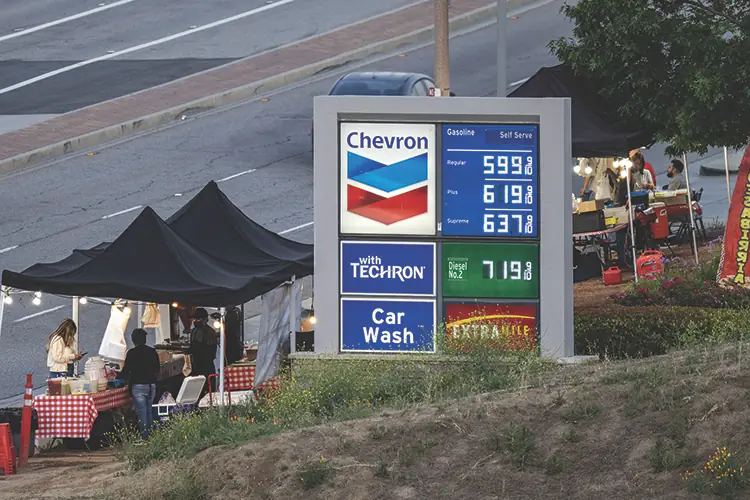
Diesel fuel is a major source of inflationary pressure throughout the PVF supply chain. Disruptions to oil output and refining in the Middle East and Russia have pushed the national average to $6.51/gallon, while average trucking rates have risen to $3.21/mile, including fuel surcharge, from $2.40/mile a year ago.
The Group of 7 (G7) countries and European allies — the United States, France, Germany, Italy, the United Kingdom, Japan and Canada — agreed to release over a four-month period 100 million barrels of crude oil, diesel and refined fuel products from strategic emergency reserves to cool surging energy prices.
The release will begin immediately and will be coordinated through the International Energy Agency.
Crude oil exports from the Strait of Hormuz have largely returned to levels seen prior to the outbreak of the Iran war, as producers and the shipping industry have found alternative routes for transporting fuel out of the Middle East.
Pipeline exports and ship-to-ship transfers are among the methods being used, while the U.S. military continues to escort some vessels.
However, the flow of refined products, especially diesel, remains constrained, pushing prices higher.
As of this writing, oil pricing at WTI is at $89.61/barrel and Brent is at $10.01/barrel. The national average for diesel fuel is $6.32/gallon.
The Iran war is not the only factor influencing the rise in gasoline, diesel and other refined products.
The closure of refineries in California and environmental restrictions and regulations that prohibit investment in new grassroots refining capacity, along with expanding demand, contribute to higher prices at the pump. Refineries were operating at 96% of capacity at the end of September.
Turnaround season and the shift to winter fuel formulations are approaching, creating additional constraints on production capacity as year-end nears.
On Oct. 5, President Donald Trump signed an executive order aimed at reducing diesel fuel costs, primarily by temporarily allowing red-dyed diesel for on-road use through the end of the year.
That fuel is usually for off-road uses such as farming. The tax break shaves of a few dozen dollars per fill depending on the size and local taxes. It does not fix the supply issue but affords temporary relief as we approach year end.
In addition, President Trump and Russian President Vladimir Putin have struck a deal for the United States to purchase a limited amount of diesel fuel to ease the price at the pump. Trump has received criticism from both sides of the aisle. As of this writing, the deal is still in effect.
Construction driven by data centers and gas-fired power
Data center construction spending accelerated by 7.5% at the end of August, according to the latest information released by Associated Builders and Contractors (ABC). The sector accounted for much of the growth in the U.S. construction market.
Acceleration has been particularly pronounced since March. ABC calculates that data center construction spending has increased at a 149% annualized pace year to date.
Higher costs are beginning to affect project spending. In an ABC survey that ended in August, 55% of respondents stated that a project had been canceled, postponed or scaled back in the previous six months, with one-third attributing the disruptions to rising costs.
Data center developers face another obstacle: a growing workforce shortage. Data center-related employment is expected to reach 650,000 positions by the end of 2026. So far, however, there aren’t enough workers to keep up with employer demand for electricians, mechanical and cooling specialists, plus data center engineers.
Currently, an estimated 81,000 jobs are open in the U.S. for electricians alone.
U.S. natural gas plant construction starts hit $4 billion beginning in the fourth quarter. Eight natural gas-fired power projects are scheduled to kick off, adding 3,076 MW of capacity.
Natural gas has taken a close second place among U.S. power-generation projects scheduled to break ground during the final quarter of 2026. Sixty natural gas power-generation projects represent a combined investment of $16.8 billion and 18,083 MW of additional capacity across 10 fuel types.
These include Entergy Corp.’s $1.2 billion, 760 MW Ridgeland Advanced Power Project in Mississippi and Takanock’s $1 billion, 700 MW Baccara Power Station in Waddell, Arizona.
New projects expand the PVF demand pipeline
Additional construction projects are also expanding the pipeline of potential PVF demand. Louisville Muhammad Ali International Airport (SDF) is planning a new 60,0000-square-foot international concourse as part of a multiyear, $1 billion SDF capital improvement program.
The new concourse will include four dual-use jet bridges, allowing gates to accommodate both domestic and international flights. Bidding is scheduled for November, with construction expected to begin in January 2027. Construction is expected to take approximately three years.
AVIO USA broke ground in late September on a $500 million rocket motor plant in the Southern Virginia Multimodal Park in Hurt, Virginia. HITT Contracting, a Falls Church, Virginia, mechanical contractor, has been designated as the general contractor. The 900,000-square-foot facility is expected to be completed in late 2028, with production slated to begin in early 2029. The Virginia facility will be able to produce thousands of solid rocket motors for U.S. tactical missile programs.
Carbon steel piping manufacturers extend lead times
Demand for carbon steel piping products has reached levels not experienced in decades. As a result, manufacturers continue to extend lead times as production capacity struggles to keep pace with incoming orders. In several product categories, deliveries now extend into 2027.
Offshore producers and suppliers of seamless carbon steel pipe continue extending delivery schedules into late 2027 and, in some cases, into 2028. Global supply chain disruptions remain a contributing factor.
Container availability remains inconsistent, while ocean freight costs continue to trend upward. These developments contribute to firmer offshore PVF pricing and increasing concerns regarding product availability. Reports of shortages involving carbon steel fittings, flanges and other critical PVF components continue to emerge across multiple market sectors.
Domestic carbon steel butt welding fittings and forged steel flange pricing have been substantially increased by several manufacturers, reflecting strong demand and rising material, shipping and manufacturing costs. This was anticipated, needed and way overdue.
Raw-material availability has forced several segments of the carbon steel butt-welding fitting market onto a “price on application” basis. Confirm pricing and availability with the manufacturer before committing to an order.
Future price increases should be anticipated due to the rising costs of material, energy and transportation.
For the PVF sector, rising energy costs affect every stage of the value chain, from steel making and manufacturing to transportation and final project execution. Companies that maintain proactive procurement strategies and realistic budgeting assumptions will be in the best position to navigate continued volatility.
Networking at the PVF Roundtable
The same market pressures driving procurement and budgeting decisions also make industry collaboration more important. The PVF Roundtable (PVFRT) continues to recognize the urgent need to develop and sustain a highly skilled workforce capable of meeting demand across the construction, manufacturing and PVF industries. Workforce development remains one of the industry’s highest priorities and requires continued support from manufacturers, contractors, distributors, engineering firms, educational institutions and end users.
Contractors, fabricators, engineering firms, pipeline operators, manufacturers and service providers are encouraged to partner with the PVF Roundtable to help attract and develop the next generation of industry professionals.
The PVFRT Charitable Foundation, a 501(c)(3) organization established by the PVF Roundtable, remains committed to supporting education and workforce development. Through scholarship programs focused on PVF-related trade education and technical training, it has awarded more than $3 million in scholarships.
Funding for these programs is generated primarily through the PVF Roundtable’s Annual Golf Tournament and Annual TroutBlast, both of which continue to receive outstanding industry support.
The next PVF Roundtable networking meeting and annual Casino Christmas Party will be held Dec. 8, beginning at 4:30 p.m., at Houston’s Bayou City Event Center. The highly popular Christmas party is both a celebration of the PVF Roundtable’s work and a fundraiser for Toys for Tots. Please bring a gift or a donation.
The PVF Roundtable continues to serve as one of the industry’s premier forums for networking, education, workforce development and advocacy. As market conditions become increasingly complex, opportunities to share market intelligence, discuss current business conditions, strengthen existing relationships and explore new opportunities are even more valuable.
In an era defined by rapid technological advancement, workforce challenges, supply chain uncertainty and evolving market dynamics, industry networking remains one of the most effective ways to stay informed and maintain a competitive advantage. The PVF Roundtable remains committed to fostering these relationships and supporting the continued growth and success of the PVF industry.