When New York City commuters step onto deep, underground subway platforms during summer heatwaves, they are routinely greeted by platform heat indices exceeding 132 F (55 C) and ambient air temperatures up to 15 degrees hotter than street level. Platform surfaces and tunnel masonry continuously absorb radiant heat from braking trains, passenger crowds and train air-conditioning exhaust, turning century-old station caverns into subterranean heat traps.
In major station complexes — such as the Brooklyn Bridge-City Hall and Chambers Street complex — summer platform temperatures average 96 F (35 C), creating dangerous heat conditions for passengers and transit workers alike.
For mechanical engineers, MEP designers and trade executives, the traditional instinct might be to specify higher-tonnage chillers or forced-air split systems. However, in an unsealed, 100-year-old mass transit system, conventional mechanical air conditioning is a physical nonstarter. There is simply nowhere to place massive, air-cooled condensers or chiller plants in the extraordinarily congested urban landscape above.
Even if space could be strategically found for cooling towers, those towers pose severe public health risks due to Legionella outbreaks. As New Yorkers well know from recent summer outbreaks and fatalities, cooling towers are not the answer.
Furthermore, attempting to cool subway caverns by rapidly moving forced air through the tunnels is equally a nonstarter. High-velocity airflow picks up heavy steel brake dust, particulates and floor debris from subway surfaces, quickly clogging equipment fins, choking condensate pans and degrading indoor air quality. Consequently, the only physically viable answer for transit platform cooling is hydronic radiant cooling.
Passive groundwater direct cooling and subsurface thermal energy storage
Before deploying active compressor chillers or complex heat pump skids, mechanical designers can capture immediate, low-cost thermal relief by leveraging the Metropolitan Transportation Authority’s (MTA) existing hydrological infrastructure. The MTA operates countless dewatering wells and hundreds of pump rooms that continuously move groundwater at a naturally stable 55 F to 66 F (13 C to 19 C) to keep tunnel structures dry.
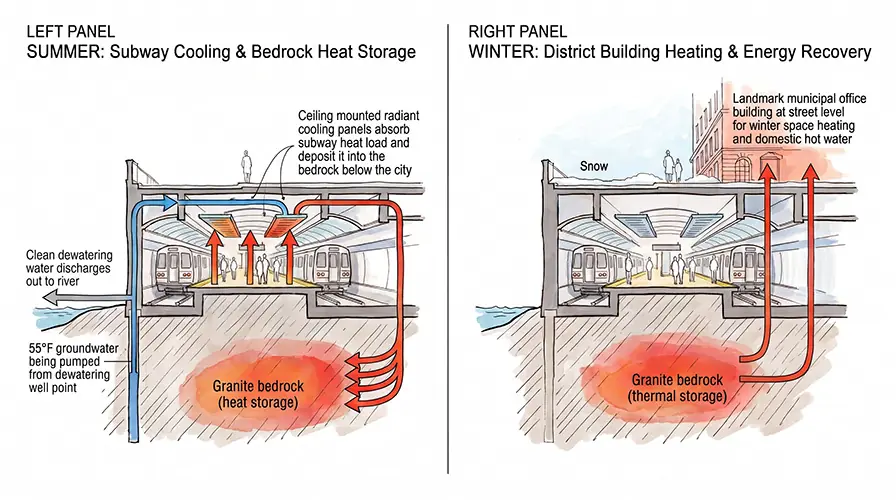
In a passive direct-exchange configuration, cold 55 F to 60 F groundwater is drawn from a single-point dewatering well in a natural bedrock fracture and passed through a high-efficiency plate-and-frame heat exchanger to achieve hydraulic isolation. On the secondary side, a closed water-and-glycol loop circulates chilled fluid (at approximately 58 F) through ceiling-mounted hydronic radiant cooling panels installed over platform waiting areas.
Because platform surfaces and ceiling vaults regularly exceed 110 F (43 C), natural radiant heat transfer occurs directly between passengers, masonry surfaces and the cool overhead panels — stabilizing platform temperatures down to an 80 F to 85 F baseline without moving dusty air.
Once the primary groundwater stream transfers its heat across the plate heat exchanger, the thermally neutral water exits and is safely discharged to surface waterways as currently routed. On the secondary closed loop, the absorbed 90-plus F platform heat is directed into a vertical closed-loop borehole field drilled into Manhattan schist bedrock.
This creates a high-density borehole thermal energy storage (BTES) battery, banking the 90 F heat plume underground for winter extraction by municipal building thermal energy networks (TENs).
This integrated passive direct-exchange and thermal banking approach delivers three major mechanical advantages:
1. Minimal electrical consumption. Operating without power-hungry compressor chillers or direct-expansion units, system energy consumption is limited entirely to small, low-horsepower fluid-circulation pumps.
2. Immunity to tunnel dust. Conventional forced-air coils rapidly clog when train piston action blows brake dust across finned coils. Hydronic radiant ceiling panels cool surfaces silently without moving air or choking on tunnel particulates.
3. Targeted microclimate relief and seasonal energy banking. While passive groundwater exchange does not provide active mechanical dehumidification, it reliably knocks platform temperatures down from sweltering 100 F to 110-plus F heatwave spikes to a stabilized 80 F to 85 F baseline, converting an unbearable “underground sauna” into a comfortable transit environment while banking renewable heat for winter district energy.
Active bidirectional geothermal networks and subsurface energy balance
While passive groundwater exchange provides immediate platform relief, relying solely on a “cooling-only” design creates a long-term thermodynamic hazard. Dumping millions of BTUs of rejected heat into the subsurface month after month without winter extraction causes ground thermal saturation.
Over consecutive seasons, the surrounding rock mass warms, degrading fluid-to-ground temperature differentials, tanking system efficiency and ultimately rendering the wellfield ineffective.
Senior hydrogeologist John Rhyner, P.G. (retained by Egg Geo and having authored more publications and completed more projects on this subject than virtually any other hydrogeologist), noted this exact ground thermal saturation issue during his design of the landmark geothermal system at St. Patrick’s Cathedral in Manhattan. To maintain long-term subsurface energy balance, transit geothermal networks must be bidirectional.
Bidirectional operation means that heat absorbed from subway platforms during summer cooling is extracted during winter months to provide space heating and domestic hot water to surrounding buildings through TENs. It is important to emphasize that bidirectional thermal energy storage does not mean relying exclusively on standing column wells (SCWs).
Closed-loop borehole systems are exceptionally competent for BTES. In fact, closed-loop BTES studies have been proven and extensively cited worldwide, including at major U.S. federal installations in Georgia.
During peak summer cooling, water-to-water geothermal heat pump chiller skids draw source water from the 55 F to 60 F groundwater dewatering stream and subsurface wellfields, delivering precision 45 F chilled water to high-load station zones while rejecting 85 F to 95 F condenser water into the subsurface formation.
In winter, the cycle reverses: heat pumps extract the stored 80 F to 90 F energy from the ground, circulating warm hydronic fluid to heat station spaces, run sidewalk snowmelt loops or supply surrounding municipal buildings.
Subterranean logistics: Staging from dead spatial assets
Executing subsurface mechanical and drilling work in dense urban centers typically involves extensive street closures, utility relocation permits and surface traffic disruption. The MTA initiative at Chambers Street solves this through an innovative logistical approach: staging operations from dead spatial assets. The Chambers Street station complex contains an abandoned center island platform that has been closed to passenger traffic since 1931.
By mobilizing equipment onto this inactive subterranean platform, drillers and piping contractors can operate 24/7 without disturbing surface traffic or active passenger train movements. However, working inside an active underground transit envelope imposes strict mechanical constraints:
• 100% electric, zero-emission rigs. Operating standard diesel drilling equipment in active subway tunnels creates carbon monoxide accumulation and severe air quality violations. Contractors must deploy low-clearance, track-mounted, 100% electric sonic drill rigs or compact crawlers.
• Glacial overburden casing. Downtown geology features a deep overburden valley of Pleistocene glacial till, silt and artificial river fill. Heavy casing must be driven deep into competent Manhattan schist bedrock before open-hole SCW or closed-loop drilling can proceed.
Municipal off-takers, UTENJA and Local Law 97 economics
The financial driver of a transit TEN relies on the monetization of harvested waste heat. Under the NYS Utility Thermal Energy Networks and Jobs Act (UTENJA) of 2022, public authorities and utilities are authorized to construct thermal distribution lines across public rights-of-way.
During winter, heat extracted from the subsurface thermal battery beneath Chambers Street is piped via insulated underground hydronic lines to nearby municipal facilities managed by the NYC Department of Citywide Administrative Services (DCAS) within a 1,500-foot radius:
• David N. Dinkins Municipal Building (1 Centre Street). A 1-million-square-foot civic office facility housing thousands of municipal employees.
• Surrogate’s Courthouse. Historic 31 Chambers Street civic facility.
• Tweed Courthouse and New York City Hall. Iconic civic infrastructure adjacent to City Hall Park.
By displacing fossil-fuel steam and gas heating baseloads in these civic structures, the transit thermal network directly shields the city from multimillion-dollar carbon penalties under Local Law 97. Long-term energy off-take sales to DCAS generate predictable revenue streams that amortize initial drilling and mechanical capital expenditures.
Furthermore, under the Inflation Reduction Act, public agencies and nonprofit entities can access direct pay investment tax credits ranging from 30% to more than 40% for geothermal network installations.
Implications for mechanical and plumbing professionals
The integration of transit thermal networks represents a broader industry transition from standalone, building-specific HVAC installations toward district-scale thermal utilities. For mechanical engineers, piping contractors and trade executives, mastering these systems requires expertise across several key areas:
• Large-scale hydronic balancing. Integrating open-loop groundwater dewatering sources with closed-loop building distribution piping through plate heat exchangers.
• Heat-recovery heat pumps. Specifying water-to-water heat pump skids capable of simultaneous chilled water production and high-temperature hydronic hot water delivery (140 F to 160 F).
• Empirical microclimate telemetry. Using high-resolution sensor networks — such as CUNY City Tech and Eco Rising Solutions’ 10,000-observation subway dataset — to accurately model radiant heat loads and size subsurface wellfields.
By capturing waste heat, using passive groundwater exchange and managing subsurface thermodynamics, mechanical professionals are turning urban transit liabilities into clean, resilient energy infrastructure.