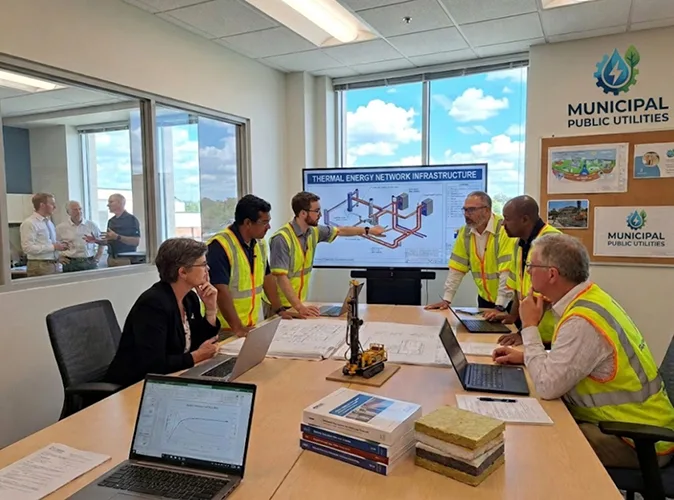
Thermal energy networks are gaining policy and regulatory momentum across the United States as a primary pathway for building decarbonization. Yet, if you look at the pre-construction budgets for early-stage, utility-led pilot projects, you might think the technology is unscalable. We see proposed capital budgets ranging anywhere from $25 million to more than $150 million for systems serving neighborhood-scale loads.
These early price tags are far above what a competitive design-build process yields. As an example, residential energy producer Eversource used a design-build approach in Framingham, Massachusetts, a project for which Eric Bosworth served as the construction professional. Real-world execution shows us that competitive processes ground these projects in reality.
A new whitepaper by Bosworth at Thermal Energy Insights, titled “Benchmarking & Budgeting: Improving Early-Stage Cost Accuracy for Thermal Energy Networks,” addresses this topic head-on (https://bit.ly/4dtSIPQ). The report provides candid insight into why these utility-scale geothermal projects look so expensive on paper. Rather than pointing fingers, we must recognize this as a common growing pain for a growing industry.
We spend every day defining the future of geothermal engineering and design, and we see these exact challenges play out in the market. We know the actual costs of drilling, HDPE piping and heat pumps. We know that refining our budgeting processes is the next crucial step toward successfully scaling TENs.
Here is a look at the key discoveries from Bosworth’s analysis, why our industry experience corroborates these truths and what we can confidently do to optimize the framework.
The dynamics of early-stage budgeting
Bosworth’s report highlights several dynamics that inflate early project estimates. These aren’t intentional flaws, but rather the natural results of how traditional budgeting works in new technology sectors:
• Consultant budgeting incentives: Consultants are paid to ensure their estimates cover the costs, and they have little reason to come in under the average. A death knell for a consultant is to come in below the projected cost. Once a utility or an owner budgets for a project, they look good when the actual pricing comes in at or below that established budget. This creates a natural lean toward heavy conservatism.
• Risk and contingency stacking: Because TENs are a novel asset class for many utilities, they are being hit with compounded layers of conservatism. A base item receives a conservative markup, a blanket contingency is applied over the whole project and soft costs are stacked on top. The report illustrates this: a standard $15,000 circulating pump can quickly balloon into a $40,000 line item by the time it reaches the final budget.
• Public docket price anchoring: Utility budgets are debated in public regulatory dockets long before construction begins. By publishing these highly conservative utility pilot budgets, we inadvertently set a high floor for contractor bids, masking the true market-clearing prices.
• The “pilot tax” on operating expenses: Projected operating costs are made to look bloated by embedding pilot-specific overheads. Regulatory reporting, monitoring and unique property taxes mask the otherwise standard physical costs of maintaining the pumps and piping.
Our perspective: A growing industry
Having engineered and consulted on geothermal and TENs implementations for years, we recognize these findings as standard industry growing pains.
When a utility approaches pumping infrastructure or buried pipe, they have hundreds of years of data and high cost certainty. However, when they approach borefields or building HVAC conversions, unfamiliarity breeds caution. The materials and labor have not skyrocketed. An HDPE pipe installation in a utility TEN shouldn’t cost significantly more than a standard gas main installation of the same diameter.
The higher costs we see are simply an artifact of an evolving process. If we adjust the process, we can confidently demonstrate to regulators and legislators the long-term viability of this industry.
Actionable solutions: The path forward
To protect the future of TENs, the PHCP industry, utility partners and regulators can adopt collaborative, market-driven frameworks. Using the data in Bosworth’s report, here are highly effective steps we can take:
• Hire consultants who have designed these projects previously: Unfamiliarity naturally drives up contingency padding. By engaging consultants who have successfully designed TENs, owners tap into a realistic understanding of material and labor requirements. This prior experience removes the need for compounded “first-mover” contingencies and brings design budgets back to reality.
• Hire consultants who have managed these projects: It is equally important to bring in professionals who have actively managed the construction and installation of borefields and thermal networks. These consultants know the real-world operational and construction elements. They can accurately strip away the pilot tax bloat and provide actionable, grounded estimates.
• Leverage paid, independent design-build estimates: Once an initial design is generally facilitated by a consultant, competent design-build firms should be paid to create a design-build budget without knowledge of what the consultant stated. When two or three firms are paid to do this — and the emphasis ought to be on paid, since there is no guarantee they will win the project — they will strive for the opportunity to provide a design-build price that they can execute themselves.
This approach ensures that prices will be reduced in a competitive market, moving us away from conservative estimates and toward true market-clearing costs.
Bosworth’s whitepaper is an excellent tool to help our industry mature. By understanding the motives behind early-stage estimates and shifting toward competitive, experience-based strategies, we are making tremendous progress. This is an exciting time for geothermal, and by working together through these growing pains, we will build the clean energy infrastructure we know is possible.
A special thank you to Eric Bosworth, principal at Thermal Energy Insights. He has deep experience in the sector, including serving as the construction professional for the Eversource TEN design-build project in Framingham, Massachusetts. He is the author of the featured whitepaper, “Benchmarking & Budgeting: Improving Early-Stage Cost Accuracy for Thermal Energy Networks.”