One morning, when microbreweries were starting to pop up, a brewer called and asked if I knew brewery steam systems. I’d never worked on a brewery boiler and thought, “Steam is steam, right? Water boils, steam travels through pipe, heat transfers and condensate returns. I got this.”
“Of course,” I fibbed.
When I arrived, the boiler was off on the manual limit pressure control. The steam pressure read zero, and water was on the floor of the boiler room. After pressing the reset button, the burner started right up. I love calls like this, I thought.
The boiler pressure started building. When it went past 5 psi, I was concerned. Glancing at the operating pressure control, I saw it was set for 15 psi. “Why would it be set for 15?” I wondered.
As the boiler pressure hit 15 psi, everything quickly went sideways. The burner shut off, but I saw the manual reset pressure control was tripped. Suddenly, the pop safety valve opened, filling the room with steam. I couldn’t see anything. That’s the day I learned that space heating and brewing boilers operate vastly differently.
Brewers like steam because it has several advantages over direct-fired kettles:
Uniform heating around the kettle.
No hot spots that scorch the wort.
Very accurate temperature control.
One boiler can serve multiple vessels.
Steam can also heat domestic hot water, clean-in-place (CIP) systems and building heat.
Choosing the right steam pressure
Steam boilers are available in different pressure ratings: low-pressure and high-pressure. Low pressure is steam at 15 psi or below; high pressure is steam exceeding 15 psi. Industrial brewers sometimes use high-pressure steam, as it allows for smaller equipment, but most craft brewers typically use low-pressure steam boilers for several reasons.
High-pressure steam scares most insurance underwriters, and the premiums reflect it. The insurance costs for low-pressure steam systems are usually lower than for high-pressure steam boilers. Some municipalities require licensed boiler operators to run the high-pressure boilers, which could increase operating costs.
Let’s consider low-pressure steam as it’s the most common.
Why brewery boilers run hotter
Commercial steam boilers typically include two basic pressure controls: an operating control and a limit control. The operating pressure control is set for the desired steam pressure at which you want to operate the boiler. As an automatic reset control, it will cycle the boiler on and off between the setpoint and the differential during a call for steam.
The limit pressure control is set to a higher pressure than the operating control and is a manual-reset type. If the boiler pressure reaches the setpoint of the limit control, it will shut off the burner and not start until the pressure drops below the setpoint and the manual reset button is pushed. I typically set this control at 5 to 10 psi higher than the operating control setpoint. The highest pressure you can set the limit control is 15 psi on a low-pressure boiler.
Modern comfort steam systems have been designed around 2 psi (or less) since the late 1800s. At that pressure, the steam temperature is about 219 degrees. Nearly all the useful heat comes from the latent heat released when steam condenses back to water.
The brewer isn't interested in heating a room; he’s trying to boil wort as quickly as possible. That requires higher steam temperatures, which means higher steam pressure. He wants a vigorous rolling boil; you won’t get that with 2 psi of steam pressure at 219 degrees, 7 degrees above water's boiling temperature.
Steam at 15 psi runs about 250 degrees, roughly 30 degrees hotter than 2-psi steam and 38 degrees higher than the boiling temperature of water. That higher temperature difference drives faster heat transfer into the wort. The practical result is that many brewery operators try to run as close to 15 psi as they can get away with.
The risk of operating at higher pressure
This choice creates unintended side effects. If the operating control, limit control and the pop safety are all set at or near 15 psi, you have almost no margin left. Operating the boiler close to 15 psi risks tripping the manual reset limit control and opening the pop safety valve, ruining the batch of beer.
The steam pop safety valve is different than the relief valve on a hydronic boiler. When the pressure inside a hydronic boiler rises, the relief valve opens slowly, allowing water to weep out to lower the pressure. The pop safety valve opens fully when the pressure reaches the safety valve's setpoint.
I have found success running the brewery boilers at around 11 psi. This provides a safety margin of 4 psi to avoid tripping the limit control or opening the pop safety valve. However, I can’t take credit for coming up with that magic number.
I was following the guideline from the pop safety manufacturer. It says, “The minimum operating pressure margin for this type of valve is 4 psig. UNDER NO CIRCUMSTANCES SHOULD THE MARGIN BE LESS THAN 4 PSIG!” It seems pretty clear they don’t want you running the boiler at 15 psig.
After some backlash from the brewer operator, he agreed to the lower pressure and discovered the system works great; no more tripped controls or lost batches from the pop safety valve opening. Brewers also tend to set tighter pressure differentials (1 to 2 psi) than comfort systems (often 3 to 4 psi). Tighter differentials mean more frequent burner cycling.
Controlling oxygen corrosion
This is one of the biggest practical differences. During the heating season, many comfort-heating boilers stay hot for months. Once oxygen is driven off, very little fresh oxygen enters unless makeup water is added.
A craft brewery may only brew one or two days a week. The rest of the time, the boiler water sits at room temperature, where it contains roughly 8 to 10 parts/million of dissolved oxygen. Oxygen + water + steel = pitting. As the water heats, the oxygen molecules are driven out of the water and sent into the piping. When steaming stops, the water cools, and air rushes back in with about 21% oxygen. The cycle repeats.
The result in many brewery plants is accelerated pitting in the boiler and piping, plus higher chemical consumption. Oxygen scavengers (sulfite or nitrite) become more critical than they are on a continuously hot comfort-heating system. Makeup water only makes the problem worse.
Boiler water treatment. All boilers require water treatment, but brewery boilers are more prone to corrosion because they may not be in use every day. The oxygen scavenger in the chemical treatment is used to keep the oxygen molecules from attacking metal surfaces.
I prefer to install a water meter on the makeup water pipe to monitor how much water is made up to the system. Excessive fresh makeup water can quickly ruin a boiler.
Managing flash steam and makeup water
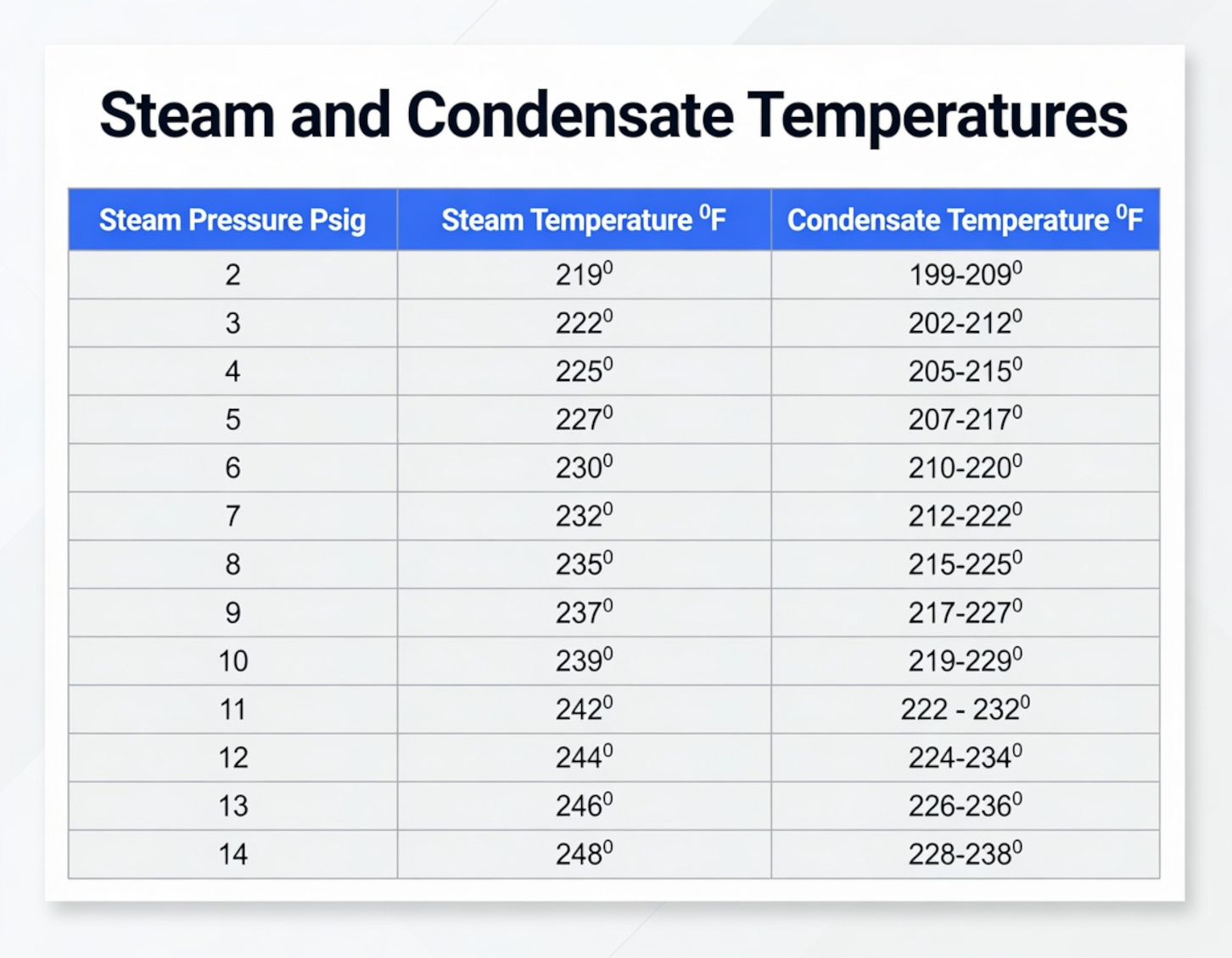
Flash steam is caused when higher-temperature condensate is released into a lower-pressure pipe. Steam at 14 psi has a temperature of about 248 degrees. The condensate temperature is typically 10 to 20 degrees lower, or 228 degrees to 238 degrees (see Figure 1). When the hot condensate enters the condensate pipe at the outlet of the steam trap, it’s at atmospheric pressure. Some of the hot condensate flashes back to steam. This presents itself as steam coming from the boiler feed tank vent.
I like to pretend the steam coming out of the vent is filled with dollar bills. Every puff of flash steam leaving the vent is money disappearing into the air.
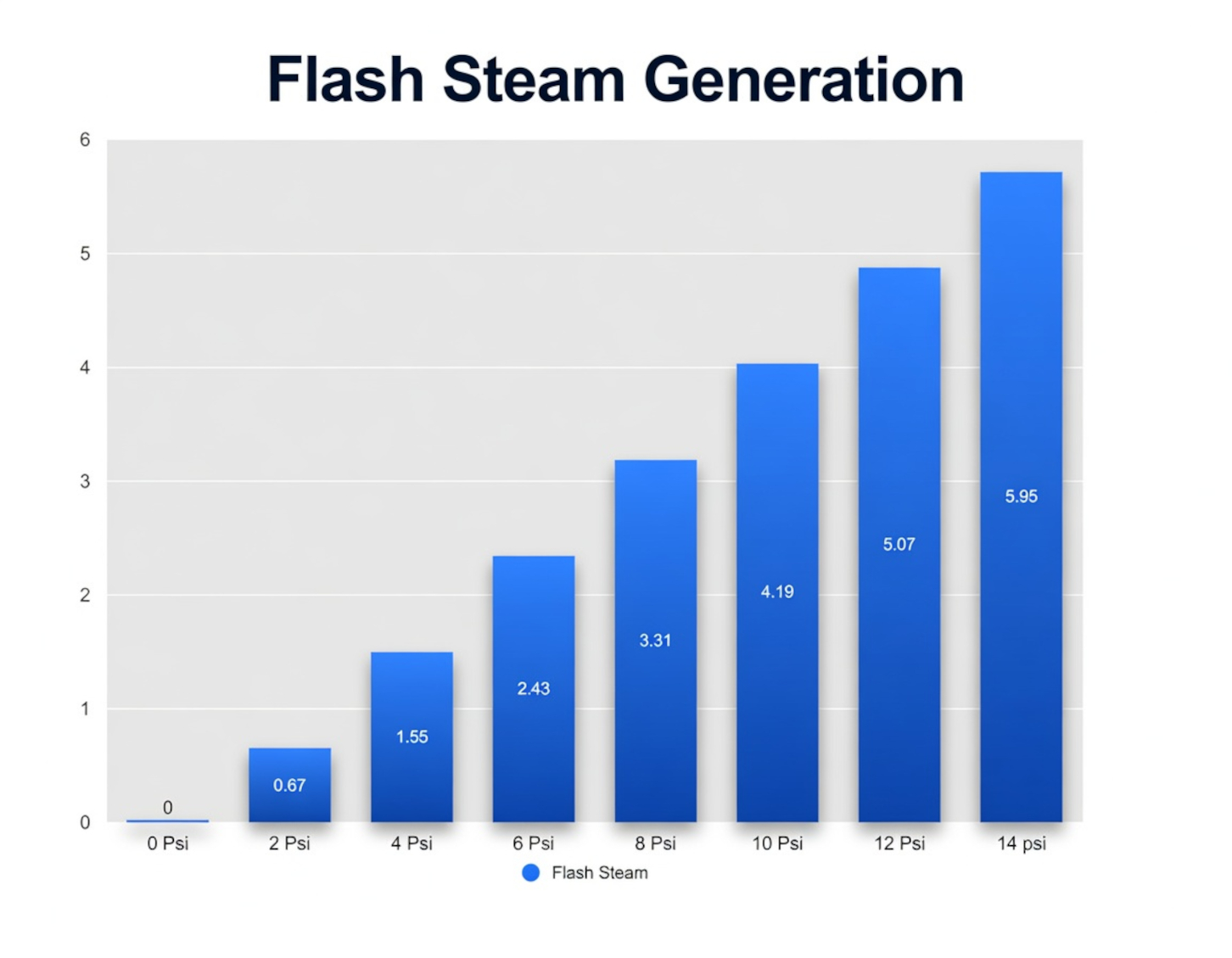
At 2 psi, flash steam is under 1%; at 15 psi, it can reach 4% to 5% or more (see Figure 2). Every pound of flash steam vented is a pound of makeup water that must be heated, treated and introduced into the system. Makeup water brings oxygen, hardness and dissolved solids.
Flash steam in a comfort-heating system usually indicates a failed open steam trap. On brewery steam systems, it’s an everyday reality and a long-term system killer. Whatever you do, don’t plug the air vent on the boiler feed or condensate tank.
Sizing boilers for the brewing schedule
Boilers for space-heating steam systems are sized by adding up the connected load, such as radiators or coils, plus 10% to 20% for piping. Brewery boilers are trickier and require the brewmaster's input. There’s a rule of thumb that says to size the boiler for 50,000 BTU/hour/barrel of capacity. I would not use this sizing, as you will see why.
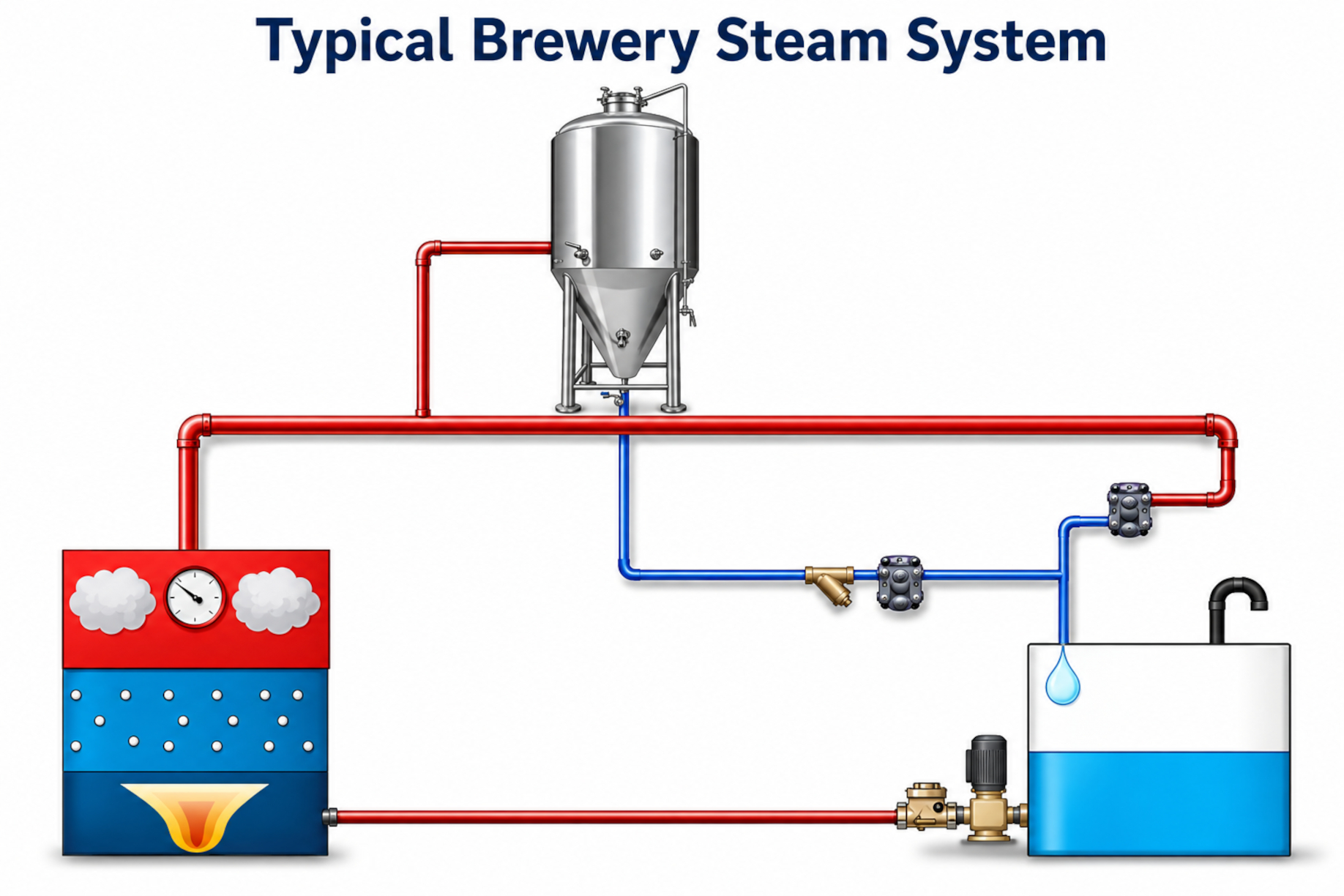
Inside a typical steam brewery, the following components require steam: hot liquor tank, mash tun and brew kettle (see Figure 3). To properly size the boiler, you must know whether the brewmaster plans to operate the vessels one at a time (staggered) or all at the same time (simultaneous). That single decision makes a big difference in boiler size.
Many new breweries start by running the hot liquor tank one day and the mash tun or kettle on another day. If the operation is staggered, a smaller boiler will work. If you size the boiler for simultaneous operation and the brewery actually staggers the process, the boiler will short-cycle, waste fuel and wear out sooner.
Ask a second question: Does the brewmaster plan to increase production later and move to simultaneous operation? If the boiler is sized only for staggered use, it will be undersized when production ramps up.
Once you get clear answers, document the basis of the sizing in writing. You don’t want the brewer to blame you two years later when the boiler can’t keep up.
The best approach is to use the manufacturer’s ratings for the equipment whenever possible. Many new brewers buy used vessels, and the recommended steam pressure or load data is missing.
When sizing a steam system without the manufacturer's BTU ratings, I use the rules of Blaine Clouston at Simplified Stainless:
Brew kettle and boiling: 32,000 BTU/hour/barrel
Hot liquor heating (from 60 F to 175 F in four hours): 19,500 BTU/hour/barrel
Mash vessel heating: 29,000 BTU/hour/barrel
Let’s size a boiler for a 10-barrel brewery using these formulas:
Brew kettle and boiling: 320,000 BTU/hour
Hot liquor tank: 195,000 BTU/hour
Mash vessel heating: 290,000 BTU/hour
Total : 905,000 BTU/hour
If we used the previous rule of thumb of 50,000 BTU/hour/barrel, we would have a boiler sized at 500,000 BTU/hour output and wouldn’t have simultaneous operation. You can see why it’s important to discuss brewery operations with the brewer.
This doesn’t include the CIP systems; keg, cask, bottle or barrel washers; or pasteurization. Those require an article by themselves as you cannot use standard boiler water treatment chemicals because of the exposure to food.
Pipe sizing. A 10-barrel brew kettle may have a 3/4-inch steam opening. If you run a 3/4-inch pipe from the boiler to the brew kettle, you will not have enough steam but will have an angry brewer — not a good thing. You would probably need a 3-inch or 4-inch pipe to carry the required steam.
I tend to slightly oversize the steam main so it acts as a buffer for when the mash tun starts. Steam pipe should always be insulated, as bare pipe loses five to seven times as much heat as an insulated one. Uninsulated steam piping causes banging pipe, overloaded steam traps and wet steam.
Why steam systems need to breathe
When the boiler is cool, the space above the water line in the boiler and the steam side of the system are filled with air. On a call for steam, the burner starts. As steam is generated, the advancing steam gently pushes the air out through the vents. When the steam cycle ends, the steam condenses and air rushes back in to take its place, essentially breathing.
One common installation mistake is installing a solenoid valve on the steam inlet to the mash tun or kettle. This small control valve can cause strange things to happen: the boiler floods, water is pulled out of the boiler when the solenoid opens and the system stops breathing. In most instances, installing a vacuum breaker solves the problem and allows the system to breathe again.
Five things to remember about brewery boilers
Higher pressure is normal, typically 11 to 12 psi.
Oxygen corrosion is a much bigger concern.
Boiler sizing depends on the brewing schedule and equipment.
Flash steam is expected.
Every steam system must be able to breathe.
The next time someone tells you, "steam is steam," remember the lesson I learned standing in boiler room water while a safety valve filled the room with steam. The principles may be the same, but the operating goals couldn't be more different. Understanding those differences can save equipment, prevent nuisance shutdowns, and keep the brewer happy.




