Steam is steam, right? On the surface, a steam boiler serving a brewery or distillery doesn’t look much different than a boiler heating radiators in an old school or apartment building. Water boils, steam moves through pipe, heat gets transferred and condensate returns to the boile However, that’s where the similarities mostly end. Steam systems designed for process loads, such as brewing and distilling, operate under vastly different rules than comfort heating steam systems. Understanding those differences is critical for efficiency, reliability, corrosion control and long boiler life. Let’s examine some of these differences.
Process heat vs. comfort heat
1. Comfort heating steam
Designed to heat air or surfaces for occupant comfort;
Seasonal operation, often idle for months;
Load varies slowly;
Tolerates small inefficiencies without significant consequences.
2. Brewery and distillery steam
Designed for process accuracy and repeatability;
Year-round or near-continuous operation;
Rapid load changes when mash tun or boil kettle starts;
Inefficiencies directly affect:
a. Product quality;
b. Fuel usage;
c. Production schedules.
Comfort steam forgives mistakes. Process steam does not.
3. Pressure setting
On low-pressure comfort steam systems, the pressure controls are usually set for 2 psi or lower. The system relies on the latent heat of steam to provide heat to the building. Latent heat is the energy required to change water to steam. It’s also the energy released into a radiator when the steam condenses back to water.
Brewery and distillery systems rely on both latent heat and steam temperature to do their jobs. The brewers or distillers try running the boiler as close to 15 psi as possible.
Process heating systems, such as those in a brewery, require steam about 30 to 50 degrees higher than the process temperature. Breweries require a rolling boil to make beer. Steam at 2 psi is about 219 degrees, and steam at 15 psi is almost 250 degrees, about 31 degrees hotter.
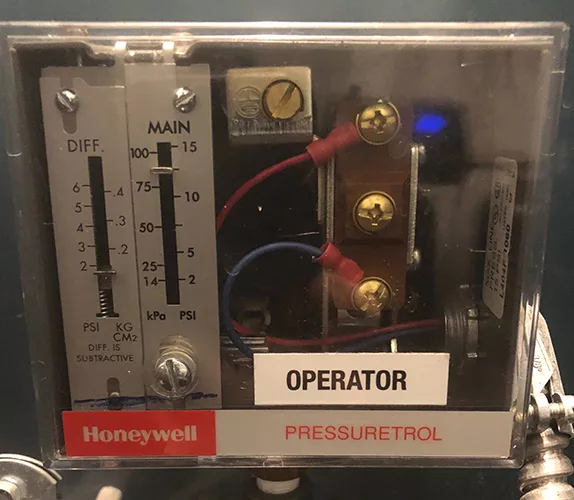
Brewers require tighter pressure tolerances than space heating systems. As a result, they tend to cycle more because the differential pressure is set close. A space-heating system may have a 3- to 4-psi swing, while brewers and distillers aim for 1 to 2 psi.
There are drawbacks to operating a low-pressure steam boiler near its rated pressure of 15 psi. The maximum setpoint for the manual reset limit control is 15 psi. You risk tripping the manual reset limit control when operating the boiler that high. The boiler will not restart until the steam pressure drops below the setpoint and the manual reset button is pressed.
The pop safety valve is also set for 15 psi. If the boiler pressure reaches the pop safety valve setpoint, the valve could open, and the owner would lose all the steam. A steam pop safety valve differs from a relief valve for a hydronic boiler. In contrast, a hydronic relief valve lifts gradually, the steam pop safety pops open fully and closes when the steam pressure drops below the setpoint. The pop safety manufacturers also have a safety margin of 4 psi. In other words, they want the boiler to operate at 11 psi or less.
4. Oxygen concerns
In a space-heating system, the boiler stays hot for most of the heating season, while a brewer may brew only a few days a week. Why is that important?
When boiler water is at room temperature, there are roughly 8- to 10-parts per million of oxygen. The combination of oxygen, water and steel provides a buffer for the oxygen molecule to attack the metal surfaces.
Oxygen corrosion is 34% higher at 86 F than it is at 122 degrees. When water is heated to steam, the oxygen molecules are driven out of the water and enter the system. The oxygen molecules are reabsorbed in the condensate water and delivered to the boiler for more munching. Did you know that dissolved oxygen is 10 times more corrosive than carbon dioxide, which forms carbonic acid?
When the steaming is done, air rushes in to replace the steam. Air is about 21% oxygen, so new oxygen molecules are absorbed into the water and then attack the metal surfaces. To control oxygen in the boiler water, an oxygen scavenger is used. It’s typically a nitrite or sulfite. While every steam boiler needs water treatment, it’s critical for brewery or distillery steam boilers due to the frequent cycling and the idle times when the boiler water temperature is allowed to cool.
Oxygen:
Dissolves rapidly into warm condensate;
It is carried back to the boiler;
Attacks steel aggressively.
This is why many breweries and distilleries see:
Pitting in boilers;
Feedwater line corrosion;
Failed condensate piping;
Shortened boiler life.
5. Flash steam
Flash steam occurs when high-temperature water is released into a lower-pressure atmosphere, and the water changes to steam. The steam is lost through the condensate or boiler feed tank vent. At 2 psi, flash steam is about 0.7%. At 15 psi, the flash steam jumps to almost 4%, five times more.
The lost steam has to be replaced with fresh makeup water, which must be heated and treated. The higher the boiler pressure, the more flash steam, and the more makeup water is added. Higher flash steam at 15 psi means five times more makeup water, potentially adding 10 to 20% to chemical and energy costs. Makeup water is a system killer.
Makeup water brings:
Oxygen;
Minerals;
Chlorides;
Hardness.
Every gallon added increases:
Corrosion risk;
Scaling potential;
Chemical consumption.
In comfort heating, makeup water is usually minimal.
In brewing and distilling, it’s often a daily reality.
Sizing differences
Steam systems are sized for the connected load. For space heating, add all the heat emitters (radiators) and 10 to 20% for the piping. In breweries, you have to include the brew kettle, mash tun and hot liquor tank, plus 10 to 20% for piping. The sticky part is whether they will run in staggered or simultaneous mode. They may operate the brew kettle one day and the mash tun on another.
If the boiler is sized for simultaneous operation, it will cycle itself to death with only the brew kettle, mash tun or hot liquor tank running. A 10-year-old brewery boiler we serviced would cycle on and off every two minutes while brewing was underway. It’s always good to talk with the brewer or distiller before sizing the boiler to discuss their planned operation.
While the steam systems technically do the same thing, there is a difference in how they operate between a space-heating system and a brewery/distillery.