Engineers are trained to solve problems. We calculate, analyze, design and develop systems that make our communities safer and improve everyday life. Yet some of the most meaningful work engineers do never appears on a set of construction drawings.
Meaningful work rarely begins with a title or an invitation. It begins when someone is willing to step forward, raise their hand and say, “I can.”
Maybe it’s serving on a committee or mentoring a young professional. It could be contributing to code development or advocating for legislation. Sometimes it involves leading a professional society or simply speaking up when an engineering perspective needs to be heard.
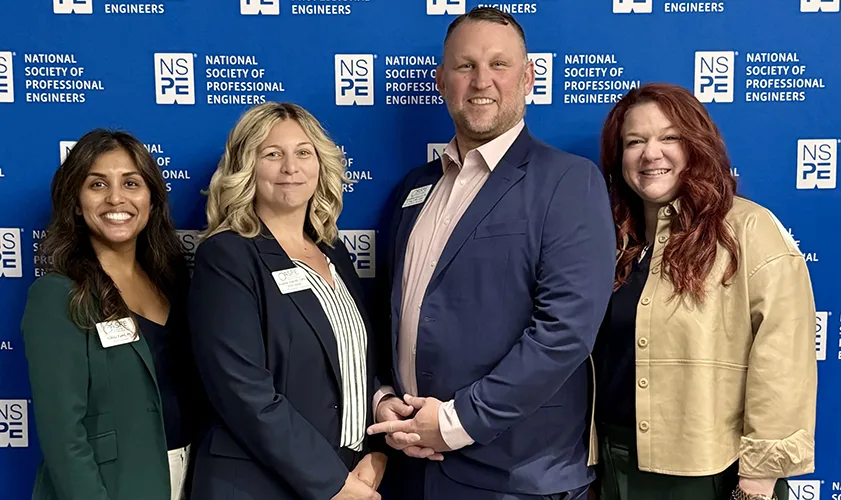
At NSPECon26 in New York City, we had the privilege of joining fellow ASPE Board members Brianne Hall, PE, FASSE, CPD, ASSE 6060, and Jonathan Franzese, PE, P.Eng, CPD, to present a panel discussion on Volunteerism & Engineering Community Involvement in Advancing Legislation. Although we arrived with different career paths and volunteer experiences, we all share one common belief: Getting involved has the power to influence not only an engineer’s career but the future of the profession.
Introduction to ASPE
The American Society of Plumbing Engineers (ASPE) is the international organization dedicated to advancing the plumbing engineering profession. With nearly 8,000 members worldwide, ASPE brings together students, emerging professionals, plumbing designers and engineers, manufacturers and other industry partners through Student, Associate, Full and Affiliate memberships (https://bit.ly/4qn64TU).
Guided by its mission and vision to advance the profession, protect public health and safety, and support the growth of its members, ASPE provides technical education, professional development, credentialing, standards and legislative involvement, networking and industry resources.
Much of that work is driven by ASPE’s volunteer committees, where members contribute their knowledge and experience to credentialing, education, technical initiatives, legislative advocacy, membership and the continued advancement of the plumbing engineering profession.
Professional development
Our panel discussion explored how volunteerism develops leadership skills, expands professional networks, creates mentorship opportunities and gives engineers a meaningful voice in shaping codes, standards and legislation that ultimately protect the health, safety and welfare of the public. We also reflected on how professional involvement has influenced our own careers, opening doors to opportunities that none of us anticipated when we first started our journey.
Before becoming involved in ASPE, none of us expected volunteer service to influence our careers the way it has. Through committee meetings, chapter events and Society initiatives, we found ourselves collaborating with engineers from across North America, and around the world.
Many of these engineers have become mentors, colleagues and lifelong friends. Those relationships opened doors to speaking opportunities, leadership positions and experiences we never imagined when we first volunteered. Volunteerism has made us better engineers, better leaders and stronger advocates for our profession.
One message resonated: The future of engineering depends on engineers who are willing to participate and remain involved. It will not be shaped by a handful of leaders. It will be shaped by thousands of engineers who choose to raise their hands, share their experiences and invest in those who follow.
Looking back on the discussion in New York, one idea stayed with us long after the session ended. Every ASPE leadership journey represented on the panel began the same way. It wasn’t with an election, a promotion or a committee appointment. It was simply by volunteering to help.
For Blair, the goal was to expand her knowledge. She joined to learn more about an engineering specialization that was not available in college. Brianne was an HVAC engineer who needed more plumbing engineering experience. She found ASPE as a valuable resource to grow her knowledge in this arena. Jonathan’s employer strongly advocated for their plumbing engineers and designers to join ASPE. Alternatively, Nikita joined ASPE for its networking benefit. As a sales engineer, she would regularly meet MEP engineers at monthly meetings.
As we concluded the discussion, we recognized another common thread among the panelists. Each of us has chosen to continue serving ASPE by seeking Society leadership roles in the upcoming 2026–2028 Society elections, which will take place this fall during the ASPE Convention & Expo in Oklahoma City.
While the specific positions may differ, our motivation is the same: to continue giving back to the organization and profession that have invested so much in our own growth. Every opportunity we accepted through ASPE introduced us to people, challenges and experiences that changed the direction of our careers.
Credentialing with ASPE
ASPE’s mission to advance the plumbing engineering profession through education and technical standards is supported by the many credentials it offers to fill an important gap in the design industry.
The Certified Plumbing Design Technician (CPDT) recognizes the foundational plumbing design knowledge while the Certified in Plumbing Design credential (CPD) demonstrates advanced competency and experience. The Green Plumbing Design (GPD) certificate focuses on sustainable, water and energy conscious design.
Together, these credentials provide a professional development pathway for plumbing designers, demonstrate specialized knowledge to employers and clients, and establish benchmarks for proficiency within the industry.
ASPE has helped bridge the gap between traditional engineering education and the specialized knowledge for plumbing system design. Credentials are not just added letters after your name; they are about demonstrating a commitment to technical excellence, continued learning and raising the standard of our profession.
Legislative initiatives
NSPECon was held in Brooklyn this year, and as we dove into legislative initiatives, it was important to discuss some local current events that are impacted by plumbing. Just earlier this summer, the city declared a Legionnaires’ Disease Cluster in the Upper East Side. Legionella and water management have changed how we think about building water temperatures, stagnation, system operation and public health.
As high-rise development continues within the city and across the country, designers are challenged to rethink how we use, conserve and reuse water. Water recycling systems, such as greywater, are important as aging infrastructure and growing demand introduce new treatment, storage and distribution requirements.
Codes, standards and legislation are the rules, playbook and referee for engineering, and each can influence the others. Engineers who participate in ASPE committees, code development and legislative initiatives can bring real-world design experience into that process. Ultimately, they are helping ensure requirements are technically sound and practical, while remaining focused on protecting public health, safety and welfare.
As we wrapped up our program, we ended with a strong call to action. We hope to encourage those who attended NSPECon —and others — to join a professional society to grow leadership skills. Other ways to get involved include engaging in code development and investing in credentials.
Within ASPE, there are countless examples of members who have raised their hands, volunteered their expertise and worked diligently to move the plumbing engineering profession forward. One of the best examples is the effort to establish a dedicated Plumbing Engineering PE exam.
For years, plumbing engineers have pursued licensure through broader mechanical engineering examinations that do not fully represent the specialized knowledge they use every day. ASPE has worked for many years with industry professionals and NCEES to demonstrate the need for a plumbing-specific examination.
Approval of the Plumbing Engineering PE exam represents a major milestone for the profession and provides a licensure pathway that better reflects plumbing engineers’ actual practice and responsibility for protecting health, safety and welfare. The next steps include continued exam development, validation of exam content, preparation of reference materials, candidate resources, and ultimately, implementation of the examination.
Looking even further ahead, the profession has an opportunity to establish plumbing engineering as a dedicated focus within an ABET-accredited engineering program. Many engineers discover this specialty only after entering the workforce.
Creating a pathway from formal education to industry credentials to a dedicated PE examination would strengthen the profession and give the next generation a clearer path into plumbing engineering.
W. Blair Minyard, PE, CxA, CPD, CDT, is a Senior Mechanical Engineer with Stantec and Vice President, Technical for ASPE. She is an active advocate for the engineering profession through volunteer leadership, technical committees, and prior service as an adjunct instructor.
Nikita Patel, PE, ASSE 6060, is a Sales Engineer at Sherman Engineering Company. She is a licensed engineer in Pennsylvania and serves as the Young Professionals’ Liaison to the ASPE Board of Directors.
Brianne Hall, PE, FASSE. CPD, ASSE 6060, is a Senior Mechanical Engineer at Fishbeck with 20 years of experience designing commercial plumbing and HVAC systems. She has served as Vice President, Legislative for ASPE since 2018 and as a Region Director for ASSE International since 2020.
Jonathan Franzese, PE, PEng, CPD, is a Senior Associate at McKinstry in Seattle, leading the Plumbing Engineering department. He serves as the Vice President, Education for ASPE, and is a member of the Credentialing committee.