While teaching a class on hybrid boiler plants at the Association of Higher Education Facilities Officers’ conference for university facility managers, I noticed one attendee sitting in the back of the room with his arms folded and a skeptical look on his face. His name was Jack, and he was the physical plant director at another university.
Throughout the presentation, Jack never nodded, smiled or took a note. He clearly wasn’t buying what I was saying. After the class ended, Jack walked over and said, “I don’t understand why anyone would install both condensing and conventional boilers. If condensing boilers are more than 95% efficient, why wouldn’t you install all condensing boilers?”
It was a fair question and one I hear often. I invited Jack to sit and talk. I knew Jack was a golfer and said it’s like a golfer who only uses a putter. He has other clubs but doesn’t use them. He didn’t budge, so I explained the benefits of a hybrid system.
Is the condensing boiler really condensing?
The answer is it depends. Manufacturers advertise efficiencies in the mid- to upper-90% range. Look closely, however, and you’ll usually find two important words printed in much smaller type: up to.
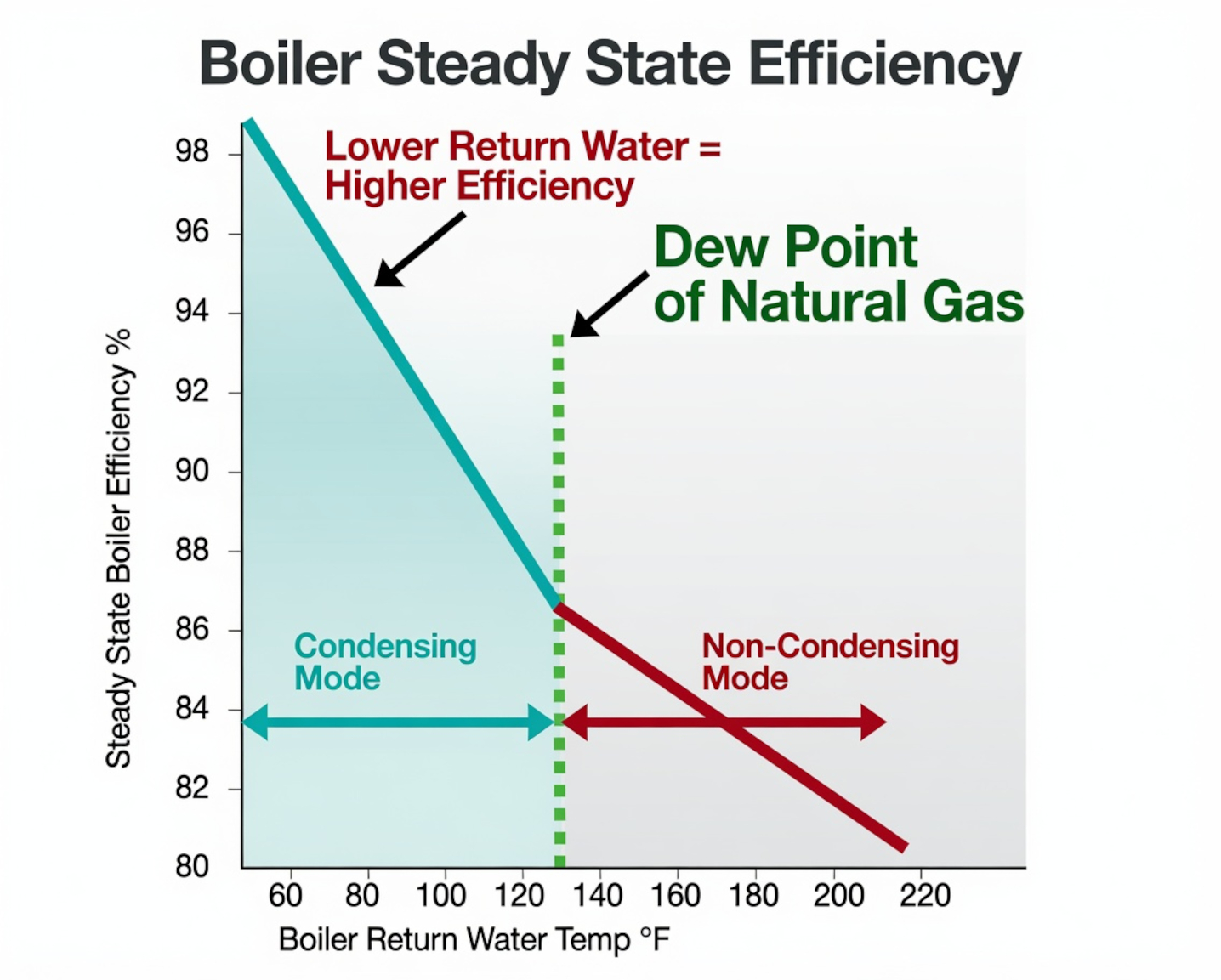
That isn’t marketing deception. It’s thermodynamics. A condensing boiler only reaches those impressive efficiencies when the water temperature is low enough. For that to happen, the return water temperature generally needs to fall below about 130 degrees. If the return water is warmer than that, the boiler still operates efficiently, but it behaves much like a conventional boiler with little or no condensation (see Figure 1).
Why furnaces are different
A 95% condensing furnace almost always operates in the condensing mode because the return air entering the furnace is roughly 70 degrees. If a hydronic system returned 70-degree water, every boiler would condense, even a conventional one. The problem is that 70-degree water wouldn’t heat the building.
Most existing commercial hydronic systems were designed around 180-degree supply water at winter design conditions, well above the condensing temperature. The condensing boiler may spend a significant portion of the heating season operating like a noncondensing boiler.
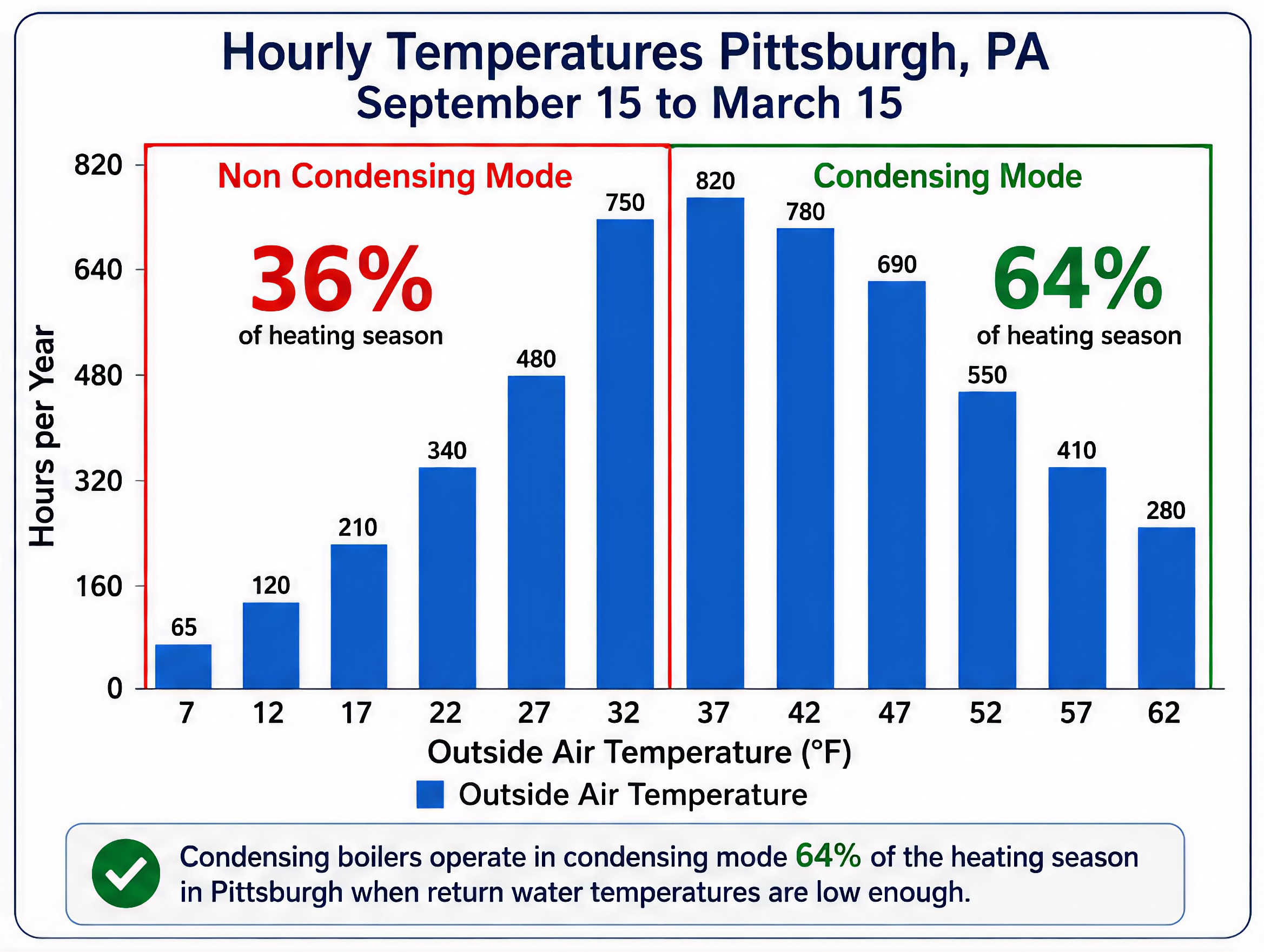
What happens in the real world? Figure 2 illustrates hourly outdoor temperatures in Pittsburgh during a typical heating season. Notice the change around 32-degree outdoor temperature. For many existing commercial buildings designed for 180-degree water, outdoor temperatures below approximately 32 degrees often require water temperatures above the condensing threshold. That represents approximately 36% of the heating season.
During those hours, the owner paid for condensing technology but may not actually be recovering latent heat. Conversely, during the remaining 64% of the heating season, lower water temperatures often allow the boiler to condense and achieve the efficiencies it was designed to deliver.
Every building is different, but a condensing boiler only delivers condensing efficiency when operating conditions allow it to condense. This is where a hybrid plant shines. Instead of forcing a condensing boiler to operate outside its sweet spot, why not let each boiler do what it does best?
During colder weather, the conventional boiler becomes the lead boiler, efficiently producing the higher water temperatures the building requires. As outdoor temperatures rise and the heating load decreases, the controls automatically shift the lead to the condensing boiler, allowing it to operate and deliver its highest efficiency. Rather than asking one boiler to do everything, each boiler operates in the range where it performs best.
Lower installation costs
Hybrid plants can also reduce installed cost. Condensing boilers generally cost more than comparable conventional boilers. Installing two condensing boilers may not provide enough savings to justify the added cost. In many retrofit projects, a combination of condensing and conventional boilers offers an excellent balance between installation cost and operating efficiency.
Existing chimneys can often continue serving the conventional boiler while only the condensing boiler requires new sidewall venting or a dedicated vent system.
This significantly reduces installation costs while avoiding multiple wall penetrations. As one customer joked, “I don’t want my building to look like a pirate ship with pipe sticking out everywhere.”
Maintenance considerations
Condensing boilers require additional maintenance because acidic condensate continuously forms inside the heat exchangers. Conventional boilers don’t continuously operate in this acidic environment and have lower maintenance needs.
A hybrid plant naturally reduces the annual operating hours on the condensing boilers, potentially lowering long-term maintenance costs while still capturing much of the available fuel savings.
Equipment life
Service life depends on several factors such as installation quality, water treatment, operating conditions and maintenance. Some published life-cycle studies suggest that condensing boilers may have a shorter expected service life than traditional boilers.
Instead of operating at high temperatures throughout the winter, the condensing boilers primarily carry the lighter seasonal loads where they are most efficient. The conventional boilers handle the prolonged high-temperature operation they were designed for.
Drawback
Water treatment becomes even more important. Every hydronic system needs proper water treatment. Hybrid systems require even more attention because several different metals may exist in the same system, including stainless steel, aluminum, cast iron, carbon steel, copper and brass.
Each metal has different corrosion characteristics. A one-size-fits-all chemical treatment is rarely the best solution. Working with an experienced water treatment specialist becomes essential.
A practical control strategy
Modern boiler controls make hybrid operation surprisingly simple. I like to use outdoor air as the switchover point. I initially have the lead boilers switch at 32 degrees. If the outdoor temperature is below that, I have the noncondensing boiler as the lead and the condensing boilers as the lag or backup. Above 32 degrees, I switch and have the condensing boilers as the lead and the noncondensing as the lag or backup. The exact changeover point depends on the building, radiation, reset schedule and heating load.
The objective is always the same: allow each boiler to operate where it performs most efficiently. It’s the best of both worlds.
Condensing boilers are incredibly efficient when operating under conditions that allow condensation. Conventional boilers have a proven track record of long life and minimal maintenance when operating at higher temperatures. A hybrid boiler plant doesn’t force either technology to operate outside its strengths. Instead, it combines the best characteristics of both. A hybrid plant offers an attractive balance of seasonal efficiency, installation cost, reliability, maintenance and long-term performance.
When I finished explaining the concept, Jack smiled and said, “I never looked at it that way.” We both agreed on one thing: The goal is to put each boiler in the operating conditions where it performs best.




