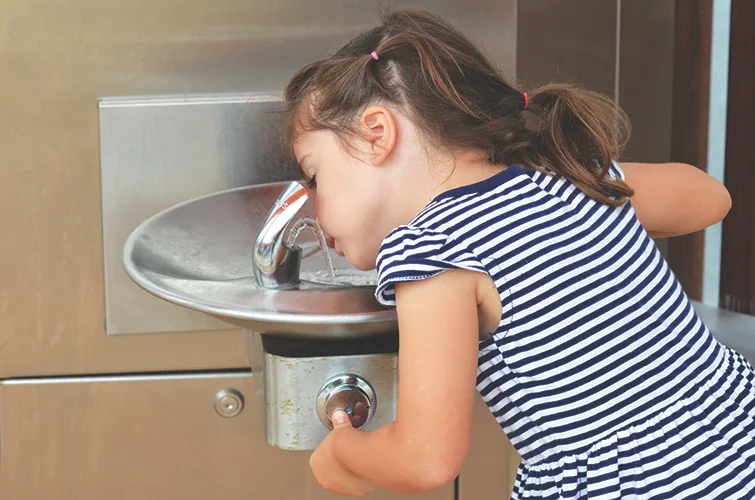
Across the country, lawmakers are searching for effective ways to protect children from lead in drinking water. For many schools — particularly those built decades ago — the challenge is significant. Aging water infrastructure can contribute to lead contamination, but replacing entire systems is costly.
Instead, some states have discovered a faster, more practical answer. Known as “Filter First,” the legislative approach prioritizes installing certified lead-reducing filters at drinking water outlets, such as water fountains and bottle-filling stations, and using point-of-use filtration systems. Rather than waiting for extensive infrastructure replacement projects, schools can quickly provide students and staff with clean, filtered drinking water.
Plumbing Manufacturers International (PMI) has been advocating for this approach, helping policymakers understand the technical realities of older water systems.
A faster solution to an urgent problem
The American Society of Civil Engineers’ “2025 Report Card for America’s Infrastructure” reports that nearly half of America’s public schools were built before 1980. Many of those buildings contain aging water infrastructure that increases concerns about lead exposure.
Replacing piping systems throughout an older school building can certainly solve the problem — but it comes at a tremendous cost in both time and money. That’s why many states are embracing Filter First legislation as a more cost-effective and efficient way to address this issue. The benefits are immediate. Adding a filtered fountain or bottle-filling station provides clean, safe drinking water to students quickly.
Michigan became the first state to enact comprehensive Filter First legislation in 2023. The state’s laws require all K-12 schools and childcare centers to develop drinking water management plans, install lead-reducing filters on drinking fountains and bottle fillers, and regularly test filtered water.
Building momentum nationwide
Other states are following Michigan’s lead and demonstrating measurable progress. Pittsburgh Public Schools have replaced nearly 1,300 unfiltered drinking fountains with filtered alternatives. The School District of Philadelphia has installed more than 2,400 lead-filtering hydration stations across the district.
These examples illustrate that Filter First is no longer simply a legislative proposal — it’s a proven strategy already improving drinking water for hundreds of thousands of students.
Some PMI members have publicly supported Filter First legislation in Michigan, Wisconsin, Pennsylvania, Minnesota, New Jersey and Massachusetts. They have also donated filtered bottle-filling stations to under-resourced school districts in several states experiencing elevated lead levels.
Making the case in Pennsylvania
Pennsylvania is one of the latest states to consider the advantages of filtering school drinking water. Matthew Windrum, PMI’s director of state government affairs, policy and advocacy, testified at a recent hearing on Pennsylvania Senate Bill 759. The proposed legislation would require certified lead-removing, point-of-use filters on school drinking water outlets and establish a Safe Schools Drinking Water Fund.
In his testimony, Windrum emphasized that protecting drinking water extends beyond regulatory compliance. He explained how PMI members understand that protecting drinking water is not simply a regulatory obligation — it is a generational responsibility. Safe plumbing systems are foundational to public health, community resilience and ensuring future generations have reliable access to clean, safe drinking water.
PMI also shared with lawmakers that installing point-of-use filters certified to the NSF/ANSI 53 standard for lead reduction provides a direct, cost-effective way to reduce lead exposure, regardless of a building’s age or plumbing configuration. Our testimony reflected technical expertise provided by PMI members who manufacture NSF-certified filtration products and systems.
Innovation built on decades of expertise
Filter First is a natural evolution of PMI members’ mission to provide safe, responsible plumbing and clean, safe drinking water for generations to come.
For decades, PMI member companies have designed and manufactured plumbing products that improve public health while conserving water. Their innovations have produced some of the world’s highest-performing, most water-efficient fixtures. Filter First builds on that same commitment as they find new ways to ensure water is safe to drink.
PMI members have long integrated sustainability into their business strategies through environmental goals, product innovation and water conservation initiatives. Filtered bottle-filling stations and advanced filtration technologies represent another opportunity to advance those efforts.
Our industry is spreading its wings and providing a solution to a problem that’s increasingly recognized and worrisome for schools, daycare centers, parents, legislators and others. It’s part of the heritage of innovation that’s always existed within the plumbing manufacturing industry.
Building a coalition of allies
PMI’s advocacy extends beyond manufacturers and policymakers to building partnerships with environmental organizations that share its commitment to protecting children’s health through Filter First policies. Organizations including PennEnvironment and Environment America have become important collaborators.
PennEnvironment helped draft Philadelphia’s pioneering Filter First ordinance, which required the city’s school district to replace outdated drinking fountains with lead-filtering hydration stations by 2025. Pennsylvania’s proposed SB 759 is modeled after that successful law.
David Masur, PennEnvironment’s executive director, recently shared with Pennsylvania lawmakers that children are particularly vulnerable to lead exposure because schools serve them during critical developmental years. He maintained that preventive filtration policies offer greater certainty than relying solely on repeated water testing, which can produce inconsistent results.
PMI echoes that concern, noting that repeated “test-remediate-retest” strategies can become expensive and unpredictable, particularly in older buildings where lead sources may exist deep within aging infrastructure.
A trusted resource for policymakers
As more states evaluate Filter First legislation, PMI will continue extending its plumbing infrastructure expertise to policymakers.
Our association serves as a trusted technical resource for legislators seeking objective information about plumbing systems, water quality, fixtures and infrastructure. Our members know the ins and outs of plumbing systems and plumbing products, making PMI a reliable and competent resource.
Policymakers can tap into our broad expertise to make informed choices that protect public health — to craft legislation grounded in science, practical implementation and real-world manufacturing experience.
By bringing together manufacturers, environmental organizations and policymakers, PMI is helping build a national coalition focused on one shared goal: ensuring every student has immediate access to clean, safe drinking water without waiting years for costly infrastructure replacement.