
One of the issues I often write about is the necessity for you, the contractor, to properly identify and calculate the true operational business costs you incur to run your business — in total and as those costs pertain proportionately to any given task.
The results you get from your calculations depend on whether you look at the numbers with honesty and mathematical prowess. Without knowing your total true operational business costs for any fiscal period, you cannot know the proportionate costs of any task.
Identifying your true operational business costs means recognizing that everything needed to run your business comes with a cost to you. And, more importantly, that you must identify said costs as those costs actually exist in order for your business to have an opportunity to minimally survive and, hopefully, be profitably successful.
Guesswork leads to bad pricing
Identifying your cost items but applying incorrect numbers to them leads to failure, whether it be due to underpricing or overpricing your services.
With the former (underpricing), you perform the service while receiving less money from the consumer than you paid to provide it. The latter (overpricing) leaves you without the opportunity to perform the service for the consumer.
The balance you need to arrive at requires you to be truthful, careful and as accurate as possible in calculating your cost factors and choosing your profit margins.
In my opinion, one qualified service tech and one properly equipped service vehicle will cost the contractor between $100 and $250 per potentially available revenue-producing hour in labor and overhead.
Yes, the cost could be less than $100/tech/vehicle hour. However, if the costs are less, it is more likely than not due to the use of incorrect factors. And yes, the cost could be higher than $250/per/service tech/vehicle hour in geographic areas where the cost of living and running a business are at the higher end.
The real cost of a tech and a truck
You must understand that there is a difference between the number of hours you pay for and the number of hours you have available to sell.
In a 40-hour, 52-week year, you pay for 2,080 hours. When you give techs two weeks for personal time and six holidays, and consider that at least 1 hour/tech/day is lost to non-revenue-producing responsibilities, there are only 1,708 potentially revenue-producing hours available to sell per tech.
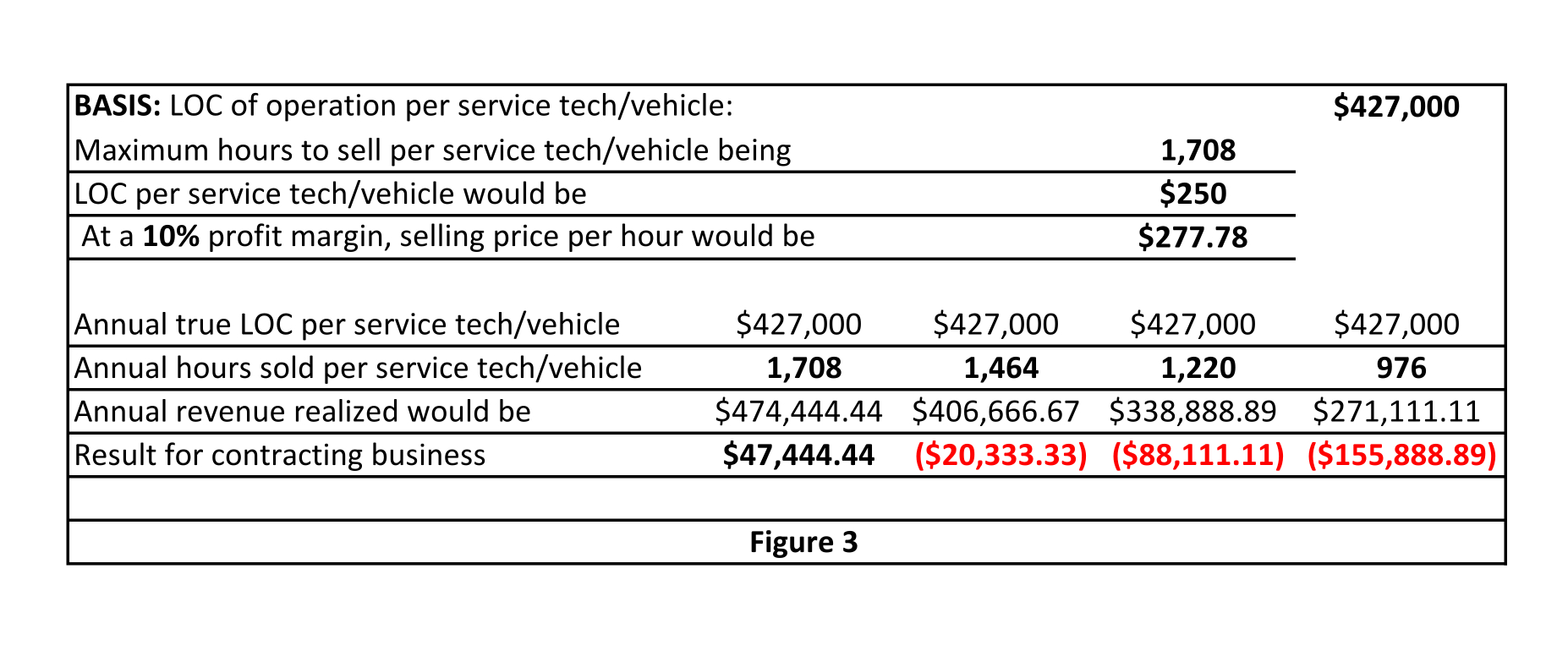
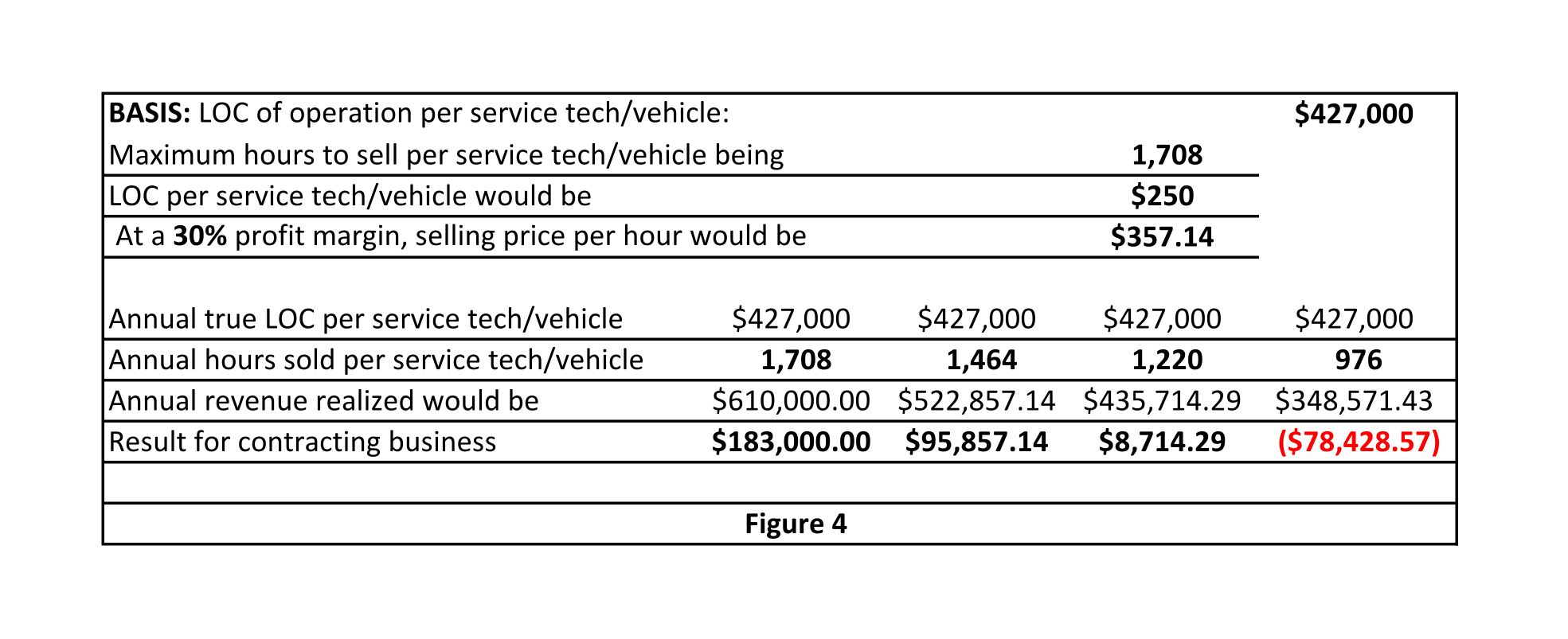
This means the annual cost to the contractor, whose labor/overhead cost (LOC) is $100/service tech/vehicle hour, is $170,8000. At the other end of the aforementioned LOC of $250, the annual cost to the contractor is $427,000.
The charts included herein show the results at the outer limits of the $100-$250 cost range.
Figure 1 shows that at the $100 hourly cost to the contractor per service tech/vehicle and a 10% profit margin, the contractor earns a profit only if all 1,708 hours are sold per tech/vehicle. At 1,464 hours sold, the contractor loses $8,133.33.
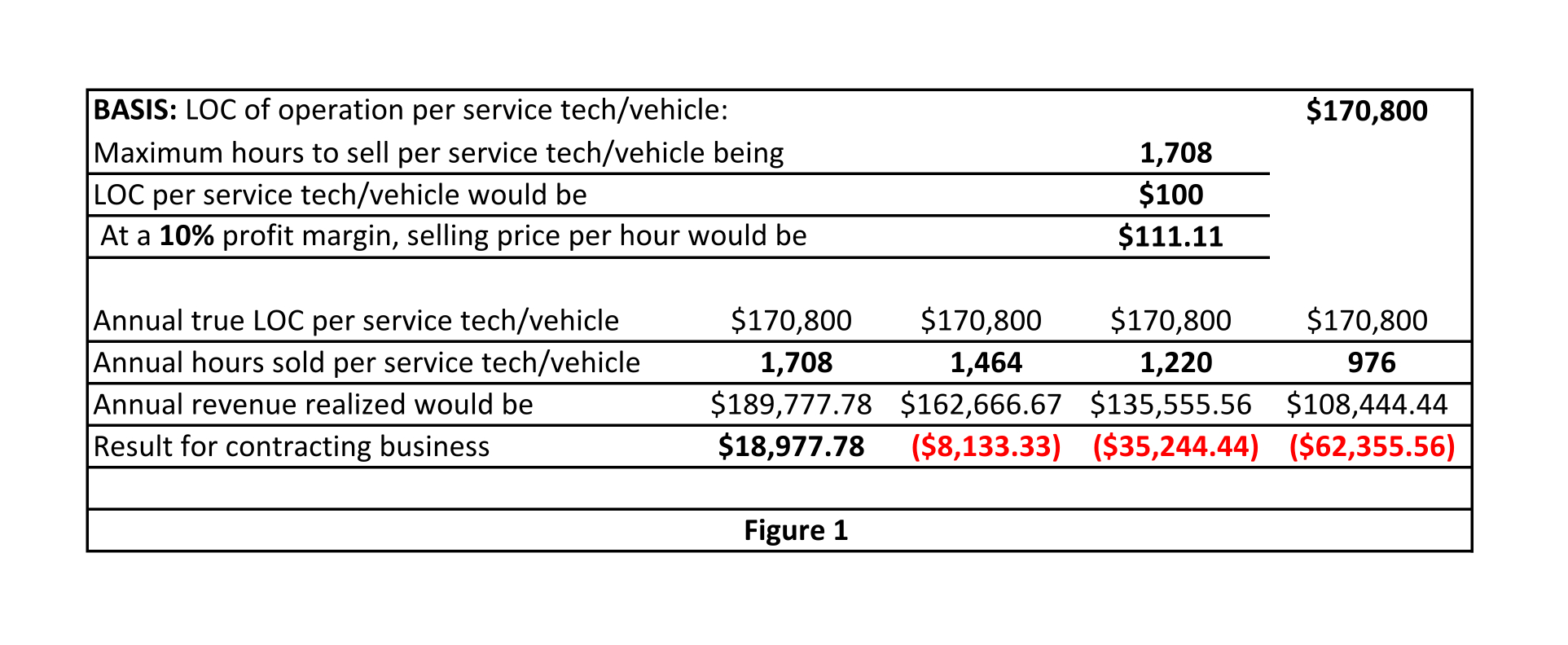
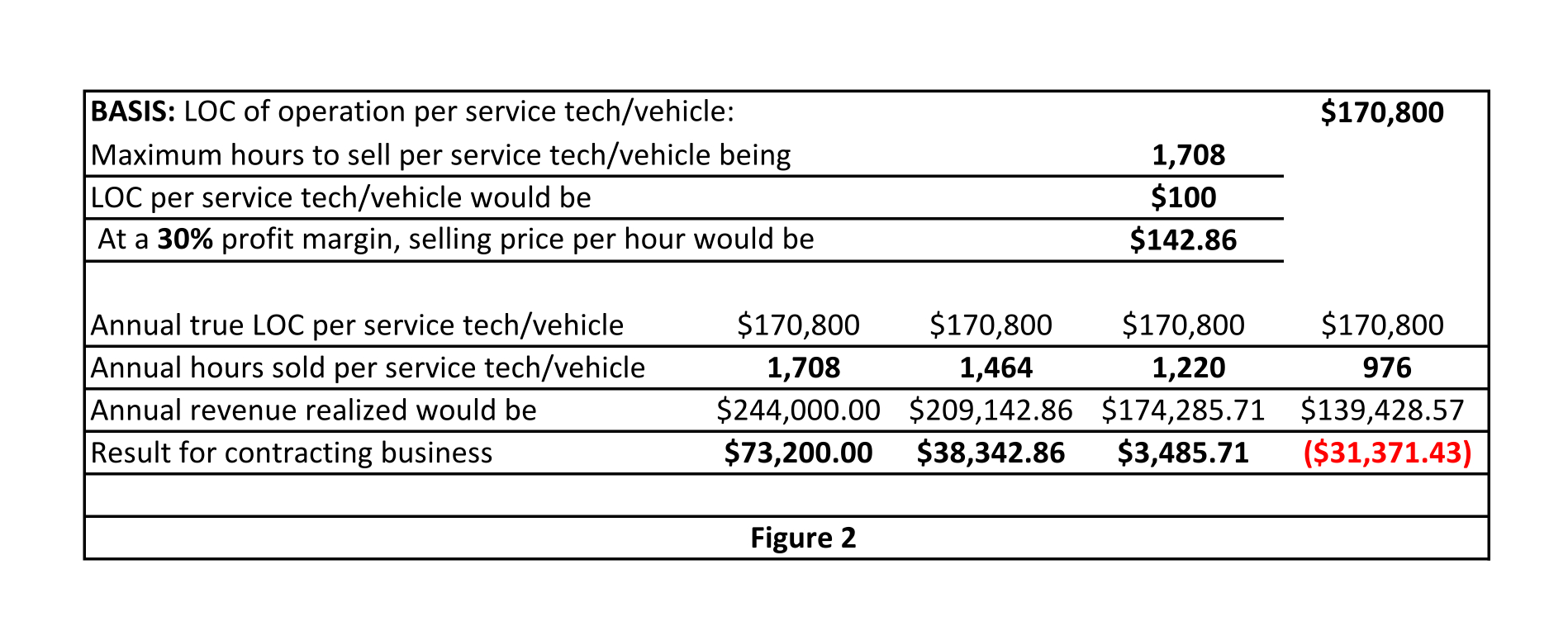
Figure 2 shows the same scenario with a 30% profit margin applied. In this case, the contractor earns a profit of $3.485.71 even when only 1,220 hours are sold per tech/vehicle.
Figures 3 and 4 show the results at the higher end of the aforementioned cost-to-contractor range.
When arriving at your selling prices, put your thinking cap on, sharpen your pencil and apply the fundamentals of mathematics combined with common-sense logic.