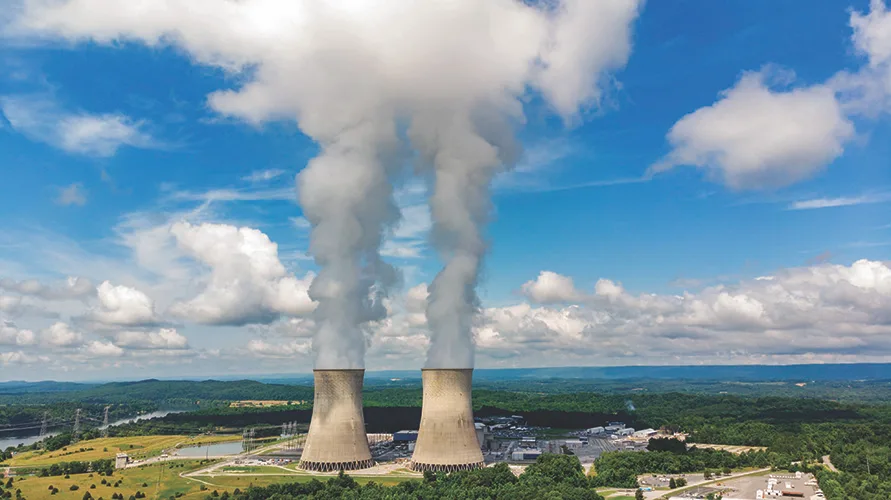
In April, construction began on two long-planned nuclear power projects, one in Wyoming and the other in Tennessee, signaling the start of the next phase of the U.S. “Nuclear Renaissance 2.0.” These projects are the first phase of an expected wave of capital investment in U.S. nuclear power, both to build new power plants and to implement in-plant capital projects such as upgrades and uprates.
Industrial Info Resources (IIR) data show that as of mid-May, developers and nuclear plant operators had scheduled 119 nuclear projects in the United States requiring pipe, valves and fittings, with a total investment value of $240 billion. Only 10 projects, valued at $11 billion, were in the construction phase; the rest were in the planning or engineering phases.
Grassroot projects totaled 19, worth $83 billion; followed by 22 unit addition projects, worth $75 billion.
By region, the Mid-Atlantic (including Maryland, North Carolina, South Carolina, Virginia and West Virginia) led the way with 29 projects valued at $68.5 billion.
However, Texas was the top state in the country, with 12 projects worth $57 billion.
A prior attempt to revive new-build nuclear power in the United States ended ignominiously, with more than 40 capital projects valued at roughly $250 billion being canceled or placed on hold. The only announced project completed was the addition of two new units at the Alvin W. Vogtle Nuclear Power Station, delivered years late and at a cost of approximately $35 billion.
This time, the nuclear power industry has two new and powerful allies — data center hyperscalers and U.S. President Donald Trump — that it lacked at the start of the 21st century, when the term “nuclear renaissance” was popularized. In fact, two other planned small nuclear projects, slated for construction in Texas at an estimated cost of $40 billion, bear the 47th president’s name.
Active movement
TerraPower, which has former Microsoft CEO Bill Gates as a backer, has similarly expansive plans for its nuclear generation technology. The company’s Natrium project in Wyoming will deliver electricity to a multistate transmission system.
Kairos Power, which is backed by Google, wants to build several next-generation nuclear power plants worldwide, including one in Tennessee, largely to power planned data centers. Small modular nuclear reactors (SMRs) such as the Kairos project in Oak Ridge generally have an electric generating capacity of about 300 megawatts (MW) per unit or less.
The main components of SMRs are modular, factory-assembled parts shipped to the plant construction site for installation, which could reduce construction times.
Meanwhile, Meta Platforms, the corporate parent of Facebook and Instagram and a developer of hyperscale data centers, signed agreements totaling 6,600 MW with Vistra, TerraPower, Oklo and Constellation Energy to boost nuclear generation. The commitments to TerraPower and Oklo are to build new, next-generation nuclear generators, while the deals with Vistra and Constellation are to extend the lives of existing nuclear plants in Ohio, Pennsylvania and Illinois.
The U.S. Department of Energy (DOE) has made billions of dollars in loans and grants in recent years to support the development of new reactor designs. The Trump administration has prioritized nuclear power to meet rising demand from data centers for artificial intelligence applications and to replace aging baseload generation, the agency said.
The energy agency is authorized to make up to $2 billion in 50-50 cost-sharing to TerraPower’s Natrium project. Separately from these two groundbreakings, the DOE recently announced a record $26.5 billion loan package for Southern Company subsidiaries Alabama Power and Georgia Power that includes licensing and upgrades for about 6,000 MW of nuclear generation.
The DOE funding is through the new Office of Energy Dominance Financing (EDF), which was established under President Trump’s omnibus tax and budget law enacted last summer.
In March, the DOE announced the Utility Power Reactor Incremental Scaling Effort (UPRISE), which “strives to significantly expand the United States’ nuclear energy capacity by increasing the power output of existing reactors, bringing dormant facilities back online and completing stalled projects.”
The amount of funding available through the UPRISE program appeared open-ended, with the DOE noting in a related press release that its Office of Nuclear Energy and EDF have “more than $289 billion in available loan authority and are able to provide up to 80% financing for eligible project costs associated with nuclear uprates at attractive interest rates.”
Upbeat remarks at groundbreakings
In upbeat, future-focused remarks, officials from TerraPower, Kairos Power, and the DOE spoke at groundbreaking ceremonies at the Natrium Nuclear Power Plant site in Kemmerer, Wyoming, and at Oak Ridge, Tennessee, in late April.
“This is the moment our industry has been working toward for a generation,” said Chris Levesque, TerraPower president and CEO. “We’re not only breaking new ground on a first-of-a-kind nuclear plant in Wyoming; we’re building the next generation of America’s energy infrastructure. The Natrium plant will deliver reliable and dispatchable power to the grid, and Kemmerer Unit 1 serves as a commercial blueprint to mobilize a fleet of Natrium plants across the country and around the world.”
He predicted the 345-MW, sodium-cooled, Natrium Unit 1 fast reactor would be built in 42 months, which would mean a late-2029 start of commercial operations. It received a construction permit from the U.S. Nuclear Regulatory Commission (NRC) earlier this year.
The facility will also have a molten salt energy storage system that can quickly boost the system’s output to 500 MW for increased flexibility and reliability, the NRC said March 9 in issuing the project a construction license. It will need to obtain a separate operating license before it can be operated.
“This is the first construction permit ever issued by the NRC for a commercial nonlight-water power reactor and represents a historic step toward deployment of a new generation of advanced reactors in the United States,” the commission noted.
Across the country, in Oak Ridge, Tennessee, officials from Kairos Power offered similarly optimistic remarks when they broke ground April 17 for Hermes Unit 1, a 50-MW SMR demonstration project.
“For nuclear projects to be successful, we need more than the right technology; we need to understand every aspect of project delivery,” said Mike Laufer, Kairos Power CEO and co-founder. “Hermes 2 is where that all comes together. Oak Ridge is our hub for nuclear construction and operations. We’re training a real workforce to do nuclear construction, learning from the Hermes 1 experience, and translating that knowledge to the Hermes 2 project next door.”
Meanwhile, Duke Energy, which serves 8.4 million customers in North Carolina, South Carolina, Florida, Indiana, Ohio and Kentucky, plans to add 14 gigawatts of dispatchable power generation by 2031, including an expansion of its nuclear footprint. CEO Harry Sideris said in May that the NRC had approved Duke’s application to operate its Robinson nuclear plant in South Carolina until 2050. He also said the company planned to seek similar extensions for all its remaining reactors.
And by April, NextEra Energy had extended the operating licenses of all its operational nuclear reactors to 2050 or beyond. U.S. nuclear reactors are initially licensed to operate for 40 years. This can be extended by 20 years at the initial license renewal, and by another 20 years (80 total years of operation) through subsequent license renewals.
NextEra also is making moves to restart its Duane Arnold nuclear power station in Iowa. The facility was scheduled to close in October 2020 for economic reasons, but it closed a couple of months earlier after severe storm damage. Plans to restart the 615-MW facility were strengthened last year when Google struck an agreement to buy the plant’s power. Plans are now in motion to restart the facility by 2029.
The Duane Arnold plant joins two other U.S. nuclear plants in the restart process: Holtec’s 812-MW Palisades plant in Michigan and Constellation Energy’s 835-MW Crane Clean Energy Center Unit 1 (formerly Three Mile Island) in Pennsylvania, both of which were decommissioned for economic reasons but are now seeing great demand for their low-emissions baseload power.
In Texas, engineering firm Fluor received a contract to provide services for a project to construct four 80-MW small modular reactors at Dow’s Seadrift site.
“The Seadrift project is expected to become the first grid-scale advanced nuclear reactor deployed to serve an industrial facility in North America,” Fluor said in a press release.
Brian Ford is editor in chief at Industrial Info Resources and has been with IIR since 2014. With global headquarters in Sugar Land, Texas, and 18 offices worldwide, IIR is a provider of global market intelligence specializing in the industrial process, heavy manufacturing and energy markets. To contact IIR, visit www.industrialinfo.com or call 713-783-5147.