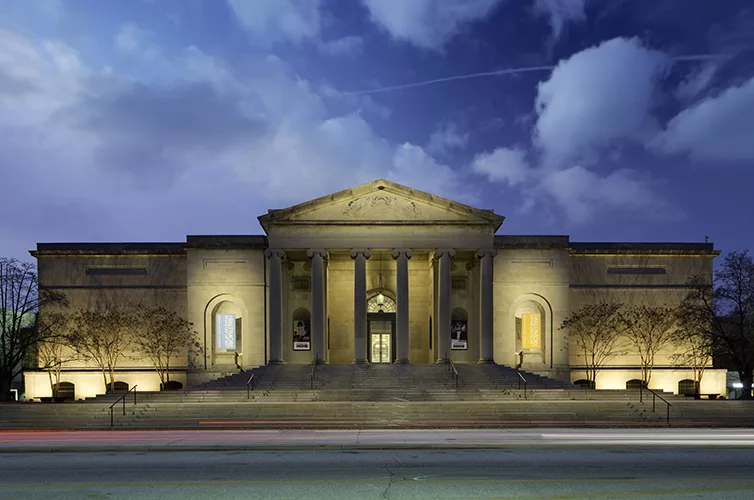
When visitors move through the galleries of the Baltimore Museum of Art (BMA) — pausing before Henri Matisse’s Blue Nude, studying a drawing by Pablo Picasso, or stepping into Amy Sherald’s American Sublime exhibition — they are unlikely to notice the fire protection infrastructure surrounding them. That invisibility is by design.
Yet those systems represent some of the most carefully considered fire suppression engineering in the region, because in a museum, the consequences of getting it wrong are permanent.
Mueller Associates has partnered with the BMA for nearly 50 years, completing more than 40 projects across the museum’s 10-building, 210,000-square-foot campus. That long relationship has yielded a deep understanding of an institution that balances two competing imperatives: welcoming the public into spaces filled with irreplaceable art, and protecting that art from every conceivable threat, including the systems designed to protect it.
Fire protection presents a daunting challenge. Water-based suppression systems are the most practical means of protecting life safety and limiting fire spread; however, in a museum, water is also the collections’ most immediate enemy.
Designing systems that honor both realities — and distinguish between the spaces that need each type of protection — is an engineering dilemma.
Mueller’s recent work on the new Nancy Dorman and Stanley Mazaroff Center for the Prints, Drawings and Photographs (PDP Center) and the Ruth R. Marder Center for Matisse Studies (Matisse Center) illustrate how that problem can be addressed.
The museum’s main building, a Neoclassical landmark that opened in 1929, established the campus’s architectural foundation. Subsequent wings and later additions were constructed across different eras, with different structural systems, building standards, and mechanical, electrical and plumbing infrastructure. Working in any part of the BMA means working in a building that is simultaneously historic and evolving.
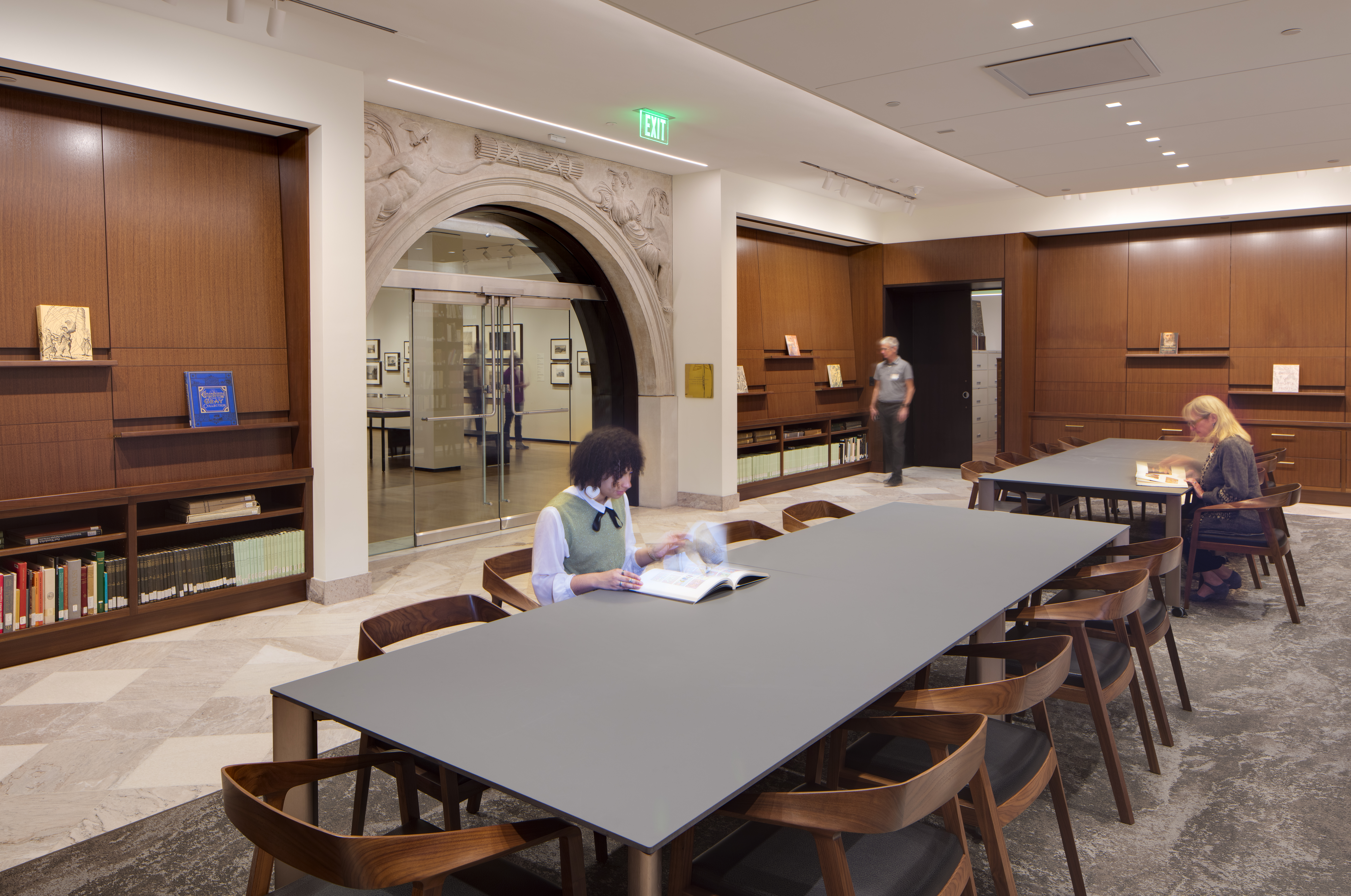
The most recent Mueller projects at the BMA — the PDP Center and the adjacent Matisse Center, designed by Quinn Evans — transformed 22,500 square feet of the museum’s interior into new and improved spaces for the study and preservation of works on paper. Together, these spaces protect and provide access to approximately 57,000 prints, 4,000 drawings and 4,000 photographs, as well as more than 1,000 prints, drawings and illustrated books by Matisse.
Because works on paper are among the most environmentally sensitive objects a museum can hold, the engineering requirements — for climate control, for water management, and for fire protection — are correspondingly demanding.
Wet pipe systems in circulation spaces
Fire protection design for a project of this scope begins with a foundational priority: life safety. The Baltimore City Fire Code, which adopts the International Fire Code and references NFPA standards, establishes water-based fire suppression as the baseline approach for giving building occupants sufficient time to evacuate safely. For the corridors and public circulation areas of the PDP and Matisse centers, a conventional wet pipe sprinkler system fulfills that role.
Wet pipe systems are the standard in most commercial and institutional buildings for good reason: They respond fastest, require minimal maintenance and remain reliable for decades. Individual sprinkler heads activate only when the heat from a fire raises local temperatures sufficiently to break the head’s fusible element — not when a fire alarm sounds, and not when adjacent heads activate.
The precision of this response is a feature, not a limitation. According to NFPA research, in 77% of structure fires where sprinklers operated, only one head activated. In 96% of cases, five or fewer operated (https://bit.ly/48w5U50).
In the PDP and Matisse centers, water distribution mains are routed strategically through common areas, keeping pressurized piping away from gallery and storage spaces wherever possible. This approach limits exposure to inadvertent leaks and keeps the infrastructure accessible for inspection and maintenance, practical considerations that reinforce the system’s reliability.
Preaction systems in gallery and office spaces
Gallery spaces, storage areas accessible to curatorial staff and office spaces present a different engineering challenge. The threat of a catastrophic fire is real, but so is the threat of accidental discharge, and, in spaces containing irreplaceable art, a nuisance discharge from a damaged sprinkler head or a false alarm is itself an emergency. A conventional wet pipe system, with water standing in the distribution piping at all times, is not suitable for these spaces.
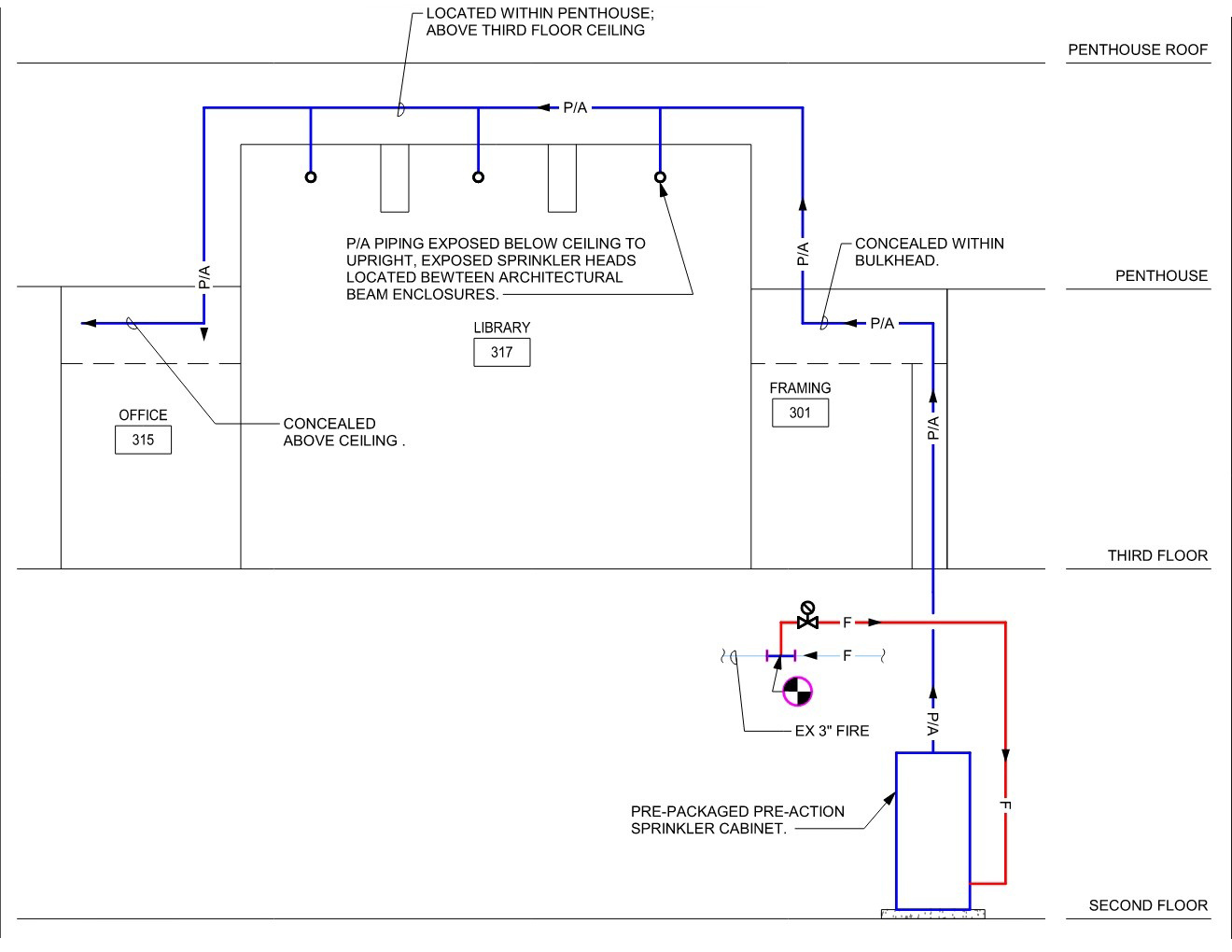
The best solution is a preaction system, which includes the same distribution piping and sprinkler heads as a wet pipe system, but with the piping charged with low-pressure nitrogen rather than water.
Nitrogen is preferred over compressed air in modern installations because it contains less moisture and is less likely to cause internal pipe corrosion over time. The nitrogen serves as a supervisory medium, its presence confirms the piping is intact, and a loss of pressure triggers an alarm at the fire alarm panel.
What distinguishes the preaction system from a wet pipe system is its requirement for two independent signals before water enters the distribution piping. An accidental sprinkler head failure — a maintenance worker striking a head, for example — releases nitrogen and triggers an alarm, but water does not flow.
A smoke or heat detector activation, similarly, does not, by itself, cause water to enter the system. Only when both conditions are present simultaneously — a detector has signaled an event, and pressure has been lost from the distribution piping — does the preaction valve open and water charge the system. Even then, water discharges only through heads whose fusible elements have activated from the heat of the fire.
This double interlock is the critical protection feature for museum spaces. A nuisance drip, a damaged head or a smoke detector activation from a dust disturbance during renovation work will not put the collection at risk.
The BMA’s preaction system also extends beyond the gallery spaces themselves to include the third-floor offices and library — areas that might otherwise seem like candidates for conventional wet pipe protection — because those third-floor spaces sit directly above or adjacent to the PDP Center, the Antioch Court and the Cone Galleries. An accidental discharge on the third floor would threaten the collections below it. Extending the preaction system upward eliminates that cascading risk.
Clean agent systems for storage areas
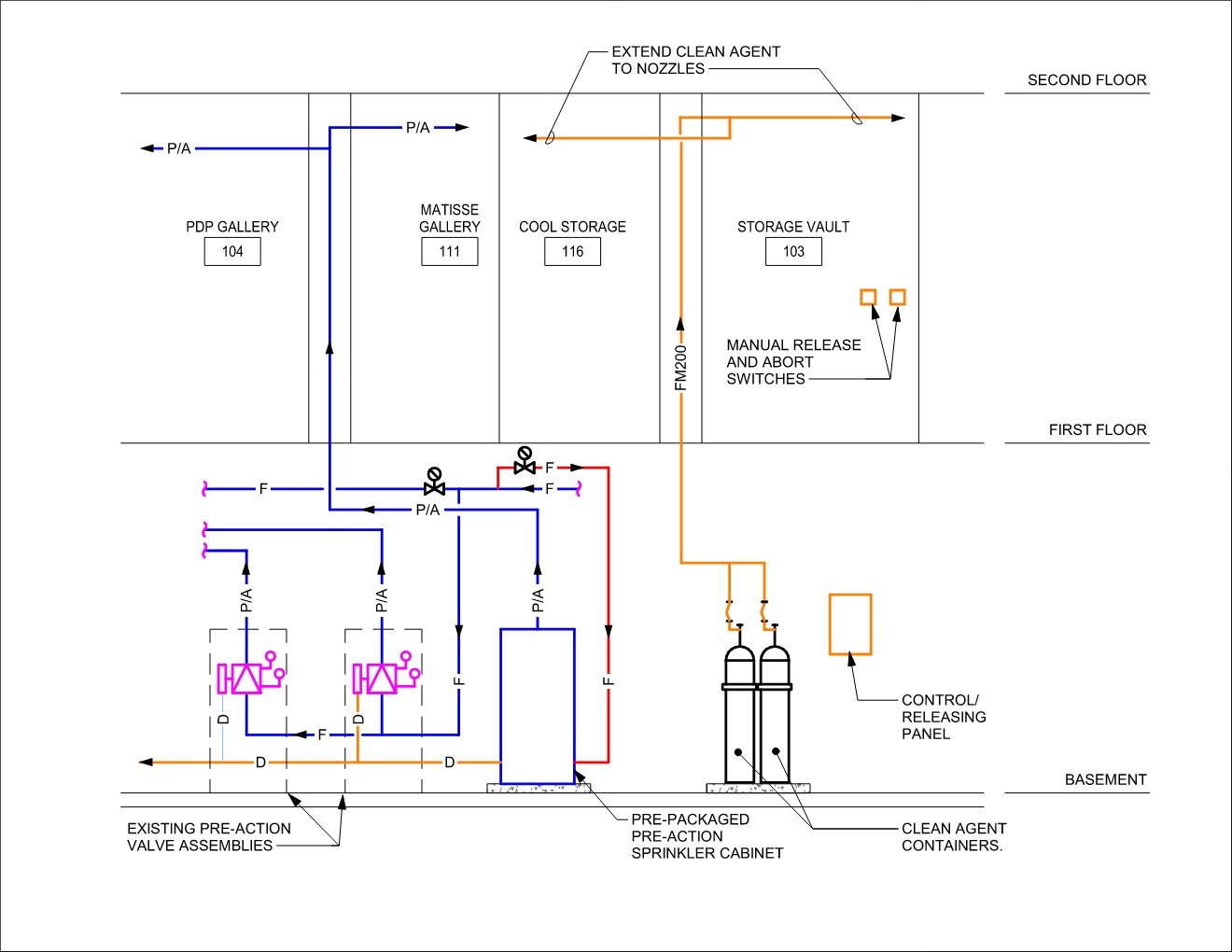
The BMA’s collection is far larger than its galleries can display at any one time. The storage areas within the PDP and Matisse centers — spaces that house objects not currently on exhibit, and that are not regularly occupied — require a different approach entirely. For these areas, waterless fire suppression is the best solution.
Clean agent systems work on the same fundamental principle as water-based suppression: Remove one element of the “fire triangle” — oxygen, fuel or heat — and combustion stops. Water-based systems primarily address heat, exploiting water’s high heat of vaporization (at 212 F) to rapidly lower air and material temperatures below ignition point.
Clean agents take a different path, with some interrupting the chemical chain reaction of combustion and others reducing oxygen concentration.
The original storage areas in this portion of the BMA were initially protected by a Halon gas system, which was deactivated when the current project began.
Halon was effective and non-toxic to occupants; however, it is a chlorofluorocarbon identified by the U.S. Department of Energy as a contributor to ozone layer deterioration (https://bit.ly/4tdqGPp). Its production was banned under the Montreal Protocol, and while existing Halon systems were not required to be immediately decommissioned, replacement with a compliant alternative was the clear path forward.
The PDP and Matisse centers’ storage areas were provided with an FM-200 system. FM-200 (heptafluoropropane) is an inert gas stored as a liquid in tanks located outside the protected storage areas. Upon detection of a fire, solenoid valves open and the agent discharges through dedicated emitters into the protected space. FM-200 suppresses fire without depleting oxygen to levels harmful to occupants, allowing for safe evacuation and subsequent entry by fire suppression personnel.
It is worth noting that FM-200 and other hydrofluorocarbon agents are themselves in a regulatory phase-down period that began after this project was completed. Installed systems are not required to be decommissioned, but future projects at the BMA and similar institutions will require evaluation of alternative clean agent technologies.
These include hybrid water mist systems, which atomize water into fine droplets that achieve temperature reduction with dramatically less water volume, and inert gas systems that lower oxygen concentration to levels sufficient to extinguish fire while remaining safe for human occupancy.
Layered protection across a complex program
The project’s program extended well beyond gallery and storage spaces. The PDP and Matisse centers encompass three storage areas, preparation areas, cool and cold storage areas, office spaces, study rooms for academic and public programs, and other publicly accessible areas, each with distinct occupancy patterns, environmental requirements and fire protection needs. Selecting and coordinating the appropriate system for each space and ensuring that the transitions between systems are seamless and code-compliant, is the practical work of fire protection engineering for a museum building.
A layered approach — wet pipe for circulation and life safety, preaction for galleries and occupied spaces above or adjacent to collections, clean agent for unoccupied storage areas — reflects a hierarchy of risk. Each system is chosen not only for what it protects against, but also for what risks it introduces.
Bringing these systems together in a building that was not designed to accommodate them, within a historic structure with the architectural and spatial constraints of the BMA campus, is the engineering challenge that defines Mueller’s work.
Fire protection engineering for museums is not primarily about flashy technology or complex systems. It is about understanding the specific risks each space presents, specifying the system that addresses those risks without introducing new ones, and integrating that system into a building that was not always designed to receive it.
At the BMA, nearly five decades of accumulated institutional knowledge makes that integration possible. The result is a museum that can pursue its mission — preserving and sharing the works in its care — with confidence that the infrastructure surrounding those works is equal to the task.
Charles Swope, PE, CPD, LEED AP BD+C, is chief mechanical engineer at Mueller Associates, where he has led plumbing and fire protection engineering for the Baltimore Museum of Art and other major cultural and higher education institutions. He’s the president of the Baltimore Chapter of ASPE. He can be reached at: cswope@muellerassoc.com.