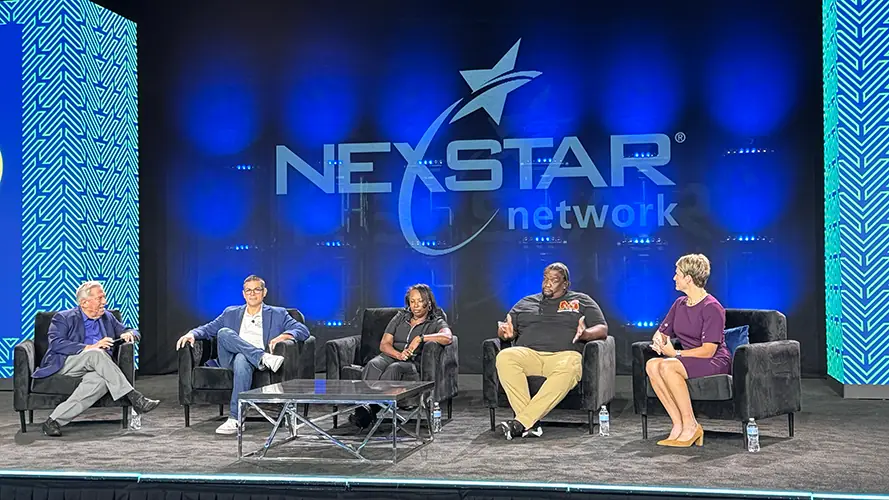
Evin Jarrett doesn’t wait to talk up the skilled trades with high schoolers. No, he’s got fourth-graders soldering pipe inside his classroom at Mayfair Elementary, Philadelphia’s second-largest elementary school. And in the summer, he’s even got a full classroom of kids ready to go at 5:30 in the morning and working straight through to lunch time.
“My big thing at Mayfair is exposure and opportunity,” Jarrett said during a panel discussion entitled “Leading the Trades,” held during Nexstar Network’s Super Meeting 2026, Sept. 14-18 in San Antonio, “We just plant the seeds letting them know about the trades, build their confidence, keep them in school and just get them interested in working with their hands and loving the trades.”
Fellow panelist Judaline Cassidy’s approach with Tools & Tiaras is built on much the same principle, although her particular mission is introducing girls ages 6 to 14 to construction jobs and other traditionally male-dominated careers.
“My mission is world domination with the girls,” said Cassidy a union plumber of more than 30 years. “We teach the girls that jobs don’t have genders.”
While the industry knows it needs more young people like those in front of Jarrett and Cassidy to join the skilled trades, the harder matters are when to reach them, how to reach them and what happens after they walk into the shop.
Those questions were at the center of a discussion moderated by well-known leadership author and teacher John C. Maxwell. The conversation also included Andrew Brown, host of the “Lost Art of the Skilled Trades” podcast and founder of an industrial tool and equipment company; and Cate Cinnamo, executive director of Explore the Trades.
Planting the seed
Jarrett came to teaching after a construction job-site injury sidelined him for two years. Faced with figuring out what came next, he returned to something he already knew.
“I love tools,” he said. “I love the trades. So what else can I do?”
Jarrett teaches not just plumbing, but electrical, masonry and carpentry to fourth- through eighth-grade students at Mayfair.
“Kids want to skip classes just to get into my classroom,” Jarrett said. “Young people will meet high expectations when they feel connected to the work and the instructor.”
Jarrett said he runs his classroom like a job site, using practical projects, stressing the importance of being on time, paying attention to details and adhering to safety routines.
“I just want kids to get tools into their hands they can touch and know how to use them,” he said. “That’s what I do.”
When he can, Jarrett gets older students that have been through some of the curriculum to mentor younger students and to lead the Saturday programs.
“Most importantly is I build relationships with the students,” he said. “I give every student individually what they need to feel successful.”
That singular attention, he said, is too often missing in education.
Through monthly workshops and an all-girls summer camp, Tools & Tiaras, a nonprofit Cassidy founded in 2017, introduces girls to everything from welding to engineering. Cassidy also spends considerable time challenging misconceptions about what people in the trades actually do.
“Most people think all a plumber does is unclog toilets,” she added. “We all know that’s the least of the jobs we do.”
Cassidy returned repeatedly to instilling confidence, too.
She told the story of a Tools & Tiaras camper who was afraid to weld. Rather than force the issue, Cassidy introduced her to virtual-reality welding as an intermediate step.
By the time the camp was packing up, the girl wanted to try the real thing.
For Cassidy, the larger purpose of the program is to show girls that “they can be fearless, awesome and strong” and that “they are built for the trades.”
More options
That’s also where Cinnamo sees a role for Explore the Trades.
She described the nonprofit as “the starting line of trade education,” providing teachers and school counselors with information they can use to introduce plumbing, HVAC and electrical careers before students assume a four-year college education is their only path forward.
“Trade education should begin well before a student is making postsecondary choices,” she added. “Students need a well-rounded look at the trades before decisions are made by default.”
To accomplish that, Explore the Trades sends educational materials and classroom resources into schools throughout the country. Cinnamo’s organization also operates a Skills Lab program, created with an equipment grant from wholesale-distributor Ferguson. The program has established hands-on plumbing, HVAC, and electrical training labs at no cost at 53 schools in 21 states.
Brown shifted from the classroom to the workplace. Contractors can spend heavily on recruiting videos, advertising and outreach, but Brown said the real test comes when that brand-new employee walks in the door ready to work and start his or her career.
“I always come back to what happens Monday morning,” he said. “Who’s waiting for them? Do they know what they’re supposed to do? Does anybody know their name? Who’s there waiting for them? That first impression is when employees find out whether what they were told about a career in the trades in general and about a company in particular is actually true.”
Brown, whose podcast gives the next generation and current tradespeople alike a way to recognize their own potential in other people’s experiences, brought the discussion around to the importance of mentorship.
“Apprenticeship teaches the trade,” Brown explained, “mentorship builds the tradesperson.”
Through his podcast conversations with apprentices, supervisors and frontline managers, Brown said effective mentors tend to share several traits: patience, clear communication and an ability to build confidence.
Cassidy also shared her tale of mentorship when contractor Brian Totora changed the trajectory of her life and helped her become the first woman in Local 371 in New York City.
“He took me into a room I was never able to get into,” Cassidy said. “I’m forever grateful.”
That experience continues to shape her work with Tools & Tiaras.
“I feel like it’s a duty to do what I do now with the girls because of it,” she said.
Jarrett credited a middle-school teacher with shaping how he teaches today.
“She poured a lot into me my eighth-grade year, and I really have to give her the credit,” Jarrett said. “I model my teaching style after her.”
What You Can Do to Lead
As the panel discussion wrapped up, Jarrett told how he routinely has to reach into his own pocket and pay for classroom materials rather than putting in a PO and waiting weeks for school administrators to make the purchase.
With that Maxwell stopped the conversation and reached into his pocket and handed him $1,000 on spot, calling himself Jarrett’s “pocket partner.”
Maxwell closed the session by asking each panelist for their recommendations for the audience to lead the trades in their own way.
While the dollars donated directly to Jarrett will no doubt go a long way, Cinnamo urged contractors to think beyond financial donations. She’s been to Jarrett’s classroom personally and said that Jarrett can turn almost any scrap material and discarded equipment, such as a “scratch and dent” water heater into a worthwhile project for students to take apart and learned what’s inside. Cinnamo also reiterated sharing her group’s free classroom posters and bilingual resource kits for schools as well as to partner with educators and schools by taking part of career days.
Jarrett urged contractors to help establish middle-school programs, pay a visit to classrooms like his with tools students could learn how to use and use social media to reach kids and families by showing their everyday plumbing, heating and electrical work.
Brown called on business owners to advocate politically and put their voices behind CTE programs, arguing that “the revolution needs funding.” In the meantime, like Jarrett, Brown added to simply start reaching out to local CTE schools and helping in any way that they need.
“And open your doors and invite students to see a shop floor,” Brown added, “and give them a real next step toward an apprenticeship.”
Cassidy also said that investments in young people will “pay dividends” and called on businesses to fund local CTE programs, donate resources and use their influence with school districts and legislators. And by means, kids need to learn about careers in skilled trades sooner than later.
“We really need to let them know early," she said, “because they want to know. That's what I found.”