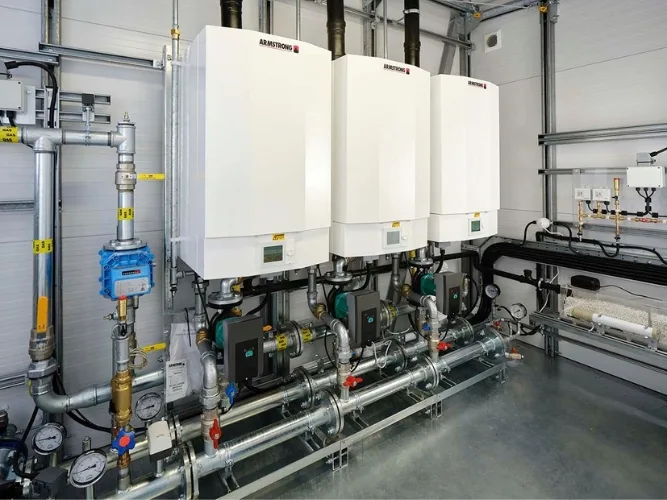
Armstrong Industrial is expanding its gas heating offering with the launch of individual gas boilers, giving industrial and commercial customers more flexibility in meeting their heating needs.
Ian Parkinson, gas offering manager at Armstrong Fluid Technology – Industrial, said the individual boilers provide a practical option where a standalone unit is appropriate, while also giving customers a route to increased capacity when required.
“These boilers are available in both floor-hung and wall-hung configurations, and can be supplied as stand-alone units or as ‘building blocks’ for larger modular boiler systems and complete packaged gas boiler houses,” Parkinson said. “We can configure gas boiler solutions around the scale, complexity and future requirements of each application.”
Scaling up
He noted that this approach allows customers to evolve their heating solutions over time, rather than being forced to commit to a larger system than their current application demands.
“Where greater capacity, staged operation or redundancy is required, multiple individual wall-hung boilers can be combined into a modular boiler system,” he explained. “Capacity can therefore be configured around the application and expanded as heating requirements change.”
These Armstrong Industrial solutions add value across a range of industrial processes where reliable hot water generation and heating are critical – in industries ranging from manufacturing, oil and gas, and chemical processing, to pharmaceuticals, water treatment, and food and beverages.
Armstrong Industrial can supply its modular heating solutions with boilers, pumps, valves, pressurization equipment, controls and electrical systems integrated into an engineered package.
Factory assembly
The modular approach allows more of the installation to be completed away from site, as these systems can be housed in fabricated plant rooms. Factory assembly and testing can reduce the amount of site-based engineering and installation work, helping to minimize commissioning risks and project complexity. These engineered-to-order packages are built and tested off-site, providing a single-source supply and rapid installation.
“Our approach reduces project risk and shortens commissioning time,” he said. “It also cuts down on the disruption in the customer’s facility – while improving workmanship by moving more of the engineering and assembly process into a controlled factory environment.”
The flexibility of this architecture is particularly relevant to industrial facilities upgrading existing heating infrastructure, where prolonged shutdowns can have significant operational consequences.
High efficiency
A key advantage of the modular heating systems lies in the use of Armstrong’s latest high-efficiency condensing boiler technology, capable of achieving operating efficiencies of up to 98,2% under condensing conditions. Combined with fully modulating burners and intelligent sequencing, the system continuously matches heat output to actual process demand, eliminating unnecessary energy consumption associated with conventional on-off boiler cycling.
“With a 6:1 turndown ratio, our boilers can modulate the burner down to a minimum output, allowing direct modulation of boiler output to meet load demands without having to cycle on and off,” he said. “This makes the boilers highly efficient, and also quiet during operation.”
Continuous improvement
Intelligent controls and demand-based operation allow operators to continuously improve energy use and reduce emissions while maintaining the consistent temperatures required by industrial processes.
“The system’s intelligent controls enhance efficiency by automatically maintaining accurate process temperatures within narrow tolerances, and providing continuous monitoring of system performance,” he explained. “Remote diagnostics allow operators to identify potential issues before they affect production. The boilers can also be reset remotely avoiding costly service call outs.”
Parkinson highlighted that Armstrong Industrial’s proposition is not simply the supply of individual boilers, but the ability to provide the appropriate level of gas heating solution for each project.
“We help customers look beyond simply replacing a boiler,” Parkinson said. “Ultimately, it’s about delivering a heating system that works smarter, uses less energy, reduces carbon emissions and creates lasting value for the entire operation.”