For contractors and end consumers, a large price difference on refrigerant can be tempting, especially when costs are putting pressure on operating budgets. However, below-market pricing should also be a warning.
A contractor recently learned that one of his customers had purchased a skid of refrigerant cylinders labeled as R-404A from an online retailer. The retailer’s price was less than 60% of the prices offered by other online sellers. The contractor was curious and, correctly, suspicious. To investigate, the contractor independently ordered a cylinder from the same online retailer.
The warning signs grew louder when the cylinder arrived in a plain cardboard box and was missing basic safety certification information required by the U.S. Department of Transportation. The cylinder was sent to a laboratory for testing.
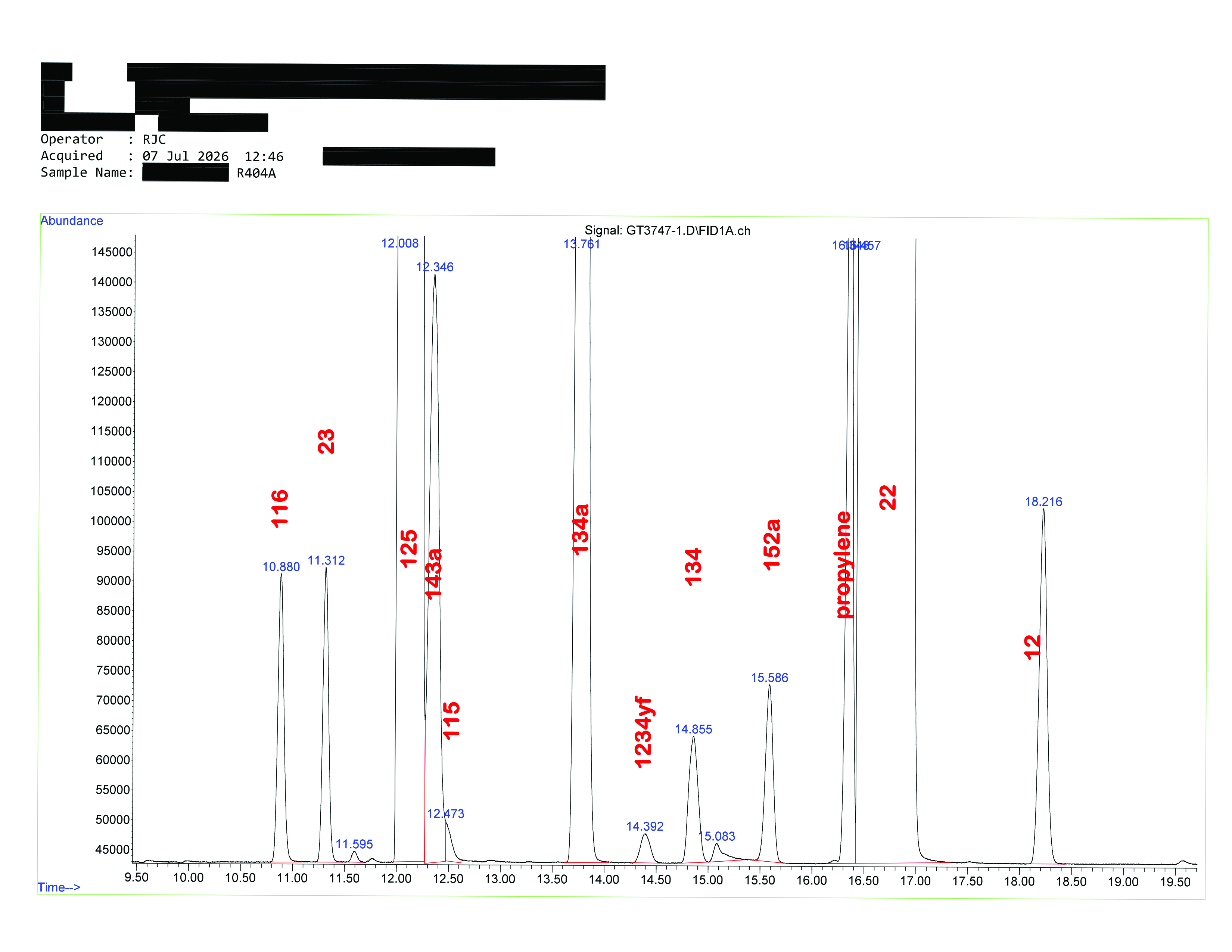
The results of the gas chromatography scan showed that the product inside was not R-404A.
The material was approximately 81% R-22, 15% R-125, 2% R-40, also known as methyl chloride, and 2% other substances, including additional refrigerants, solvents and hydrocarbons. Testing also found 13% noncondensable gases, more than eight times the permitted limit. The pressure inside the cylinder was 10 psig above the expected reading.
Clearly, the seller was selling counterfeit R-404A into a market already being reshaped by the HFC phasedown and state restrictions affecting the sale of virgin refrigerants. This illegal substance would have behaved very differently (even dangerously) inside equipment designed for R-404A, and numerous suspicious sellers of refrigerant have popped up in recent months.
More work for the compressor
As we all know, refrigeration systems are designed for use with specific refrigerants. Their components and controls depend on predictable relationships among temperature, pressure and refrigerant flow. When the contents of a cylinder do not match the label, those relationships no longer hold.
“Based on the composition [of the sample] provided, an R-404A system would likely operate poorly,” said a refrigeration engineer interviewed by HARDI.
At a typical low-temperature operating point, the pressure-temperature mismatch is substantial. For example, a suction pressure corresponding to roughly -20 F saturation with R-404A would correspond to a saturation temperature roughly 10 F warmer with pure R-22. The actual counterfeit mixture would have its own pressure-temperature relationship, making system behavior even less predictable.
This means the equipment owner would see higher operating costs and systems unable to maintain proper temperatures for storing perishable food.
The tested material could also have placed considerable stress on the system’s compressors. R-22 can leave a compressor at a higher temperature than R-404A. Excessive heat can damage valves and shorten compressor life, and the noncondensable gases would add to that strain.
In practical terms, the equipment could suffer elevated head pressure from the extraordinarily high level of noncondensable gases, while the counterfeit refrigerant itself would alter suction pressure, compressor loading and cooling capacity. The result could be higher energy consumption, reduced refrigeration performance and accelerated compressor wear — all adding costs to the equipment owner and likely ending in premature compressor failure.
Not only costly, but dangerous
Refrigerant blends that do not meet specification or are completely counterfeit can have much more significant downsides than poorly operating equipment.
R-40 presents a particularly serious problem with aluminum. ASHRAE warns that methyl chloride does react with some metals while other refrigerants are rated as nonreactive. In contaminated systems, R-40 can react with aluminum to produce strong acids and other highly reactive compounds and can lead to equipment failure.
It is also flammable and not intended to be part of an R-404A blend. The 2025 ASHRAE Handbook provides a stark warning: “In 2011, several suspected substitutions of R-40-containing refrigerant mixtures for R-134a in aluminum-containing refrigeration and air-conditioning systems resulted in equipment failures, explosions and even fatalities.”
The gas chromatography analysis also found the presence of methylene chloride, or R-30, a toxic solvent that the EPA has identified as presenting serious health risks, including neurotoxicity and cancer risk from chronic exposure, can be produced along with R-40 when making feedstocks for R-22 (https://bit.ly/4zAO5h0).
One plausible explanation of these contaminants is inadequate purification of low-cost feedstocks used in illegal R-22 production. A counterfeiter focused on minimizing production costs may skip or reduce purification steps that would normally remove residual compounds such as R-30 and R-40.
For a supermarket looking to reduce service costs by buying below-market refrigerant, it could end up costing the business significantly. Refrigeration trouble can lead to emergency service calls, disrupted operations and lost refrigerated or frozen products. If contaminated material circulates through a rack serving multiple cases and freezers, removing it and restoring reliable operation could become a major and costly project.
The wider illegal refrigerant trade is not hypothetical or limited to overseas markets. On June 17, 2026, a federal court sentenced an individual who pled guilty to refrigerant smuggling in 2024 (https://bit.ly/4giP3XN). According to the U.S. Department of Justice, he attempted to bring six 25-pound cylinders of R-410A from Mexico into the United States through Texas. He received a $1,400 fine and three years of probation.
This enforcement action involved 150 pounds of refrigerant, showing that illegal products do not need to arrive in massive commercial shipments to enter the market.
Help customers recognize the warning signs
Customers may view refrigerant as a commodity and compare offers primarily by price. Distributors and contractors need to explain that a steep discount can carry costs far beyond the purchase price: equipment damage, added troubleshooting, refrigerant recovery, downtime, product loss and possible safety or environmental exposure (https://bit.ly/3SbpdMh).
Refrigerant should be purchased through established, reputable channels. Customers should be cautious of online sellers whose product origin, documentation or identity cannot be verified. Missing cylinder markings, incomplete documentation, unfamiliar packaging, unexpected pressure readings and prices far below the rest of the market deserve scrutiny.
As the refrigerant market keeps shifting, counterfeit products remain a risk to legitimate refrigerant sellers unless consumers are educated on the dangers of buying counterfeit refrigerants. The best protection the industry has is making sure everyone in the field knows what to look for before they connect a cylinder to a system.
Alex Ayers is HARDI’s lead lobbyist and regulatory expert, with more than a decade of experience in Washington, DC. A former Iowa caucus delegate, he built early roots in grassroots politics. He has lobbied, published and testified on taxes, energy, environment, agriculture and economics. His work has been cited by the Wall Street Journal, Forbes and the Tax Foundation.