Whether designing a building’s water system, installing and commissioning one, developing a water management program (WMP), or troubleshooting water quality problems, it is important to have a good understanding of the water supply to a building water system (BWS), whether the supply is from a connection to a public water system (PWS) or is self-supplied.
This series provides insights and guidance for building owners and operators to establish a better understanding of their PWSs; self-supplied systems are designed and operated according to requirements and standards of local health departments or other authorities having jurisdiction. Part 1 includes a short review of how a BWS fits in with a PWS.
How Does a BWS Fit in with a public water system?
A PWS’s mission is to provide a reliable water supply at an adequate water pressure to support its customers’ needs for water, and at a level of water quality that ensures safe drinking, bathing and other uses of the water.
Meeting these objectives doesn’t result in water quality and pressure being the same at all customers’ service connections. In fact, water pressure and quality can vary significantly from customer to customer depending on where they are located within a PWS’s distribution system, the time of day and demand for water, and the season of the year.
Water pressure for some customers might be as high as 100 psi or greater whereas for others it might at times drop to 20 psi or lower, all of which can change at any time with changes in water demand.
Water storage tanks are often located within a distribution system to make sure that water pressure and supply are maintained during high demand. However, water main breaks occur and construction is continually in progress such that the distribution system is an ever-adjusting system. Therefore, it becomes important to establish a good understanding of the PWS upon which a BWS is dependent.
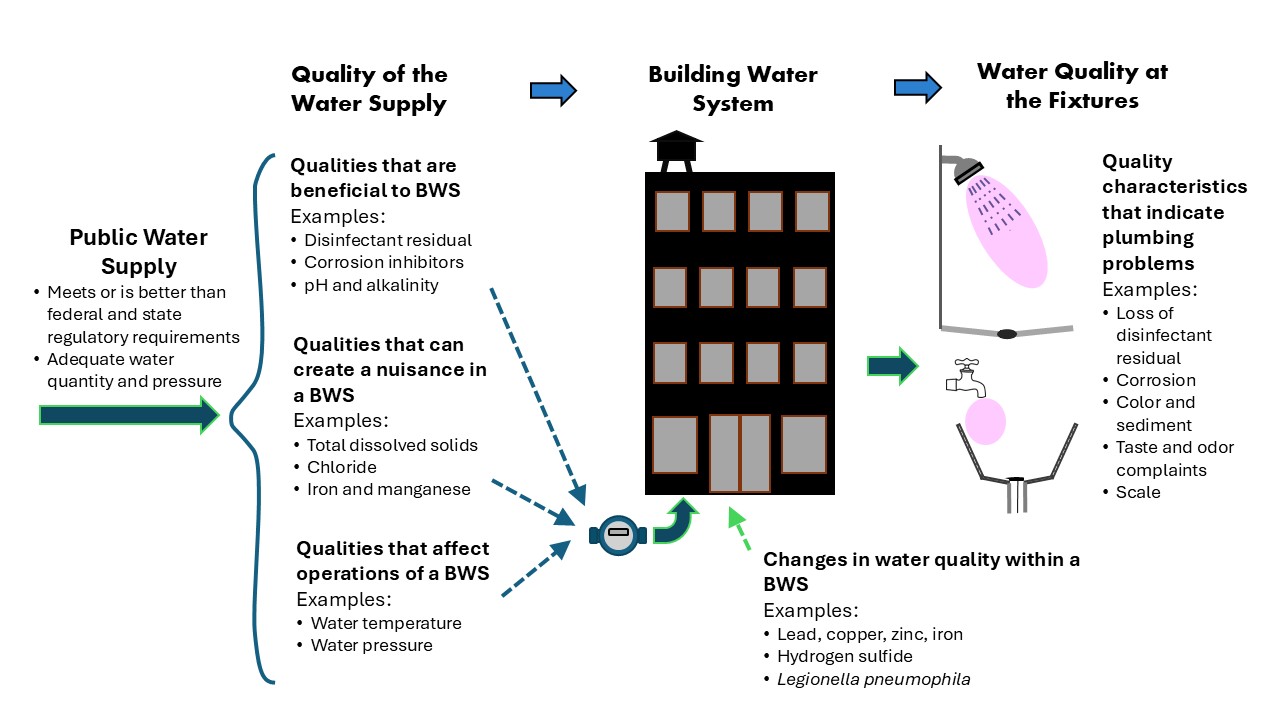
As shown in Figure 1, BWSs are the last leg in the process of supplying water to an end user that starts with a PWS and ends with the intermittent use of water at fixtures within BWSs. Water quality and service characteristics of the PWS can remain stable to the end user or they can change within the BWS. Understanding the characteristics of the water supplied to a BWS helps owners and operators know how to better manage their supply within the BWS.
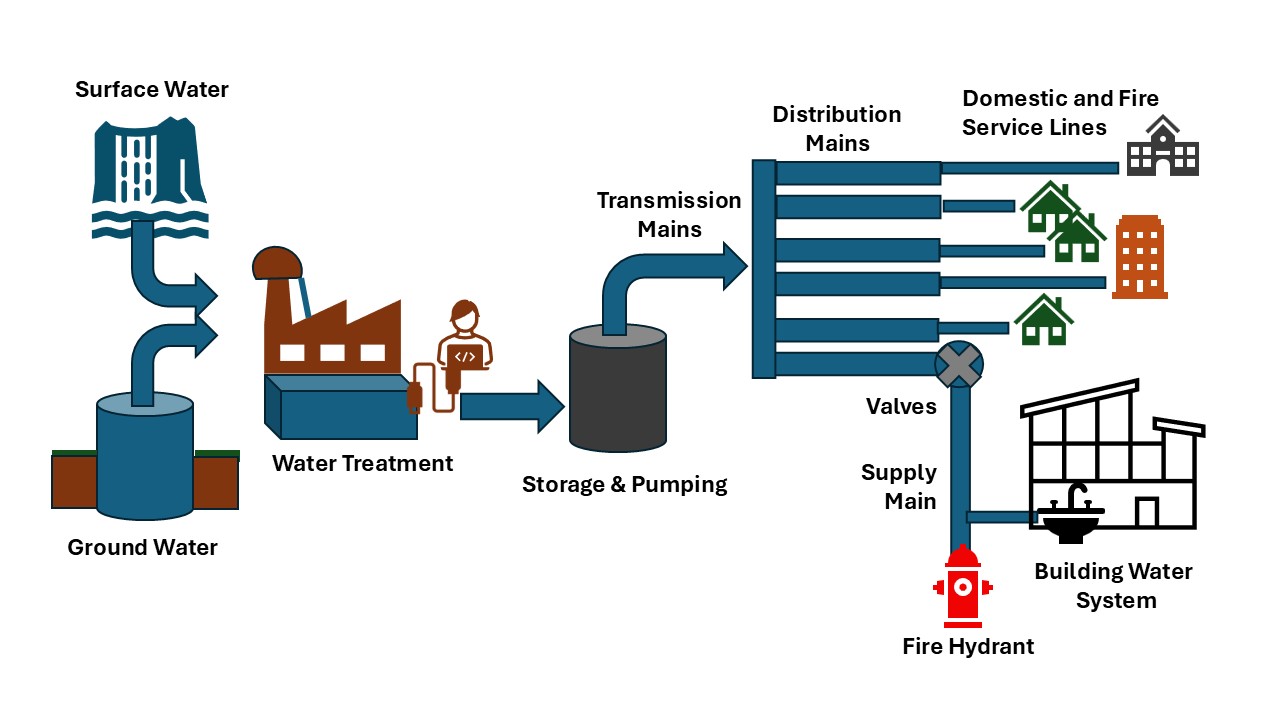
Basic layout of a public water supply system
The source water used by a PWS plays a major role in the quality of the potable water provided to the BWS. The majority of small- and medium-sized public water systems rely on ground water. Larger PWSs tend to rely on surface water alone or surface water and ground water.
Surface water includes streams, rivers, lakes and reservoirs. Ground water supplies tend to be subject to fewer sources of contamination; however, they are not free of their water quality issues. Surface water supplies vary a great deal in water quality characteristics.
Source water supplies require much protection. Maintaining a source water protection program is one of many requirements for regulated water systems.
A foundational concept for PWSs is providing safe drinking water centers on multiple barriers. This concept reinforces that no single operational or design aspect of a PWS alone can guarantee the provision of safe water 24/7. Thus, there are multiple designs and operational elements that must be in place.
For example, a list of multiple barriers includes:
Source water protection;
Effective and reliable water treatment;
Operator training and certification;
Proper design and maintenance of distribution system infrastructure;
Adequate provision of water pressure and flow;
Security of water storage facilities;
Water quality monitoring and reporting.
This multiple-barriers paradigm is equally applicable for BWSs. For example, whole-building carbon filtration might be employed as a barrier to low-level contaminants present in the supply, but it can deplete the disinfectant residual, which in turn would interfere with control of biological hazards like Legionella pneumophila.
Water softening at the point of entry to a BWS is a common building treatment system that is used to reduce the effects of hard water and to improve water quality for end users but can be a place for biological growth. Therefore, multiple controls are needed, which might include water temperature management and system flushing exercises.
Water treatment is a critical barrier against chemical and microbial contaminants. Treatment is selected based on source water characteristics.
Ground water sources may need very little, if any, treatment, whereas surface water sources always need a basic level of treatment for public safety. Some characteristics can be changed, such as pH, hardness, organic matter content, iron and manganese, and bacteria levels. Other characteristics may be difficult to change, such as sodium and chloride levels, contaminants such as pesticides and herbicides, and radiologicals.
While the science and engineering of water treatment have become quite advanced, many treatment systems remain quite simple. Ground water may need very little treatment such that only disinfection is needed. Water that is very hard, or high in calcium carbonate, needs softening.
Most surface waters need treatment to remove organic and inorganic matter along with disinfection. Conventional treatment includes coagulation, flocculation and sedimentation followed by filtration. Filtration can be advanced using sand filters or with ultrafiltration and microfiltration, which can remove many contaminants that sand filters cannot remove. Biologically active filtration can remove organic matter and disinfection by-product precursors.
In addition to filtration, disinfection can be advanced with processes such as ozonation or ultraviolet light. Desalination, such as with reverse osmosis filtration, can remove total dissolved solids, minerals and salt.
As a result, the final water quality after treatment can be significantly improved over the quality found in a source water.
Many water supplies have chemicals added during treatment such as free chlorine or chloramine for a disinfectant residual, hydrated lime for pH adjustment and alkalinity, and phosphates for minimizing the corrosive actions of the potable water on pipe materials. During water treatment, the disinfection of the water by using chlorine forms disinfection by-products which have EPA limits for public health purposes.
Once the water has been treated to meet federal and state requirements for drinking water, the potable water is distributed to customers through water mains, storage facilities, pumping stations and service connections.
Some water quality characteristics can change during distribution to customers. Changes are influenced by such factors as water temperature, pH, pipe material and the retention time of water in distribution.
Biofilm can form on pipe walls, sediment can accumulate at closed valves, disinfection by-products can continue to form in storage facilities, and the disinfectant residual can decay. Chloramine decay can lead to biological nitrification or the conversion of ammonia to nitrite and nitrate.
Therefore, a PWS samples for and tests water throughout its distribution system and from customers’ taps to ensure adequate water quality is delivered to end users.
Figure 2 provides a general diagram of a PWS, from water supply source, through water treatment, and into distribution for delivery to customers.
Various operations and configurations can influence the quality of the water received:
Closed valves can allow sediment to accumulate and chlorine residual to die off.
Unlined cast iron mains can corrode and release iron.
Blending of waters can result in different water quality being received on different days.
Storage facilities can allow biological nitrification to develop.
Thus, it is not sufficient to know the quality of the water as it leaves a water treatment plant since, during distribution, it can change in significant ways.
Regulations and standards for PWSs
PWSs are subject to regulations established by the Environmental Protection Agency (EPA) under the Safe Drinking Water Act. In addition, each state which maintains primacy for enforcing the federal regulations can add to the EPA’s requirements. These federal and state regulations set minimum requirements for the provision of a safe drinking water supply.
PWSs also maintain water quality throughout distribution via meeting industry standards related to aspects like storage operations and maintenance, and by developing and implementing water management strategies. The American Water Works Association (AWWA) provides resources for understanding water treatment and distribution such as Water Quality & Treatment: A Handbook on Drinking Water, Water Quality Complaint Investigators Guide, and Plain Talk About Drinking Water. In addition, AWWA maintains Manuals of Water Supply Practices, such as:
M5 Water Utility Management;
M12 Simplified Procedures for Water Examination;
M20 Water Chlorination/Chloramination Practices and Principles;
M21 Groundwater Operations;
M68 Water Quality in Distribution Systems.
PWSs can provide Consumer Confidence Reports or annual reports on its compliance with water quality standards. These provide information regarding the sources of water supply, water treatment being used, and compliance with federal and state water quality standards. However, these reports often do not provide everything a BWS owner or operator needs to know.
Part 2 of this series will include an overview of the water quality parameters and water characteristics that may impact (and inform) system design and operation, as well as guidance on parameters that can be measured as part of a water supply assessment.
Gary A. Burlingame is Principal Scientist, Technical Services and Research at IAPMO in Ontario, California. He can be reached at [email protected].
Tim Bartrand, Ph.D., is the Director of Water Research at IAPMO. Based in Narberth, Pennsylvania, he can be reached at [email protected].
Christoph Lohr, PE, CPD, LEED AP BD+C, ASSE 12080, is Vice President of Technical Services and Research at IAPMO. Based in Phoenix, Arizona, he can be reached at [email protected].
References
ANSI/ASHRAE Standard 188-2021 Legionellosis: Risk Management for Building Water Systems. ASHRAE, 2021.
ASHRAE 2023a. Guideline 12-2023 Managing the Risk of Legionellosis Associated with Building Water Systems. ASHRAE, 2023.
ASHRAE 2023b. ANSI-ASHRAE Standard 514-2023 Risk Management for Building Water Systems: Physical, Chemical, and Microbial Hazards. ASHRAE, 2023.
Centers for Disease Control and Prevention. Developing a Water Management Program to Reduce Legionella Growth & Spread in Buildings – A Practical Guide to Implementing Industry Standards. CDC, 2017.