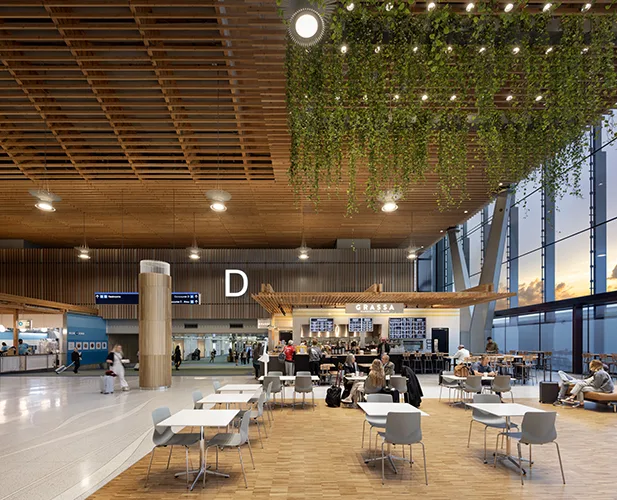
Portland International Airport, owned and operated by the Port of Portland, had a systemic grease problem across its food concessions. Dozens of dispersed tenants relied on aging gravity lines and tenant‑maintained interceptors that routinely clogged and overflowed, jeopardizing both operations and code compliance across the concourses.
To solve the problem without tearing up the FAA‑compliant tarmac or shoehorning interceptors into already congested utility corridors, the Port of Portland partnered with PAE Consulting Engineers to evaluate alternatives. Together, they ultimately implemented a vacuum‑based grease waste system that could pull fats, oils and grease (FOG) long distances — horizontally and vertically — from widely scattered concessions back to centralized separation equipment.
By having PAE and AcornVac, Inc. co‑engineer larger‑capacity accumulators, stainless‑steel vacuum mains with sawtooth slopes, and redundancy into a phased rollout, the team delivered a system that has run for more than a decade with clean pipes, minimal overflows and lower lifecycle costs. That same adaptable backbone is now being extended across newly renovated terminals as the airport continues to reuse and expand the vacuum plumbing system.
Project background
Portland International Airport’s journey with vacuum plumbing began more than 13 years ago with Terminal Grease Separation phase 1 (TGS 1). This was an initial installation serving a pre‑security concession area, undertaken by the Port of Portland as the airport’s owner and operator.
To comply with newly updated grease waste regulations, every food service tenant needed to improve their capture and management of fats, oils and grease. However, the Port of Portland’s existing approach, which used hydromechanical interceptors located inside individual tenant spaces, had resulted in inconsistent maintenance, frequent clogging and grease bypass into the main drainage lines.
Recurring blockages in the gravity system disrupted concession operations, increased the risk of code violations and environmental incidents and drove up emergency repair costs. Together, these issues underscored that tenant‑managed point solutions were no longer tenable in a 24/7 airport environment.
Building on the success of TGS 1, the Port of Portland and PAE later planned Terminal Grease Separation phase 2 (TGS 2) to extend vacuum plumbing across multiple concourses — a move that would turn vacuum transport and centralized separation into the primary strategy for grease management at the airport. I served as the Port of Portland’s lead technical authority for both phases, guiding the transition from traditional gravity systems to vacuum plumbing and coordinating design decisions with operations and maintenance staff.
Technical challenge
The first vacuum setup for the TGS 1 project worked well; however, upgrading Portland International Airport’s grease waste system across the facility encountered significant technical challenges:
• The FAA-compliant tarmac prioritized safety and durability, making subsurface modifications difficult.
• Installing multiple conventional below-grade grease interceptors would have required extensive demolition and reconstruction of the tarmac at a very high cost, given the complexity and scale of the work.
Beyond the physical barriers, the airport’s deplaning level was already densely packed with existing utilities, leaving limited ceiling space for new piping or equipment. Any new system would have to be routed carefully to avoid those utilities and to navigate around critical infrastructure such as baggage conveyors, which require precise clearances to maintain operational safety and efficiency.
Compounding these challenges was the airport’s decentralized food service operations. Tenant contractors, responsible for installing and maintaining plumbing in their leased spaces, operated largely outside the Port of Portland’s direct control. This arrangement raised concerns about the long-term integrity and consistency of any new system, since variations in contractor expertise and attention to detail could create vulnerabilities or future maintenance issues.
Finally, the airport’s status as a significant transportation hub imposed strict operational requirements. Any solution would have to be installed and maintained with minimal disruption to daily activity, since 24/7 operations leave little room for extended shutdowns or construction-related interruptions.
Collectively, these factors made the implementation of traditional grease management systems not only prohibitively expensive but also logistically impractical, necessitating a fundamentally different approach to meet both regulatory and operational needs.
AcornVac system overview
PAE developed a vacuum plumbing strategy that used AcornVac’s vacuum plumbing system to move grease waste long distances from scattered concessions back to centralized separation equipment without disturbing the FAA‑compliant tarmac.
The team configured larger AcornVac accumulators to provide sufficient usable volume for multiple airport food tenants, allowing each concession to discharge by gravity into a nearby tank while vacuum transport occurred behind the scenes. PAE specified stainless-steel vacuum mains in place of cast iron to reduce weight and improve corrosion resistance in a FOG‑ and chemical‑rich environment, and laid out runs that could lift and carry waste both vertically and horizontally to a central collection point.
To maintain performance while threading new mains through congested utility zones and around baggage systems, the design incorporated sawtooth slope adjustments, dual extraction valves, overflow protection and secured strainers to meet the airport’s reliability and maintenance requirements in a 24/7 terminal.
Implementation process
The successful deployment of the AcornVac system at Portland International Airport followed a carefully coordinated implementation process involving multiple stakeholders. In that first project, TGS 1, AcornVac organized demonstrations using a mobile showroom, allowing Port of Portland officials to observe the technology in action and pique their interest.
Key personnel from the Port of Portland were also invited to tour the AcornVac manufacturing facility in Chino, California.
As the program expanded into TGS 2, PAE and AcornVac focused on contractor education, providing targeted training on stainless-steel assembly, slope transitions and other vacuum‑specific details so field crews could execute the design reliably. To maintain quality and ensure adherence to specifications, multiple inspection points were established throughout the installation, including checks at 35% and 80% completion, as well as a final inspection before commissioning.
Because the port was risk-averse, a ‘belt and suspenders’ approach was taken, with built in redundancy in every part of the system — from dual extraction valves to overflow protection — to ensure airport operations would continue even if a component failed.
Through this structured, collaborative process, the AcornVac system was integrated into the airport’s infrastructure, setting a new standard for grease waste management in complex public facilities.
Operational benefits
The AcornVac system delivered a range of operational benefits for Portland International Airport, with custom modifications implemented to ensure reliability and ease of maintenance.
Based on the initial installation 13 years ago, airport staff knew the system’s reliability was exceptional since the airport has had very few overflows and inspections show the pipes remain clean. This maintenance win confirms the vacuum transport, and centralized separation approach effectively prevents the accumulation of fats, oils and grease.
The system’s adaptability has also proved valuable. As food service tenants and layouts have evolved, the AcornVac infrastructure has adapted with minimal disruption, simplifying cleaning and maintenance for airport staff.
The adoption of a vacuum-based solution allowed maintenance personnel to service debris separators and other system components without disrupting concourse operations above — a key advantage in an airport environment, where minimizing downtime and avoiding interference with passenger flow are critical.
Financial and environmental impact
The financial impact of the vacuum system at Portland International Airport was significant. By avoiding extensive tarmac demolition and reconstruction for multiple below‑grade interceptors, the Port of Portland eliminated one of the largest potential project costs.
The AcornVac system also reduced the number of grease interceptors required and used lighter stainless steel piping in place of cast iron, lowering labor requirements and installation time.
In operation, the system’s modularity and component reusability have added further value. One of the biggest advantages was being able to reuse tanks and control panels from the first phase in the current terminal expansion project, TCore, which after more than a decade are still going strong.
This combination of avoided civil work, leaner mechanical scope and long‑lived components helped the Port of Portland reduce both capital and ongoing maintenance costs while limiting revenue risk from unplanned outages.
The AcornVac vacuum plumbing system also delivered clear environmental benefits for the airport. By improving grease capture and transport, the system prevents blockages and overflows that could send fats, oils and grease into the municipal wastewater system or nearby waterways. Centralized separation, combined with the vacuum system’s self‑cleaning action and fewer emergency interventions, has made grease handling more predictable and controlled, supporting the Port of Portland’s broader sustainability and resource‑management goals.
Lessons learned
Portland International Airport’s TGS 1/2 and TCore projects, all using the AcornVac system, yielded several essential lessons that can guide similar infrastructure upgrades in complex environments:
• Early stakeholder engagement is crucial. Demonstrations and facility tours played a vital role in fostering trust and understanding among port officials, contractors and maintenance staff.
• Clear division of responsibilities enhances accountability. Assigning gravity piping installation to tenant contractors and vacuum system maintenance to port staff clarified roles and reduced confusion, leading to better system integrity and more consistent upkeep.
• Comprehensive training and quality control prevent issues. Providing thorough training for all installation teams and establishing multiple inspection points throughout the process helped maintain high standards and catch potential problems before they could impact operations.
• System modularity and component reusability drive long-term value. Designing the system so that major components can be reused during expansions or upgrades maximizes return on investment and minimizes waste.
• Redundancy and customization enhance reliability. Incorporating features such as dual extraction valves, overflow protection and secured strainers addressed the airport’s specific operational risks and ensured uninterrupted service in a 24/7 environment.
• Vacuum technology offers distinct advantages. The vacuum-based solution proved not only more cost-effective but also easier to maintain and adapt as the airport’s needs evolved, confirming its value over traditional gravity systems.
• Procurement. The port worked within the public procurement process to select the sole source vendor during the design phase, which provided additional quality control during design and a long-term commitment to the project and the Port of Portland by Acorn. It could be a mistake to use an open, low-bid procurement for a specialty system like this, because no two vacuum systems are equal in terms of design, operation and maintenance.
These lessons highlight the importance of collaboration, adaptability and a focus on long-term operational excellence when introducing innovative infrastructure solutions in demanding public settings.
A vacuum system may not be the first tool engineers consider for grease control, but at Portland International Airport it turned out to be the only approach that could satisfy code, preserve critical infrastructure and still give the owner long-term flexibility. By pairing AcornVac’s hardware with PAE’s system-level thinking, the Port of Portland turned a chronic maintenance liability into a piece of backbone infrastructure it can confidently design around for the next generation of terminal projects.
Eric Walczyk is a senior associate at PAE Consulting Engineers in Portland, Oregon. He has over 20 years’ experience designing plumbing and fire protection systems for manufacturing and research facilities, libraries, office buildings and other complex project types, and has contributed to nearly 50 projects that achieved LEED Gold certification or higher. Eric is a past vice president of the American Society of Plumbing Engineers’ Portland Chapter.