With nearly 20 years of experience in plumbing design, I’ve seen an evolution in philosophies around many topics. Some truths that many engineers for years held to be self-evident have been discovered to be questionable at best, and outright false in other cases.
Take, for example, the codified use of Hunter’s Curve to size domestic water systems. Hunter’s Curve has never accurately accounted for variability in water usage across building types, user populations and fixture types. As such, the method has become increasingly inaccurate as plumbing technologies have evolved and led to the widespread oversizing of domestic water systems.
Recent research and discoveries in water usage, such as the Water Demand Calculator, coupled with new findings on waterborne bacteria propagation have shown that inaccurate sizing can lead not only to unneeded construction costs but also risks to public health.
The philosophy behind grease-interceptor design is another plumbing topic that has drastically changed over my career. I’ve known many plumbing designers who sized grease interceptors arbitrarily with little regard to the real demand being placed on them. The required sizing method could also vary by plumbing code, and some plumbing codes even allowed multiple methods that produced drastically different results.
I’ve observed engineers who sized grease interceptors according to one of these code-mandated methods, but then doubled the calculated size with the false belief that doing so would extend the life of the unit. And perhaps worse, some code-mandated methods have been proven to be harmful to the grease interceptor and piping system.
With all this conflicting information, many plumbing engineers have become confused as to how to size a unit for the best performance and longevity; however, recent research has revealed a method that is more correct than those used in the past.
Bigger isn’t always better
Many codes mandate sizing methods that tend to oversize plumbing systems. While some plumbing systems and equipment are forgiving if oversized, grease interceptors are not.
Properly sized grease interceptors turn their liquid and food solid contents over into the sewer about every 24 hours. When grease interceptors are oversized, the liquid flows become inadequate to move the contents through and out of the unit. These contents settle to the bottom, become septic and produce hydrogen sulfide gas.
Hydrogen sulfide is noxious, highly toxic and corrosive. Buildup of this gas in the interceptor can cause nuisance odors, is a health risk to maintenance personnel and the public, and can cause unit and piping failures.
Many documented cases exist of buried grease interceptors — particularly concrete and metal units — collapsing due to corrosion. Some of these incidents have prompted building code officials to rethink their mandated sizing methods and issue new regulations around interceptor maintenance. However, too many codes (and engineers) still use outdated sizing methods.
Sizing methods to avoid
Correctly sizing a grease interceptor requires an understanding of both the flow through the unit and the amount of grease produced by the equipment it serves. Many historical grease interceptor sizing methods did not accurately predict either of these, often erring on the high side of each. These methods paid little regard to building types and hours of operation, user behaviors, connected equipment types, building location and many other factors that influence the load on an interceptor.
The most basic sizing method still used by some codes is based purely on the drainage fixture units connected to a grease interceptor. This has been problematic because kitchen equipment has evolved to produce less waste and drainage fixture unit values have not stayed current with technology.
Furthermore, the equipment required to be connected to a grease interceptor can vary drastically by code, municipality and capabilities of the local sewerage authority. Some of these entities require floor drains, handwashing fixtures and other low-flow or low-grease sources to still be connected to the unit, thus driving up the size unnecessarily and leading to the problems mentioned earlier.
Another method often used in the past requires calculating the instantaneous flow of all equipment connected to the interceptor. This involves calculating the volume of liquid and waste that could be contained in and drained from sink basins and dishwashers along with flow rates for all other equipment.
After determining this, the designer would occasionally apply a diversity factor to it based on expected usage, meal program or user behavior, along with another correction for the time to retain grease in the interceptor. This also fails to account for factors that establish the real load on the unit.
The grease production sizing method
The sizing method that I’ve found yields the best results is the grease production sizing method (GPSM). GPSM accounts for both the peak flow rate of the connected kitchen equipment along with the amount of grease it produces. To perform the calculation, designers need to have engineering specifications of the connected equipment along with information about the meal program.
For the total peak flow rate of the kitchen, consider the discharge rates of all the connected equipment along with the behaviors of the users. Talking with your client about how the kitchen operates, where it’s located, who it serves and other local characteristics are key. For example, a restaurant that is open for lunch and dinner in a large city’s business district will see much different demands than a restaurant located off a highway in a rural area.
For the former, if a dishwasher and pot sink are connected to the grease interceptor, it’s likely they will run almost constantly during service hours and for a time after closing. In this situation, these constant, high-flow items should drive the flow rate of the unit. If this same restaurant also has hand sinks and area floor drains connected, these will see much less frequent use, and may not factor in to the peak flow on the interceptor.
To determine the amount of grease produced by the kitchen, you’ll need your client to provide:
The types of food served;
Whether plates and flatware will be predominantly disposable or cleaned by dishwasher;
The kitchen’s hours of operation;
Peak meal period, timing and duration;
Anticipated number of meals served per day;
How often they prefer to pump the accumulated grease out of the interceptor (90 days is common).
The amount of grease that a kitchen produces is often found by empirical data, such as detailed in the American Society of Plumbing Engineers’ Design Handbooks. The table below establishes a probable amount of grease produced per meal based on the type of facility you are dealing with.
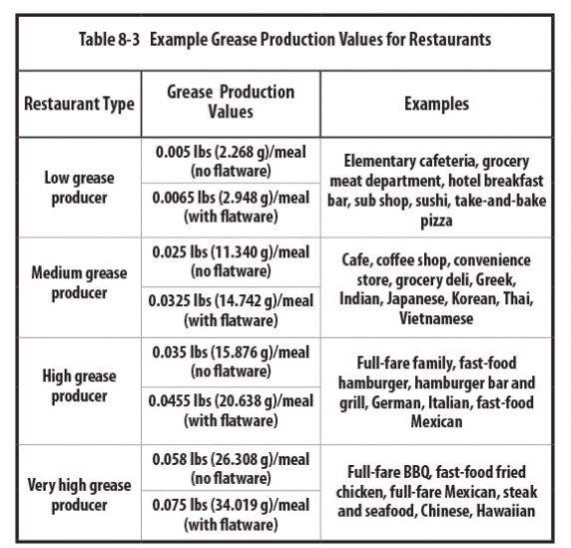
Using this table, you can determine the amount of grease produced per day provided you know the types of food served (No. 1); whether plates and flatware will be predominantly disposable or cleaned by dishwasher (No. 2); and the anticipated number of meals served per day (No. 5). You can then determine the grease retention capacity the interceptor must have based on the pump out period (No. 6).
Some designers may add a small amount of discretionary capacity on top of this to account for surges. Surges can be difficult to predict, but can be indicated from the hours of operation of the kitchen (No. 3) and when the peak meal period is and how long it lasts (No. 4), along with considerations to entertainment or other special events.
Use caution when adding capacity, as grease interceptors are unforgiving when oversized.
A note on materials
Like their sizing methods, the best material for a grease interceptor has changed over my career. Concrete and steel units were common years ago. However, there have been many documented instances of failure of both types, mainly due to corrosion from hydrogen sulfide and strong chemical cleaners.
Polypropylene tends to be more resilient to corrosion and is often a better choice. Polypropylene, however, has a lower material strength than concrete or steel. If you are faced with an unusually deep burial depth (often 10 feet or greater), consult the manufacturer to ensure the unit will not collapse. If there is any chance of this, a stainless steel unit may be a better option.
The piping material that should be used in grease waste systems has also been a subject of debate over the years. Years ago, many designers I knew preferred cast iron because of its ability to withstand hot kitchen wastes and abuse from sewer augers that were used to deal with clogs. However, cast iron is subject to corrosion from cleaning chemicals and hydrogen sulfide gas, making it a poor choice for this application.
Other designers preferred polyvinyl chloride (PVC) since grease is less likely to adhere to its smooth surface and is reasonably resistant to corrosion. However, PVC does not react well to temperatures above 140 F and has been known to degrade in corrosive environments.
Other designers used chlorinated polyvinyl chloride (CPVC) piping that is commonly used in laboratory waste applications, citing its greater resistance to high temperatures and corrosion. However, material tests have revealed that CPVC reacts poorly to grease wastes and manufacturers have verified this.
The two materials I’ve settled on as acceptable for a grease waste application are stainless steel (either 304 or 316) and epoxy-coated cast iron, in that order of preference. Stainless steel has shown resilience to grease waste and other corrosives common in kitchens; it also holds up well to high temperatures and sewer augers. Epoxy-coated cast iron has similar qualities, although the coating will not protect the pipe if it is chipped away.
Reducing risk
Grease interceptor failures are often catastrophic, particularly when they collapse due to weakening under corrosion. Replacing the unit alone can cost well into the five figures and beyond, and a prolonged shutdown of a kitchen can cause a business to fail.
Correctly sizing a grease interceptor and choosing resilient materials for the unit and system greatly reduces the risk of a failure, but never eliminates it. Many building types are still prone to hydrogen sulfide gas buildup. Kitchens that see periods of infrequent use, such as those in seasonal restaurants, schools that close for the summer and office buildings that only operate on weekdays are all culprits.
If a grease interceptor is subject to long dormant periods, recommend that your owner pump it out immediately beforehand.
Some codes require that liquid level monitors be installed in grease interceptors so that an owner is notified when it is time to pump them out. However, some interceptors do not perform well when monitors are installed, as they can interfere with the baffles that separate liquid from grease. Always consult the manufacturer if you are considering putting anything in the unit that is not provided as an option.
Altogether, grease interceptors cannot be arbitrarily sized as they sometimes were in the past, and some sizing methods yield better performance than others. Even if the code you are working under uses an outdated method, it is often worth seeking a variance in favor of something better.
The costs of replacing an improperly sized unit include your owner’s time, money and business, as well as your relationship with them.