The geothermal industry is standing at a precipice: not of a decline, but of a radical, utility-scale expansion. The conversation has shifted from individual residential heat pump installations to the broad, systemic deployment of thermal energy networks (TENs).
However, a persistent challenge remains: How do we efficiently harvest the massive amounts of thermal energy moving through our industrial and digital infrastructure?
The answer emerges from a surprising source. Lonnie Johnson, the Hall of Fame inventor known for the Super Soaker, has spent years refining a technology that is now ready for the prime time of the energy sector: the Johnson thermo-electrochemical converter (JTEC).
By integrating JTEC technology into our burgeoning TENs, we are moving beyond simple heating and cooling. We are entering the era of the “solid-state thermal exchange,” where our infrastructure becomes intelligent, efficient and mechanically simple.
High-temperature geothermal: The solid-state successor to ORC
For decades, high-temperature geothermal extraction has relied on the Organic Rankine Cycle (ORC). While effective, ORC systems are fundamentally mechanical beasts. They require complex assemblies of turbines, pumps and volatile working fluids to convert heat into motion and then into electricity. These systems introduce significant friction, maintenance costs and parasitic loads that cap their efficiency.
The JTEC engine represents a fundamental departure from this mechanical legacy. It is a solid-state device with no moving parts. Instead of using heat to drive a turbine, the JTEC uses electrochemistry. It leverages a pressure differential created by heat to move hydrogen ions through a proton-conducting membrane.
This process generates electricity directly from the temperature gradient. By eliminating the friction and mechanical losses of an ORC system, the JTEC can operate significantly closer to the Carnot efficiency limit. For deep geothermal projects, this means extracting more kilowatts per gallon of brine, with a fraction of the maintenance overhead.
The low-temperature reality: A future frontier
It is important to be precise about the thermodynamics of waste heat. While the JTEC can harvest energy from sources down to 175 F, we must acknowledge the economic reality of ultra-low-grade heat. The 100-degree-to-130-degree water currently rejected by standard data centers or immersion cooling loops is, for now, not a viable candidate for electricity generation.
The physics of converting such small temperature differentials into voltage remains a next-generation frontier.
However, this does not mean this heat is without value. In a TEN, this low-grade heat is the perfect feedstock for district heating loops. The JTEC’s role here is not necessarily to generate power from this tepid water, but to wait for the high-density, next-generation computer chips that will push fluid temperatures well above 175 degrees — where generation becomes not just feasible, but highly profitable.
The real revolution: The Carnot refrigeration cycle
While power generation grabs headlines, the most immediate and disruptive application of JTEC technology lies in its reversibility. When we apply electricity to the JTEC stack, it transforms into a solid-state heat pump of unprecedented efficiency. This is the realization of the Carnot refrigeration cycle without a mechanical compressor. By electrochemically compressing and expanding hydrogen, the JTEC moves thermal energy against the gradient with virtually no friction losses.
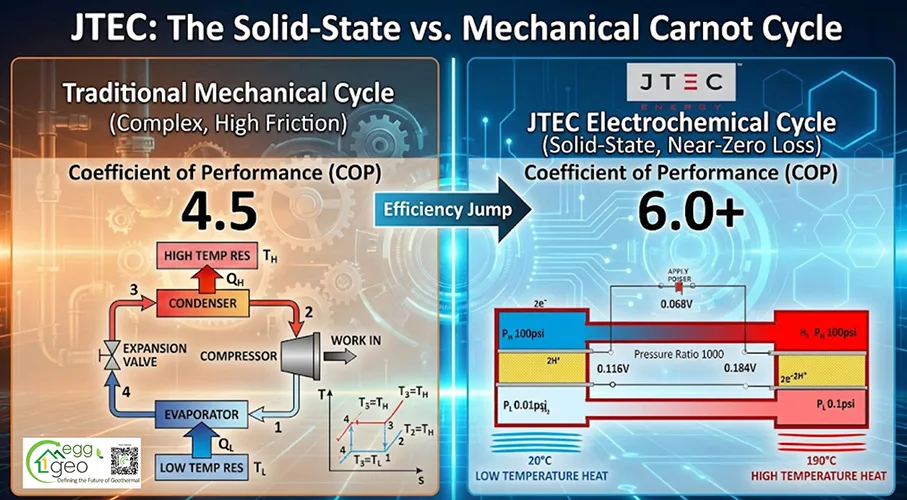
To understand the magnitude of this shift, we must look at the numbers. Traditional vapor-compression heat pumps are hitting a thermodynamic wall, struggling to push Coefficient of Performance (COP) ratings beyond 4.5 or seasonal energy efficiency ratio (SEER) ratings past 21 due to mechanical friction and compressor losses.
The JTEC shatters this ceiling. By eliminating moving parts and operating on a near-reversible electrochemical cycle, JTEC targets a COP of 6.0+ and a cooling efficiency exceeding SEER 26. This is not just an incremental improvement; it is a leap toward 60% of the theoretical Carnot limit — a level of efficiency previously thought impossible outside of a laboratory.
For the end-user, this means the same cooling power for nearly half the energy input.
Strategic integration: The path forward
For mechanical contractors and engineers, this is the “kill app.” It offers a path to replace the massive, energy-hungry chillers and rooftop units that dominate our skylines with compact, silent, solid-state arrays.
At Egg Geo, we see an immediate strategic fit for JTEC within our current project pipeline. We are actively discussing pilot integrations with JTEC leadership — including CEO Mike McQuary and Lonnie Johnson himself — to bring this technology into the field.
Our vision is a unified industry where we stop fighting thermodynamics with heavy machinery and start working with it through solid-state innovation. Whether generating power from a deep geothermal well or providing ultra-efficient cooling for a data center, the JTEC provides the heart of a truly circular energy economy.