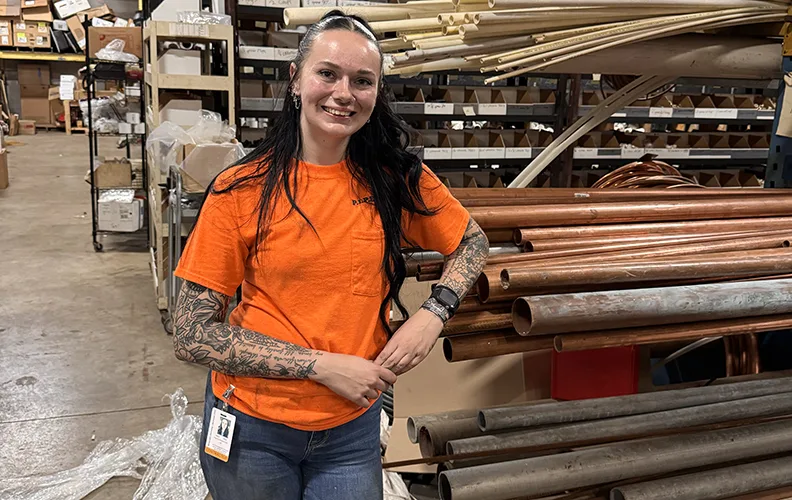
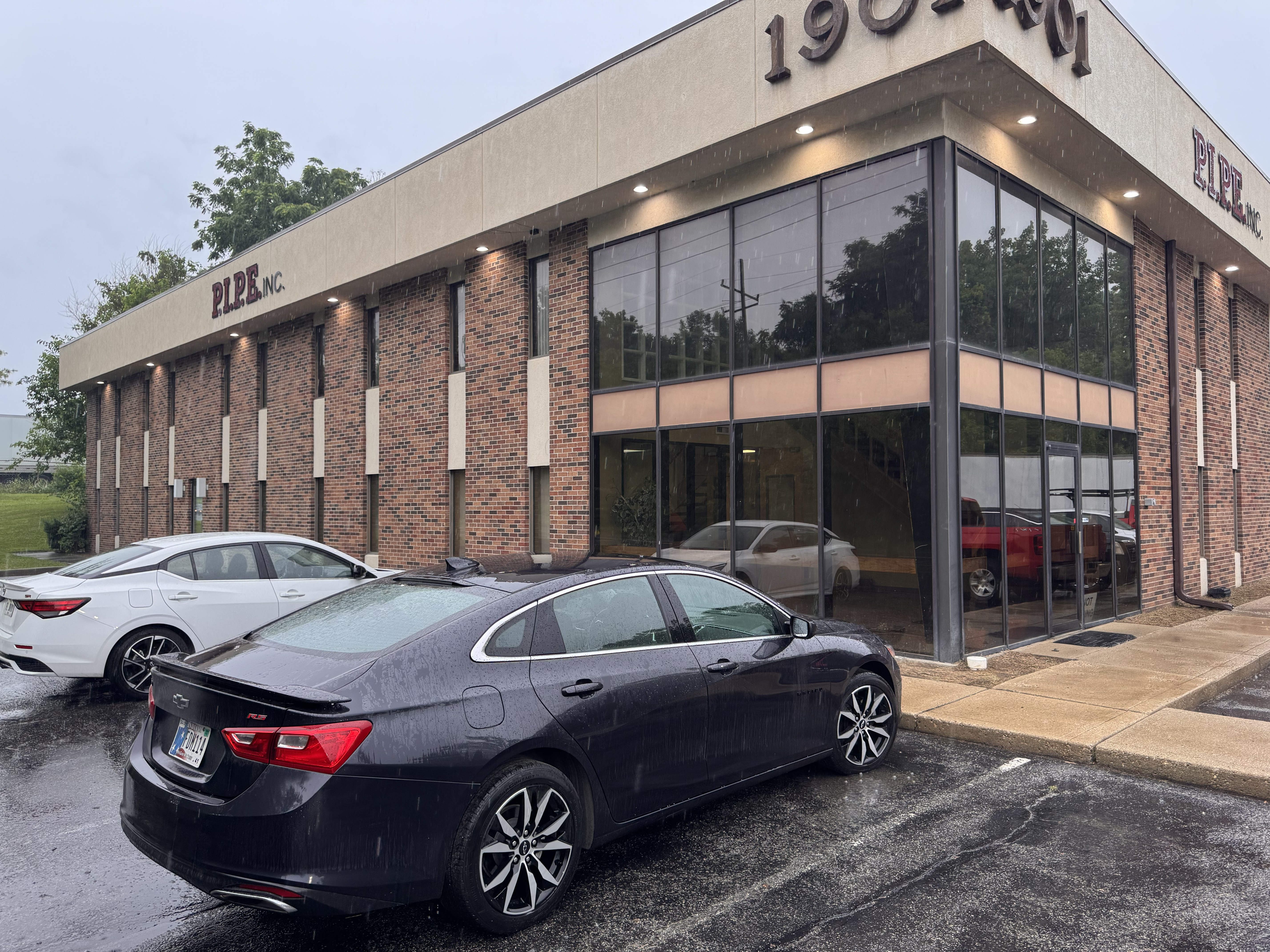
We planned to talk to Valerie Butler earlier in the day when we headed to see her at P.I.P.E. Inc., a contractor specializing in commercial plumbing and fire protection in the Indianapolis market and where she’s worked since 2020.
But our morning interview didn’t take place until late-afternoon. So we started by asking her to describe her day and, well, let’s hear her tell it.
“I had an eventful morning, that’s for sure,” Valerie says. “I had to get to a school project that’s about 45 minutes away so I was up and at the office by 5 a.m.—which honestly isn’t unusual for me, since I do the office work on top of being in the field. But today I also had to borrow one of our guys’ trucks because I don’t have a company truck yet. From there it was a scramble. I left around 6 to swing by another jobsite to grab a press tool, then to a second site to pick up a 10-foot ladder. By the time I actually pulled into the school jobsite it was 7. I’m the only plumber we have who’s cleared to be on that site right now—background check, DCFS, Safe Hiring, E-Verify, all of it— and I was meeting a P.I.P.E fire sprinkler installer who also has all the clearances you need to do work at a school. So when we got a 48-hour notice that we had to get copper hydronic pipe and sprinkler line out of the way so the demo crew could get in next week, we were the two to do it. If we hadn’t done that work today, it would have likely pushed the project back by weeks.”
That kind of morning, equal parts credentials, logistics, pressure, teamwork and problem-solving, is an accurate snapshot of Valerie’s young PHCP career so far. She still holds her original two titles, project coordinator and estimator, conferred when she joined P.I.P.E. But she’s also the company’s safety director and quality control coordinator. When we met her last June, she was a week from sitting down to take her journeyman license, which has since earned.
And if she wasn’t busy enough at work, she’s quickly rising through the leadership ranks at the Indiana PHCC and an incoming second-year instructor at her alma mater, Mechanical Skills Inc.’s Plumbing Apprenticeship School.
It’s a résumé that has made her an industry star, in particular after being named a top PHCC Foundation scholarship winner in 2024 and the PHCC’s 2025 Plumbing Apprentice of the Year at last year’s CONNECT in Grand Rapids, Michigan.
Beyond the accolades, however, is a story of a Marine veteran determined to enter the skilled trades, the mentors who helped her prosper and the role she’s since grown into providing proof of what the next generation of tradespeople can be.
Finding the trade
Valerie’s path into plumbing started after a serious injury forced her to out of the Marine Corps she had enlisted in after trying out one semester of college. At just 19, she headed back home to Indianapolis to figure out what came next.
What came next wasn’t exactly glamorous: a job at a preschool paying $8 an hour while sharing a two-bedroom apartment with her father and brother.
Her father, Joe Butler, co-owns a stocking rep agency in Noblesville, Indiana, that supplies water heaters and boilers primarily for the commercial and industrial markets. While he certainly did have PHCP industry contacts, Joe’s first instincts were for his son.
“He was trying to convince my brother to get into the plumbing trades,” Valerie recalls. “But he had no interest in it. However, he was catching my interest. So I approached my dad and said, that sounds pretty awesome.”
At first, her father’s thoughts were blunt: Girls don’t typically do this kind of work. Valerie pushed back anyway, and he told her instead of becoming a plumber, maybe it might be better to try for employment at a supply house.
While she looked for work, her father did mention her interest to break into the trades to Mark Helm, a longtime friend and co-owner of P.I.P.E.
Helm got in touch with Valerie. She went to Helm’s office for an appointment and inside of 10 minutes had a job.
That was just six years ago. At the time Valerie had, by her own description, “no plumbing background” and came into the industry “greener than green.”
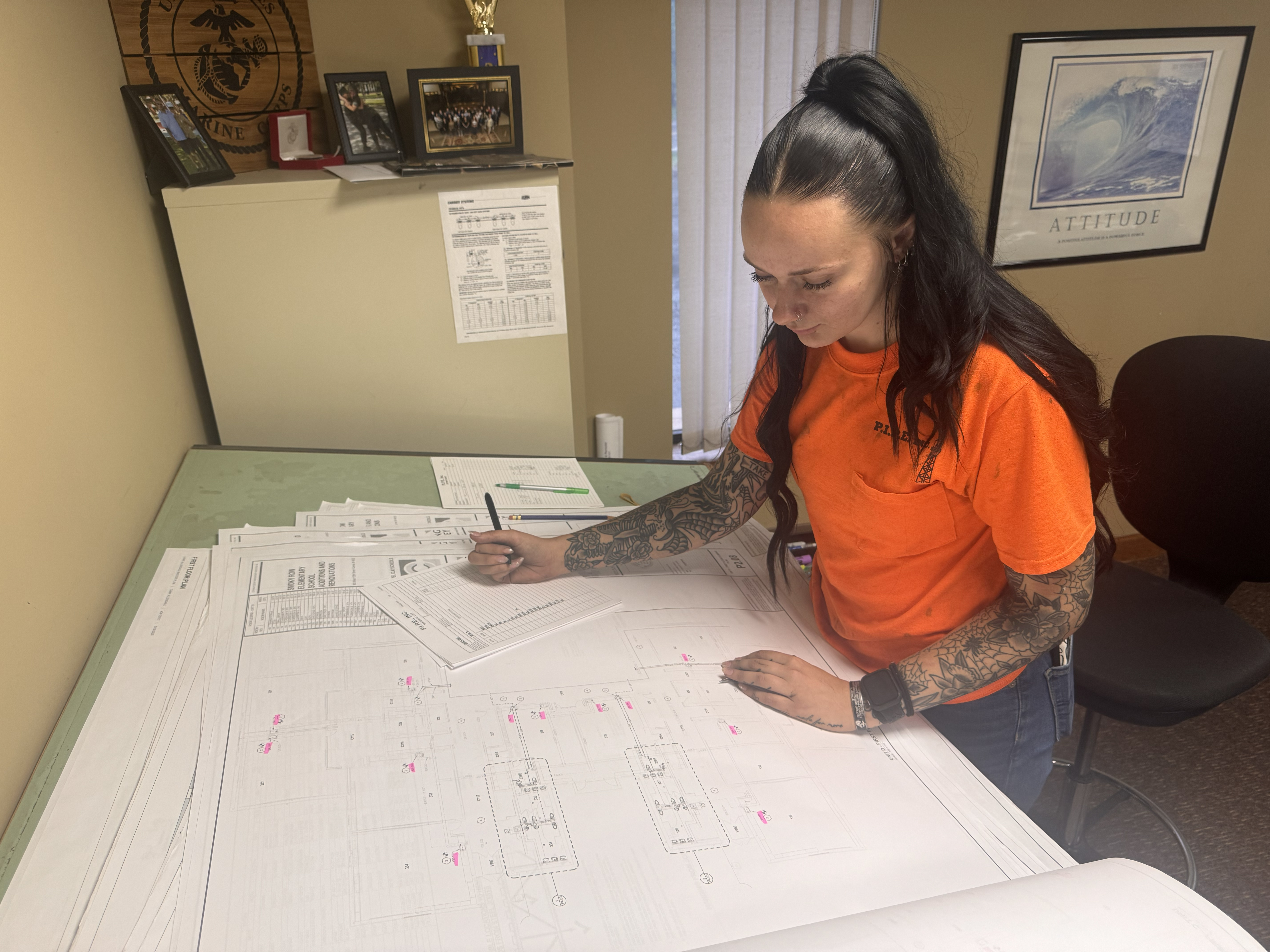
She began working inside P.I.P.E.’s offices poring over blueprints, doing fixture takeoffs, fitting counts, material pulls — all the while giving her a curiosity about the systems she was organizing, but had never touched.
A year or so into the job, P.I.P.E.’s safety program needed an overhaul. Butler volunteered to rebuild the program herself. It took her six months to renew safety checklists, quality-control checklists, OSHA certifications and conduct monthly walkthroughs with the company’s insurance adjuster. When P.I.P.E’s insurer came back for its underwriting renewal meeting, the adjuster told her boss it was the best meeting he’d ever had with the company.
Plus, the safety department overhaul came with a promise from Helm.
“If you get us to the point where the insurance company is not worried about us,” he told Valerie,” I’ll give you an apprenticeship.”
Her actual introduction to fieldwork in 2022 came almost by accident. A journeyman finishing a bathroom trim project in Richmond, Indiana, was stuck with a helper who couldn’t master shower valves and kept breaking porcelain toilets.
Valerie, caught up on her office work, asked if she could go help.
“So I went out to Richmond and the foreman showed me how to do one shower trim,” Valerie says, “and then he watched me do one and then from there on I knocked out about 30 in a day.”
After returning to the office, she made sure to again catch up on office work and got the approval to go back out into the field.
“That’s how it started,” she adds.
A month later, she enrolled at Mechanical Skills, the well-known PHCC-affiliated program. Indiana’s plumbing apprenticeship path is notably rigorous — state law requires four years of study, including some 576 classroom hours plus 6,400 hours on-the-job training before sitting for the journeyman exam all the while requiring a sponsorship from a licensed contractor.
In May 2026, Valerie graduated as valedictorian of her class.
Mentors
Ask Butler what the industry could do differently to keep young people in the trades, and she points to mentorship — specifically, the kind that assumes competence is coming soon rather than begrudging its absence right now.
“One of the biggest things that helped me get through my apprenticeship is just having the mentorship,” Butler says.
She credits two people in particular: Dave Heffner, her first-year instructor at Mechanical Skills, and the foreman at P.I.P.E. who first showed her how to do that shower trim at a job site in Richmond.
We never did talk with Heffner, but after she graduated he wrote this on LinkedIn: “Valerie Butler was one of my 1st Year students 4 years ago and I have continued to mentor her since that time. She is also a Marine Corps veteran. In addition to all of the awards that Valerie has received over the last year, she received the Robert V. Hallam Valedictorian Award last night for the highest overall four-year grade point average. I’m incredibly proud of Valerie for all of her achievements and hard work to cross the finish line last night. Semper Fi, young lady!”
Her valued P.I.P.E. colleague, only a few years older than Butler, became her primary field mentor. What made him effective, in her telling, wasn’t just technical knowledge — it was a teaching style built around demonstration, observation and patience.
“His teaching style was to show me how to do something and then watch over me doing it before letting me go on my own,” she adds. When she had questions, he stopped what he was doing to answer them, even mid-task.
“He had a lot of consideration,” Valerie says.
That relationship hasn’t ended. A few weeks before this interview, Valerie ran into a heat pump unit stuck dumping through its relief valve. She called him and asked how to hand-crank it. He walked her through the fix without a hint of condescension.
“He doesn’t say, oh, you don’t know how to do that?” she adds. “He’s like, this is what you do. Let me know if you need more help.”
To Valerie, that consistent help is the difference between an apprentice who sticks around and one who doesn’t.
She contrasts that style with an older, less patient model still common in the trades, where veteran tradespeople decide a newcomer “isn’t worth their time.”
Given that a fully credentialed plumber can take the better part of a decade to develop, Valerie argues the industry’s ability to hold onto apprentices in year one and two depends heavily on whether that early mentorship is generous to up and comers.
“It’s just having someone who’s open and willing and excited to teach you,” she adds. “That makes you think, OK, I can keep showing up and learn more.”
Butler’s mentors extend beyond plumbing work. Chuck Gillespie, executive director of the Indiana PHCC, has become both a sponsor of her association career and an outspoken advocate for what she represents. He remembers the first time he saw her walk into an Indiana PHCC board meeting.
“I didn’t expect her to be 24 years old at the time,” he told us over a Zoom meeting after he first met Valerie. “But when she sat down and started to talk about her story and how she got into the trades, I immediately figured she’s going to become the face of our organization.” (She literally is the face you see on the Indiana PHCC’s web site.)
Recruited in 2022 when Mark Helm handed her a flier and told her she was joining the state PHCC, she has since cycled from executive member-at-large to state secretary to her current post as vice president of the association. She is slated to become president-elect and president of the state association within two years, all before she turns 30 — a trajectory that includes chairing Indiana’s adaptation of Georgia PHCC’s Recognizing Outstanding Safety (ROPES) program, making Indiana the fourth state to implement it.
Gillespie has since brought her to national PHCC leadership summits and legislative conferences, watching her hold her own in rooms full of industry veterans twice her age.
“She is the model for who we need as far as more leadership, more growth, more opportunities,” Gillespie adds.
Paying it forward
Valerie is candid about the fact that she is still, in 2026, something of an anomaly on most jobsites. In fact, she is P.I.P.E.’s first and so far only woman to complete a plumbing apprenticeship start to finish. The assumption that she can’t physically handle the work follows her from site to site: a superintendent insisting on carrying her ladders or a coworker trying to take copper pipe out of her hands before she’s asked for help.
“I’m fully capable of it,” she says. “I don’t need you to carry these ladders for me. It just takes being able to actually prove that I can do the work. Then, the guys are OK since doing the work is why we’re all here.”
That firsthand experience of having to earn a place in a male-dominated trade is a large part of why Valerie has become an active recruiter for the next generation — and specifically for young women who might not otherwise consider the field.
Working with Gillespie, she visits area high schools carrying a bag of tools — a hacksaw, a press tool, an expansion tool, a bandsaw — and lets students handle them before she ever mentions plumbing by name.
“I have more young women come up who want to know the tools and want to hold them than I actually do the young men,” she says.
Valerie has since helped several of those students find their own way into apprenticeships, delivering a message that a four-year degree isn’t the only route to a stable career and a skilled trades career isn’t just for men.
For Gillespie, that visibility has real utility. Students used to walk past the plumbing and HVAC booths at career fairs without a glance. Now, with Valerie in the room, they stop and ask what the work involves.
Gillespie considers her a bridge between generations at a moment the industry badly needs one.
“She really does represent her generation so well,” Gillespie says. “She is what a plumber can look like today!”