You’re standing at the back of your truck making sure you have everything for the boiler install today. If you stand there long enough, you might think you have everything you need to avoid a trip back to the shop or your local wholesaler. That would be the day, wouldn’t it? In either case, you’ve got a truck full of parts that require careful consideration when installing. Get it right, be the hero. Get it wrong? Expect callbacks!
These are only a few of the components that I see incorrectly installed or installed in the wrong spot. Mistakes like these tend to cost dearly. Whether it’s time and materials or, even worse, an insurance claim or a lost customer, let’s get them right the first time!
Catching dirt
First on the list are devices designed to catch dirt and debris. This could be a strainer, filter media or even a dirt separator. Having one in the system is great, but if you install it downstream from all the expensive bits, what good will it do?
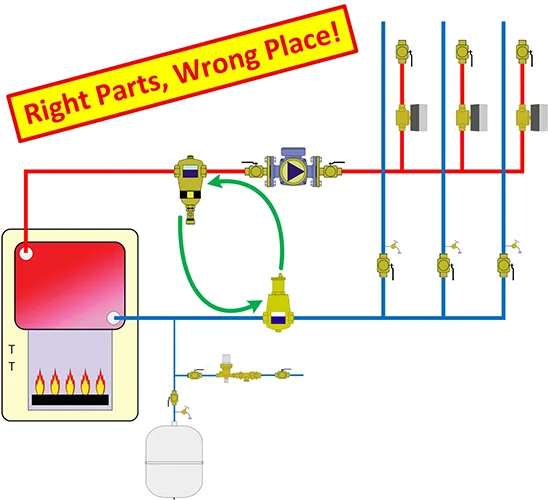
In most cases with dirt-catching devices, we want to see them installed on the common return or, at the very least, on the boiler return. Installing it after your boiler or circulators on the supply going out to your system means that all the dirt and debris must go through your boiler(s) and circulator(s) first!
Whenever I imagine scenarios like this, I always try to compare them to something that most people are familiar with. Many boiler installers also install forced-air heating and cooling systems and should know right where to install the air filter in the system. Installing a dirt separator after the boiler is like installing an air filter after the forced-air furnace and accompanying indoor refrigerant coil. Doesn’t make much sense, does it?
Catching air
So long as it’s not your first day on the job, you already know the importance of controlling and removing air in your hydronic systems. Air causes corrosion, no heat, noise and reduced efficiency in your installations. So, how do you get rid of air? Proper purging during the installation is a big help. After that, you must rely on air vents and air separators to finish the job.
In a pipe full of water, air bubbles want to make their way to the top, similar to that big bubble in your bottle of water. This is why you typically place air vents at high points throughout. Big air bubbles rise and fill the air vent; the float drops, opening the valve; pressure from the system forces the air out until the air vent fills with water and the float rises, closing the valve. Pretty simple device, no?
I often see air vents improperly installed. Installing them into a tee in the middle of a horizontal section of pipe will hardly do you any favors. Unless air has filled the entire section of pipe, the air bubbles will blow right by. I prefer to see them installed at the top of a vertical section of pipe, typically into a tee where the direction of flow changes. This allows the flow to make the turn, and you can hope that the bubbles will go straight through the tee into the air vent.
This is similar to the drip legs you install in gas piping, except the air isn’t falling; it’s rising.
The next weapon to rid your hydronic systems of air is an air separator. Its job is to catch entrained air and microbubbles as they travel through your piping. This means that the air is moving and hasn’t gotten lazy and floated to the top. This also means that we don’t need to install the air separator at a high point such as an air vent. The more common air separators do, however, need to be installed in horizontal pipe — but not any old section of pipe!
Air separators need to be installed where the system temperature is the highest, and the pressure is the lowest. In a mechanical room, this typically means on the outlet of a heat source before your circulator. It could also mean on the return of a chilled water system. The higher the water temperature and the lower pressures make gases want to come out of solution. Proper placement of your air separator means you’ve made its job easier!
Not considering the above and installing the air separator on the discharge of a circulator where the pressure is increased due to the differential created to induce flow, or placing it on the cooler boiler return, isn’t going to help. In fact, you’re only ensuring job security for yourself or possibly the next company when your customer is tired of seeing you back.
Doohickies above expensive stuff
Probably one of my biggest pet peeves: installing serviceable items or parts prone to leaking above boilers or expensive controls. The list is long, but to start, let’s talk about backflow preventers. If there’s a vent, count on water coming out. The fact is that backflow preventers are designed to leak. If that water wasn’t leaking, it could mean system fluid (chemicals, cleaners, etc.) could be going right back into your potable water.
I agree, a failed backflow preventer is a nuisance, but it’s something you and your customers should be grateful for. Yes, it means a service call, but I’d rather that than the alternative. If you take a backflow preventer and install it directly above a boiler, electrical control or burner, you can count on the service call getting a lot more expensive.
Same goes for things such as air vents, which don’t typically leak for no reason. Often, these fail and leak due to debris in the internal valve, preventing it from sealing. This is similar to that old motorcycle in the shed that floods because the needle valve in that old, worn-out carburetor won’t seal. It’s a gentle reminder to remember to shut off the fuel when you put it away!
I understand that there are times when it’s unavoidable, such as that 4 1/2-square-foot closet install, but in general, keep these items below the boilers and keep the controls above any piping or serviceable parts.
So, like raindrops on freshly washed cars and whiskers on kittens (my wife’s allergic), these are a few of my least favorite things. I’m sure there are many more, but we’ll save those for another day. Do yourself a favor: Think a few steps ahead, plan out your jobs and create functional, beautiful heating systems that will go the distance for your customers.