As extreme conditions and natural disasters place growing pressure on infrastructure systems, communities need solutions that improve durability, reduce risk and help maintain essential services when they are needed most.
In late September 2024, precast concrete played a crucial role in recovery efforts after Hurricane Helene devastated Lake Lure, a scenic community of 1,400 residents in the Blue Ridge foothills of North Carolina. The hurricane’s heavy rains caused the lake to rise above the dam, resulting in massive flooding, washed out bridges and both streets and lakes filled with debris from boats, docks, trees and other structures.
Boulders slid down the mountains, damaging the town’s sewage system and taking off the top part of the pump station, causing thousands of gallons of untreated sewage to be emptied into the Rocky Broad River. The destruction needed to be fixed immediately; however, delivery of a new pump station top couldn’t be promised until early 2025. That’s when Gainey’s, a leading manufacturer of custom wastewater, stormwater and industrial precast concrete products across Louisiana and the Gulf Coast, stepped in to help from 700 miles away.
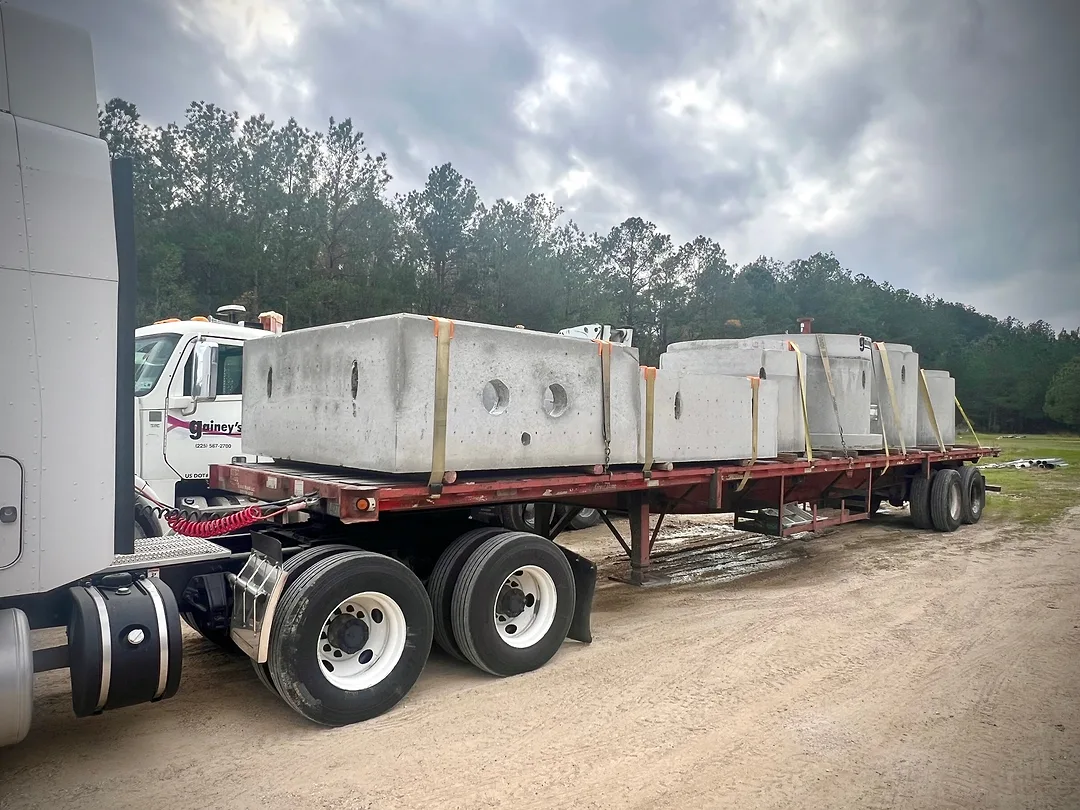
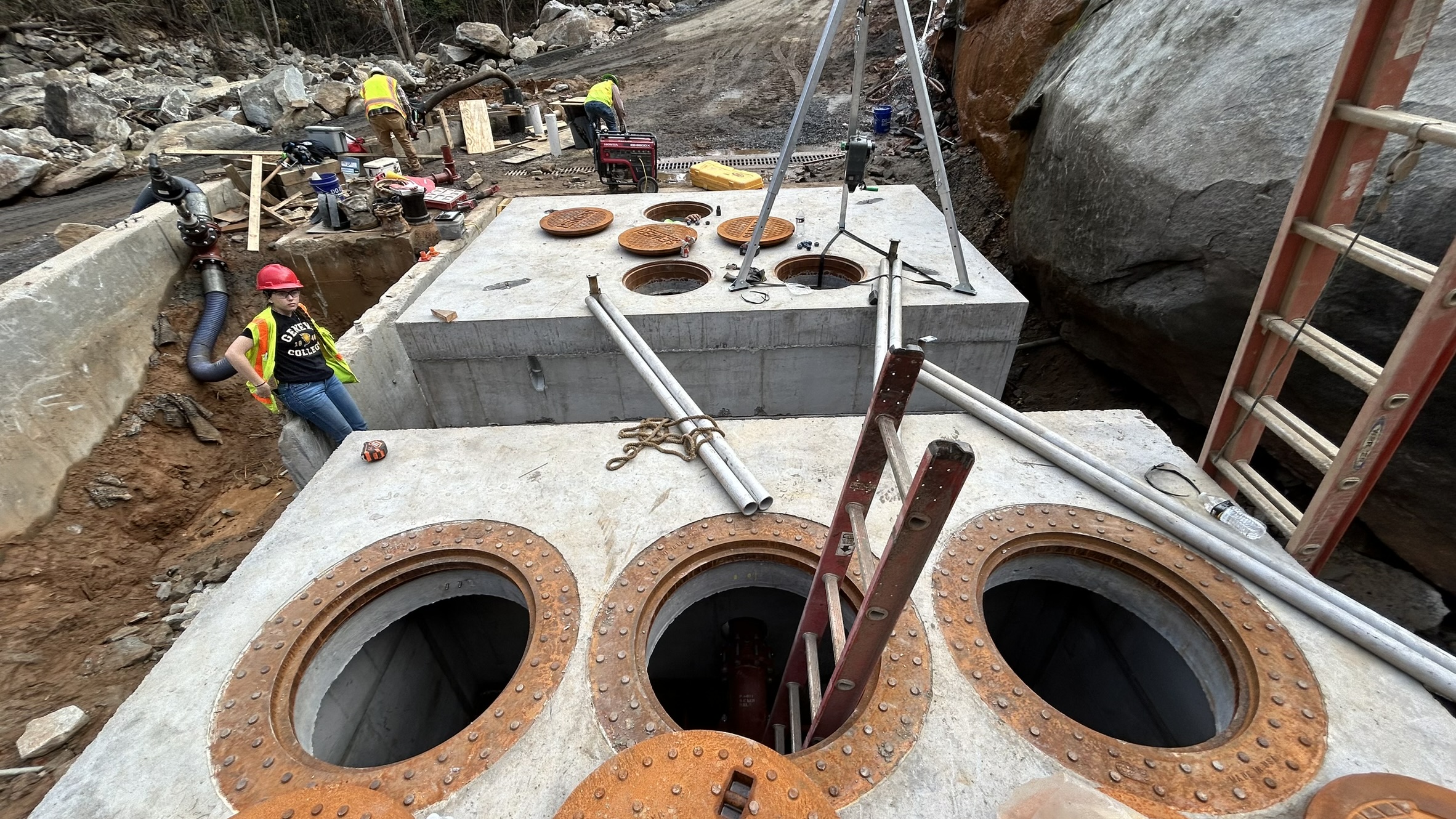
The custom job consisted of replacing the damaged top and walls of the wet well vault, two risers, a flat-top section, a vault box and a pressure reducing valve (PRV) structure weighing 20,000 pounds. Gainey’s used individual panel pieces to adjust the dimensions to fit the existing wet well vault, a large structure measuring 11 feet across and 9 feet high.
Normally, a project such as this takes two weeks to complete, but given the urgency for the community, Gainey’s went into production on October 21, with the last piece poured on October 23. The pieces arrived at Lake Lure on October 28 via flatbed trucks.
When the construction crew onsite finished with their repairs to the existing part of the wet well, Gainey’s contractors were able to put the new pieces in place all in one afternoon.
Design considerations for utility systems: The resilience of precast
Gainey’s response following Hurricane Helene shows how precast concrete can support climate-resilient infrastructure when extreme weather puts essential systems at risk. Precast structures can be engineered to remain stable, durable and functional even when site conditions are at their worst.
In flood-prone environments, the mass and size of the precast structure, combined with a properly designed base slab and adequate soil overburden, provide reliable resistance to buoyant uplift.
Unlike lightweight plastic tanks and piping, which can float or migrate as water tables rise and fall, precast systems can be detailed for anti-flotation so that the downward forces from concrete and overlying soil comfortably exceed the upward buoyant forces. In flood conditions, the sheer mass of precast, plus a properly designed base and soil cover, means precast can reliably resist buoyancy where lighter systems will want to float.
In aggressive wastewater and challenging soil environments, mix designs can incorporate admixtures to reduce permeability, improve sulfate and chemical resistance, and produce denser, more watertight concrete that limits ion ingress and protects embedded reinforcement.
Owners and engineers can specify coatings, liners or specialized mix designs to enhance corrosion resistance and extend service life without sacrificing structural capacity.
When storms bring debris and physical damage, reinforced and fiber-reinforced precast can be detailed to absorb those impacts and, if something does crack, the structure can usually be repaired in place instead of starting over.
Protecting public health
As the bulk of wastewater and stormwater systems is underground, when those systems fail during a flood or hurricane, the impacts are immediate, ranging from contaminated water to disrupted access to slower recovery. Given the serious consequences of these system failures, these systems should be treated as strategic risk mitigation rather than cost items to be reduced to the bare minimum.
Precast design for these systems starts with the question of stability under extreme hydrostatic forces. After a hurricane or major storm, groundwater levels rise and water tables surge, creating significant uplift pressures.
Precast uses engineered mass and geometry, heavier sections, enlarged base slabs and soil overburden to ensure that downward forces exceed buoyant forces, so structures stay anchored and functional even as groundwater fluctuates.
Watertight performance is equally critical, especially when tanks and structures are handling contaminated flows. Modern precast designs address this at both the material and detailing levels.
Precast elements can be engineered to resist traffic loads, debris impacts, scour and even blast-type demands by designing appropriate reinforcement systems to control cracking and maintain the damaged concrete as a single system.
Precast turns buried utilities into frontline infrastructure by staying anchored under floodwaters, keeping wastewater contained and taking the kind of physical abuse that comes with major storms, often with damage that can be repaired instead of replaced.
Planning for future climate challenges
Lightweight alternatives to precast concrete may be selected because they’re cheap and fast to deploy, but they can be more vulnerable to flotation, fire, deformation and impact. When failure occurs, such systems typically require full removal and replacement rather than repair.
Precast systems, by contrast, are generally heavier and designed for structural robustness and, in many cases, can be repaired in place if damage occurs. Over a 50- to 100-year horizon, the ability to repair rather than replace can play a significant role in long-term maintenance planning and lifecycle cost considerations.
Future designs also need to account for recovery from past events and the likelihood of more frequent extreme conditions. Industry professionals are continuing to refine standards for resilient precast solutions that use mass and geometry to resist uplift, specify mixes and coatings for aggressive environments, and detail reinforcement to better withstand traffic loads and debris impacts.
These approaches can help reduce maintenance demands, limit emergency interventions and improve system reliability when conditions exceed historical norms.
Choosing precast can offer design flexibility, including engineered mass, watertight concrete mixes, protective coatings and reinforced systems for demanding environments. In practice, these characteristics may support long-term resilience by reducing the likelihood of repeated failures and unplanned replacements.
As infrastructure owners plan for future investment needs, especially in the context of evolving climate, regulatory and sustainability pressures, materials like precast that prioritize resilience and repairability should remain an important consideration in lifecycle decision-making.
Brad Chinery serves as vice president of technical services for the National Precast Concrete Association, where he is responsible for advancing the precast industry and leading the technical team that supports members and professionals in the precast industry. Chinery is a U.S. Air Force veteran and professional engineer with more than 16 years of technical leadership and decision-making experience in high-pressure and high-impact environments. He earned a B.S. in Civil Engineering from the United States Air Force Academy and an M.S. in Engineering Management from the Air Force Institute of Technology.



