August marks the midpoint of the third quarter as the United States responds to Iran’s alleged breach of the Memorandum of Understanding by commencing strategic airstrikes against key military targets, including those associated with the Strait of Hormuz.
Within an hour of making concessions during negotiations, Iran reportedly initiated drone and missile attacks against cargo vessels and U.S. bases located throughout the Gulf region, effectively ending the ceasefire agreement.
As of this writing, the United States has re-instituted a full blockade of the Strait of Hormuz. The blockade applies only to vessels traveling to or from Iranian ports or carrying Iranian cargo.
President Donald Trump previously announced that the proposed 20% tariff would be replaced by trade and investment agreements between Gulf states and the United States. “Those investments will be MASSIVE but, at the same time, extraordinarily good for them and their future.”
As of this writing, West Texas Intermediate crude is trading at $79.44/barrel, while Brent crude is trading at $84.90/barrel.
Looking ahead, the direction of global oil markets will depend largely on how quickly shipping through the Strait of Hormuz returns to normal and whether geopolitical tensions begin to ease.
If an agreement is reached to end the conflict, shipping through the Strait of Hormuz gradually recovers during the third quarter and Iranian sea mines are removed, global oil demand could return to growth by year-end.
Industry deals and acquisitions
Leading building materials manufacturer CRH has announced an agreement to acquire U.S.-based infrastructure products supplier Arcosa in an all-cash transaction valued at approximately $8 billion.
Arcosa provides infrastructure materials, engineered products and construction solutions serving transportation, utility and energy markets.
CRH Americas is headquartered in Atlanta, Georgia, while the company’s global headquarters are located in Dublin, Ireland.
“As demand for U.S. energy and utility infrastructure solutions accelerates, this transaction places CRH at the forefront of an immense growth opportunity and demonstrates our ongoing commitment to building market-leading positions through disciplined capital allocation,” says CRH CEO Jim Mintern.
Ferguson has entered into an agreement to acquire FloWorks for $1.6 billion from Wynnchurch Capital, expanding its nonresidential value-added capabilities.
FloWorks (FWI Holdings) is a leading industrial distributor and service provider of highly engineered valves and flow-control solutions.
“FloWorks strengthens our leading position in high-growth industrial end markets while adding meaningful capabilities and geographic coverage that we can leverage across our nonresidential customer group,” says Kevin Murphy, CEO of Ferguson.
The transaction is expected to close during the third quarter, subject to customary closing conditions and regulatory approvals.
Energy infrastructure projects advance
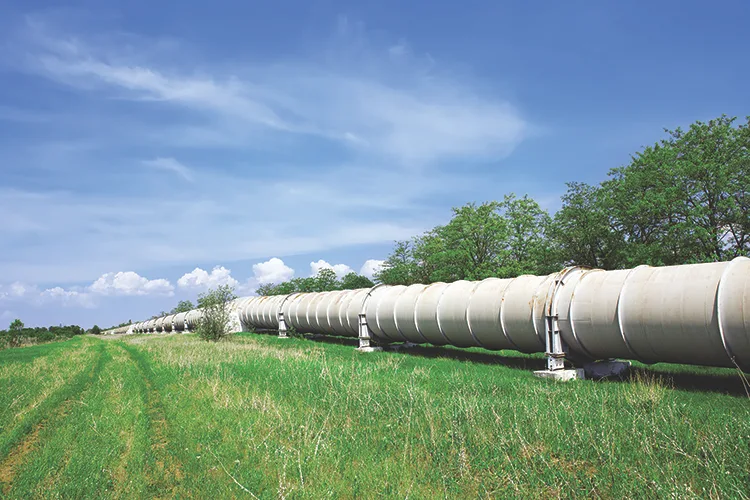
Permian Basin natural gas pipeline debottlenecking continues to advance rapidly as developers work to meet the growing demand for natural gas-fired electric generation supporting AI-driven data center development.
Energy Transfer has approved the expansion of its Transwestern pipeline. The Transwestern Desert Southwest Pipeline expansion includes a 516-mile, 42-inch OD natural gas pipeline connecting the Permian Basin with markets in Arizona, New Mexico and Texas.
The $5.3 billion expansion has been upgraded to a 48-inch OD pipeline, increasing capacity to 2.3 Bcf/d. The project is expected to enter service during the fourth quarter of 2029.
Chevron has entered into a 20-year agreement to supply electricity to Microsoft, which plans to develop what could become one of the nation’s largest AI data center campuses in West Texas.
The company is partnering with Joule, an energy company launched by investment firm Engine No. 1, to develop a power-generation complex that will supply the data center using natural gas produced from Chevron’s Permian Basin operations. The proposed 2.7-gigawatt campus will occupy more than 2,000 acres in Reeves County, Texas, in the heart of the Permian Basin.
Dominion Energy South Carolina and Santee Cooper plan to construct a $5 billion, 2,281-megawatt natural gas-fired power plant.
The utilities stated that the proposed project, to be located at the site of a retired coal-fired generating station, represents the most cost-effective option among the alternatives evaluated.
Dominion Energy and Santee Cooper expect the facility to enter commercial service by mid-2033.
PVF supply pressures intensify
Demand for carbon steel pipe, fittings, flanges, valves and related PVF products continues to accelerate, reaching levels not experienced in decades. Growth is being driven by AI-related data center construction, oil and gas development, LNG infrastructure, electric power generation, advanced manufacturing investments and ongoing industrial modernization.
As a result, manufacturers continue to extend lead times as production capacity struggles to keep pace with incoming orders. In several product categories, deliveries are now extending into 2027.
Offshore producers and suppliers of seamless carbon steel pipe continue extending delivery schedules into late 2027 and, in some cases, into 2028. Global supply chain disruptions remain a contributing factor.
Container availability remains inconsistent, while ocean freight costs continue to trend upward. These developments are contributing to firmer offshore PVF pricing and increasing concerns regarding product availability. Reports of shortages involving carbon steel fittings, flanges and other critical PVF components continue to emerge across multiple market sectors.
Domestic carbon steel flange pricing has increased, reflecting strong demand and rising manufacturing costs. Pricing for domestic carbon steel butt-welding fittings has remained relatively stable; however, market participants continue to anticipate additional increases should raw material costs, freight expenses or supply constraints intensify.
In today’s environment, proactive communication throughout the supply chain has become increasingly important. Maintaining close coordination among project owners, engineering firms, contractors, distributors, suppliers and manufacturers is essential for successfully managing procurement schedules and project timelines.
Early material planning, strategic purchasing decisions and realistic scheduling assumptions will remain critical to delivering projects on time and within budget.
Networking at the PVF Roundtable
The PVF Roundtable continues to recognize the urgent need to develop and sustain a highly skilled workforce capable of meeting the demands of the construction, manufacturing and PVF industries. Workforce development remains one of the industry’s highest priorities and requires the continued support of manufacturers, contractors, distributors, engineering firms, educational institutions and end-users.
Contractors, fabricators, engineering firms, pipeline operators, manufacturers and service providers are encouraged to partner with the PVF Roundtable to help attract and develop the next generation of industry professionals.
The PVFRT Charitable Foundation, a 501(c)(3) organization established by the PVF Roundtable, remains committed to supporting education and workforce development. Through scholarship programs focused on PVF-related trade education and technical training, it has awarded nearly $3 million in scholarships.
Funding for these programs is generated primarily through the PVF Roundtable’s annual golf tournament and annual TroutBlast, both of which continue to receive outstanding industry support.
The golf tournament, held May 11, 2026, was completely sold out and achieved record participation. Major sponsors included Weldbend Corp., Ferguson Industrial and MRC Global, reflecting the industry’s continued commitment to education and workforce development.
The next PVF Roundtable networking meeting is scheduled for August 11, 2026, beginning at 4:30 p.m. at Houston’s Bayou City Event Center. The dinner meeting will feature guest speaker Chris Conrad, retired Chevron executive and owner of Republic Boot Co.
The PVF Roundtable continues to serve as one of the industry’s premier forums for networking, education, workforce development and advocacy. As market conditions become increasingly complex, opportunities to exchange information, strengthen relationships and discuss industry trends become even more valuable.
In an era defined by rapid technological advancement, workforce challenges, supply chain uncertainty and evolving market dynamics, industry networking remains one of the most effective ways to stay informed and maintain a competitive advantage. The PVF Roundtable remains committed to fostering these relationships and supporting the continued growth and success of the PVF industry.