Being without air conditioning in the Atlanta heat is stressful enough. But there’s another type of stress that’s easily overlooked. Techs enter the home carrying tools and equipment. These strangers move through rooms, access attics and basements, and create noise throughout the service call. For most customers, these inconveniences are temporary. For individuals with autism, PTSD, dementia, ADHD or other sensory needs, however, they can create significant stress.
“People’s houses are their most intimate, safe space,” says Brian Davis, general manager and part-owner of Dayco Systems Heating, Cooling and Plumbing, an Acworth, Georgia-based contractor that has been in business for 40 years. “There’s nothing safer than getting home, closing the door and knowing you’re safe. And we disrupt that. We’re invasive. It’s loud. It’s different. We didn’t really consider the impact we may have been having on some homeowners or on their children.”
That realization led Dayco to rethink what customer comfort truly means.
Last April, the company partnered with KultureCity, a nonprofit organization dedicated to improving accessibility and inclusion, and became the first home services company certified through the agency to provide sensory-inclusive services during service calls.
“This partnership with Dayco is a powerful example of what happens when organizations move from intention to action,” says Uma Srivastava, KultureCity’s executive director. “When strangers come to someone’s home for a visit, it is important for a company like Dayco to empower their own employees to create a space where individuals of all sensory needs feel seen, supported and empowered.”
According to KultureCity, 1 in 4 individuals has a sensory need, including conditions such as PTSD, autism, epilepsy or Parkinson’s disease. Sensory sensitivities can make everyday environments overwhelming or even physically painful.
“You could be born with a condition or have acquired it through a life event such as a car accident or stroke,” Srivastava adds. “And even those who don’t have a firm diagnosis can get overwhelmed from time to time. So we want to make sure that the 1 in 4 of us is truly being welcomed and accepted in our communities.”
Dayco’s beginnings
Dayco Systems was founded in 2006 by Dean Allen Yarrington, whose initials give the company its name.
Yarrington, originally from Iowa, grew up helping his father run his HVAC business. He eventually earned an engineering degree from the University of Northern Iowa and an MBA from Wichita State University, then built a corporate career at Johnson Controls and Honeywell. After years of traveling through the Midwest and South America while raising a family, Yarrington settled in the Atlanta area.
We were unable to speak directly with Yarrington, but in a company YouTube video he says that at that point in his life he thought, “Maybe I’ll do something different” — and started Dayco.
Yarrington credits a “very astute manager” with introducing him to the concept of “non-financial compensation.” Everyone needs a paycheck, but non-financial compensation encompasses satisfaction, gratification, well-being and purpose.
“And there’s a lot in this business that lends itself to that non-financial gratification, particularly when you take care of somebody that’s without air conditioning in Georgia in the summertime,” he says. “You’re a hero, and that’s a good feeling and it’s genuine.”
Yarrington describes the company’s customer service philosophy this way:
“We are completely focused on our customers. We take good care of our team, but our team takes great care of our customers. So we’ve got that mentality from top to bottom and it shows.”
Davis, a military veteran, came to Dayco in 2016 just two weeks into a HVAC program at a local trade school. Yarrington originally hired him as a part-time warehouse helper — sweeping floors, scrapping old units — and over a decade Davis worked his way to the top of now managing the company’s day-to-day operations.
That ground-up perspective shapes how he thinks about every aspect of the business, including a question his team began wrestling with: What kind of experience are we actually creating inside people’s homes?
“We stayed true to our origin story of serving our neighbors,” Davis says. “That’s where it started. That’s where we hold true today — how can we best serve our neighbors, our community, our homeowners?”
Enter KultureCity
The spark for change came through an unexpected source: a long-time Dayco customer who also happened to be a passionate advocate for KultureCity told Davis about the organization as the Dayco was exploring ways to better serve its community. The connection became personal as well — Dayco’s Marketing Director Christina Simpson has a child with autism.
Once Davis heard the statistic that 1 in 4 people has a sensory need, he did the math. In peak summer months, Dayco technicians can make upward of 60 service calls per day across the company’s fleet. Multiply that across a week, and the team was interacting with hundreds of households — a significant portion of which almost certainly included someone with a sensory need.
“Once we heard that statistic, it kind of put things into perspective,” Davis recalls.
Founded 12 years ago by husband-and-wife physicians Dr. Julian Maha and Dr. Michelle Kong, KultureCity has grown into an organization that works with more than 7,000 venues and organizations across 41 countries. Every NBA arena is certified. LEGO stores, LUSH Cosmetics, major festivals and more sports stadiums have come on board. The organization was simultaneously active at the Stagecoach Music Festival in Las Vegas, MLB games in Mexico City and the NFL Draft in Pittsburgh on the same weekend PHC News spoke with Srivastava.
Training the whole team
KultureCity’s sensory certification is straightforward. The self-paced online training only takes an hour. At the conclusion of the training, participants must pass a 10-question quiz with a score of at least 80%.
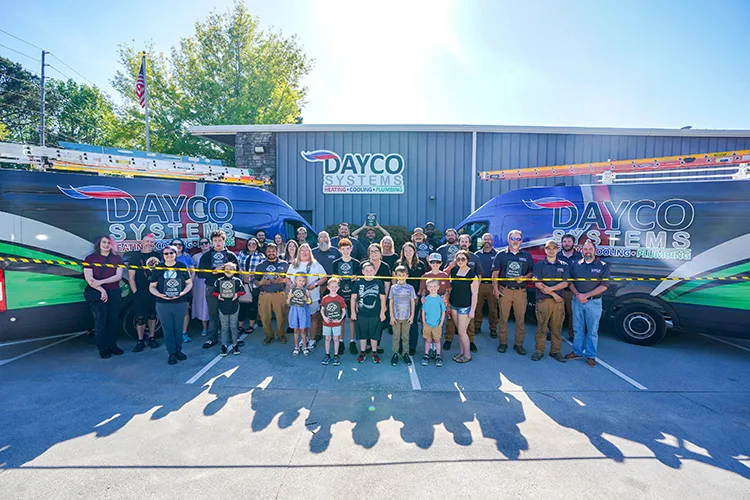
KultureCity requires that at least 50% of an organization’s staff complete the online training annually to maintain certification. However, Dayco went considerably further by enrolling the entire company — all 35 field staff (technicians, installers and sales personnel) plus every member of the administrative team, approximately 45 people in total.
“That includes even our customer service people who are answering the phones,” Davis says. “Typically when your AC is out, that’s a very tense moment for a lot of people. So we trained them too, to handle every situation.”
Dayco has also incorporated sensory-inclusive language directly into its call scripting, so customers are informed of the company’s certification before a technician even pulls into the driveway.
Sensory bag in action
Along with the training, every service vehicle now displays a KultureCity certification sticker on the outside — a logo that customers may already recognize from arenas and public venues. On the inside, every vehicle carries a KultureCity sensory bag.
The bags contain noise-reducing headphones sized for both adults and children, and three different types of fidgets, because different individuals respond to different textures. (Other bags handed at public event contain other items, such as sunglasses that lessen the effects of fireworks.)
The proof of concept arrived almost immediately after training was complete. A Dayco technician arrived at a home where a young boy began showing visible signs of distress during the service call.
The technician recognized what was happening, stepped outside to his truck, retrieved the sensory bag, brought it in and offered the boy the noise-canceling headphones. The boy put them on, picked up a fidget, and the entire dynamic of the call shifted.
Ideally, the bags are loaned for the duration of the service call, but Davis says the technician ended up leaving the bag with the family.
“We don’t normally give them away, but we’re not going to take something if it’s really helping our customer because it’s going to help even further than just that moment,” Davis says.
For KultureCity, Dayco’s partnership represents the opening of an entirely new category. Srivastava says conversations with other home services companies are already underway. “We have conversations with a few,” she told PHC News. “It’s just a matter of them going through the paperwork process and signing on and committing to the training.”
For Dayco’s part, the certification has already extended beyond service calls. The company participates regularly in community events — home shows, local festivals, outdoor gatherings — and brings sensory bags to those as well, displaying the KultureCity symbol so that anyone who needs support can find it.
“We want to make sure that we are able to recognize the need and have those bags with us while we’re at the event,” Davis says. “So if there’s anybody that may need them, we can also be there for them.”